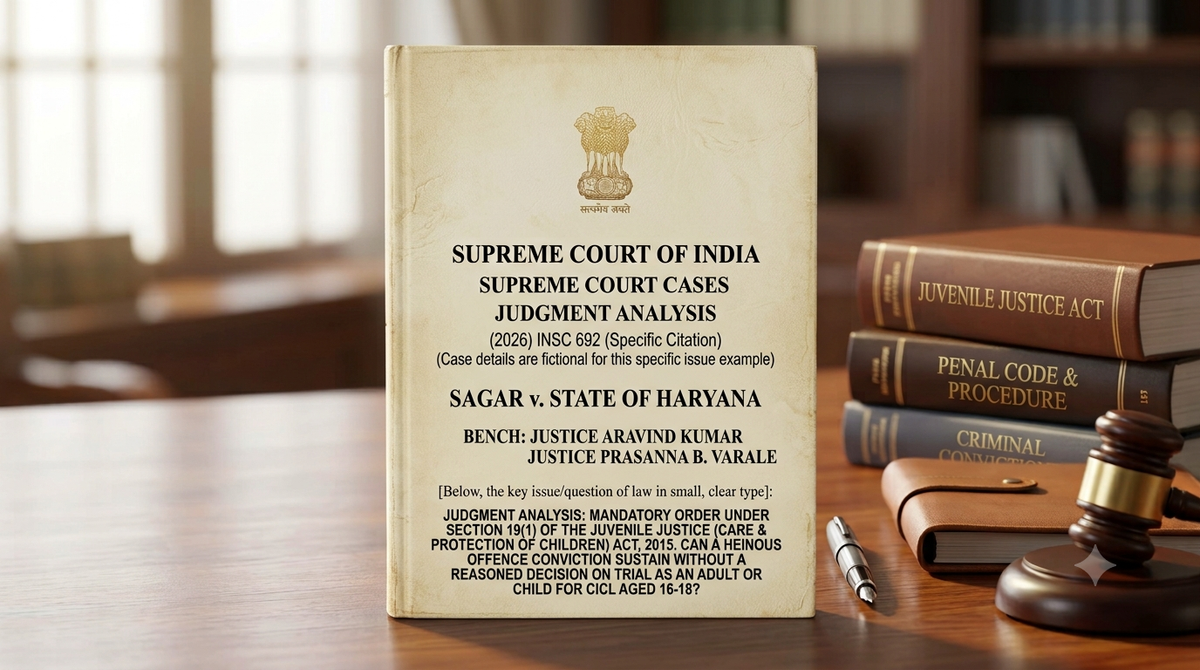
Sagar v. State of Haryana
(2026) INSC 692
Key Issue / Question of Law
Whether the conviction and sentence of a child in conflict with law (aged 16-18 years) for a heinous offence can be sustained when the Children's Court proceeded with trial as an adult without passing a reasoned order under Section 19(1) of the Juvenile Justice (Care and Protection of Children) Act, 2015, determining whether the child should be tried as an adult or as a child.
Ratio Decidendi
Section 19(1) of the Juvenile Justice (Care and Protection of Children) Act, 2015 is mandatory and not directory. The Children's Court must, upon receipt of the preliminary assessment from the Juvenile Justice Board under Section 15, pass a reasoned order determining whether the child in conflict with law is to be tried as an adult or as a child. The word 'may' in Section 19(1) must be read as 'shall' because the consequences of trial as an adult versus trial as a child are fundamentally different, including the maximum sentence (life imprisonment vs. three years) and disqualifications. Non-compliance with Section 19(1) vitiates the entire trial, and the conviction and sentence cannot be sustained.
Holding / Decision
The Supreme Court allowed the appeal, set aside the conviction and sentence recorded by the Children's Court and affirmed by the High Court. The Court held that the entire trial stood vitiated due to non-compliance with Section 19(1) of the JJ Act, 2015. The appellant, who was 16.5 years old at the time of the offence and had undergone incarceration for over six years, was acquitted and discharged from bail bonds. The Court directed all Children's Courts across the country to pass a reasoned order under Section 19(1) before proceeding further in any matter.
Background & Facts
On 21.10.2018, the appellant, aged 16.5 years, was alleged to have participated in a group attack resulting in the death of Mandeep Kumar. The police filed a chargesheet under Sections 302, 323, 341 read with 148, 149 of the Indian Penal Code, 1860. The Juvenile Justice Board conducted a preliminary assessment under Section 15 of the JJ Act, 2015 and opined that the appellant should be tried as an adult, committing the matter to the Children's Court under Section 18(3). The Children's Court proceeded with trial as a sessions case, convicted the appellant under Section 302, IPC, and sentenced him to 14 years rigorous imprisonment, with a direction to be kept in a place of safety till age 21 and thereafter transferred to jail. The High Court affirmed the conviction. The appellant appealed to the Supreme Court.
Statutes Involved
- Section 15, Juvenile Justice (Care and Protection of Children) Act, 2015 — requires Board to conduct preliminary assessment of mental and physical capacity of child aged 16-18 years for heinous offences
- Section 18(3), Juvenile Justice (Care and Protection of Children) Act, 2015 — empowers Board to transfer trial to Children's Court if preliminary assessment indicates need for trial as adult
- Section 19(1), Juvenile Justice (Care and Protection of Children) Act, 2015 — requires Children's Court to decide whether child is to be tried as adult or as child, and pass appropriate orders
- Section 21, Juvenile Justice (Care and Protection of Children) Act, 2015 — prohibits death penalty or life imprisonment without possibility of release for child in conflict with law
- Rule 13(6), Juvenile Justice (Care and Protection of Children) Model Rules, 2016 — mandates Children's Court to record reasons for decision under Section 19(1)
Full Analysis
The Supreme Court began by noting that the primary question before it was whether the conviction and sentence could be sustained in the absence of an order under Section 19(1) of the Juvenile Justice (Care and Protection of Children) Act, 2015. The Court observed that the Juvenile Justice Board had conducted a preliminary assessment under Section 15 and committed the matter to the Children's Court under Section 18(3). However, upon receipt of the matter, the Children's Court proceeded directly with trial as a sessions case without passing any order under Section 19(1) determining whether the appellant should be tried as an adult or as a child.
The Court undertook a detailed analysis of the statutory scheme under the JJ Act, 2015. It noted that Section 2(12) defines 'child' as a person who has not completed 18 years, and Section 2(13) defines 'child in conflict with law' as a child who has not completed 18 years on the date of commission of the offence. Section 15 requires the Board to conduct a preliminary assessment for children aged 16-18 years accused of heinous offences. If the Board concludes the child should be tried as an adult, it transfers the matter under Section 18(3) to the Children's Court.
The Court held that Section 19(1) is the critical provision at the Children's Court stage. It states: 'After the receipt of preliminary assessment from the Board under section 15, the Children's Court may decide that—(i) there is a need for trial of the child as an adult... (ii) there is no need for trial of the child as an adult and may conduct an inquiry as a Board...' The Court held that although the word 'may' is used, it must be read as 'shall' because of the serious consequences flowing from the determination. If the Children's Court decides to try the child as an adult, it follows the procedure of a sessions trial, and the child can be sentenced up to life imprisonment (subject to Section 21). If it decides to try the child as a child, it conducts an inquiry as a Board and can pass orders under Section 18, with a maximum sentence of three years in a special home. The determination also affects disqualification provisions under Section 24.
The Court relied on Rule 13(6) of the Juvenile Justice (Care and Protection of Children) Model Rules, 2016, which mandates that 'The Children's Court shall record its reasons while arriving at a conclusion whether the child is to be treated as an adult or as a child.' This reinforces the mandatory nature of Section 19(1).
The Court distinguished Ajeet Gurjar v. State of Madhya Pradesh (2023) 15 SCC 678, where the matter was remitted back for compliance with Section 19(1). However, in Thirumoorthy v. State (2024) 12 SCC 307, this Court had held that non-compliance with mandatory provisions of the JJ Act vitiates the entire trial and quashed the conviction. The Court followed Thirumoorthy, noting that the appellant was now 24 years old and it would be futile to remand the matter for a fresh assessment of his mental capacity at the time of the offence in 2018.
The Court also considered but rejected the possibility of reducing the sentence to the period already undergone or limiting it to three years. It held that in the absence of compliance with Section 19(1), which determines whether the procedure should be a sessions trial or a summons case, the entire trial stands vitiated. The Court could not substitute its own determination for the mandatory statutory procedure.
The Court concluded by directing all Children's Courts across the country that upon receipt of records under Section 18(3), the first duty is to pass a reasoned order under Section 19(1) before proceeding further. The conviction and sentence were set aside, and the appellant was acquitted.
Practical Implications for Advocates
1. For defence counsel: Immediately upon receiving a case where a child is being tried by the Children's Court, check whether an order under Section 19(1) of the JJ Act, 2015 has been passed. If not, file an application or raise the issue before the trial court. Failure to do so can be raised in appeal as a fatal jurisdictional defect.
2. For Children's Courts: Upon receipt of a matter transferred by the Juvenile Justice Board under Section 18(3), the first and mandatory step is to pass a reasoned order under Section 19(1) deciding whether the child is to be tried as an adult or as a child. This order must record reasons, as per Rule 13(6) of the Model Rules, 2016.
3. For prosecutors: Ensure that the Children's Court complies with Section 19(1) before the trial proceeds. If the Court proceeds without such an order, the entire trial may be set aside on appeal, as this judgment and Thirumoorthy have held.
4. For appellate courts: When a conviction of a child in conflict with law is challenged, the first issue to examine is whether the Children's Court passed an order under Section 19(1). If not, the conviction cannot be sustained, and the Court may quash the conviction rather than remand if the child has crossed the age where a meaningful assessment is possible.
5. For policy makers and judicial academies: This judgment highlights the need for training of judicial officers on the mandatory procedures under the JJ Act, 2015. The Court's direction to all Children's Courts underscores that compliance with Section 19(1) is non-negotiable and must be strictly enforced.
Advocate's Note — Agarawal Associates
As senior counsel at Agarawal Associates, this judgment is a critical reminder of the mandatory procedural safeguards under the Juvenile Justice Act, 2015. First, for defence counsel representing a child in conflict with law, always scrutinise the trial court record for compliance with Section 19(1). If the Children's Court has not passed a reasoned order determining whether the child should be tried as an adult or as a child, the entire trial is vitiated. This is a powerful ground for quashing the conviction, as this Court has now held that non-compliance is not curable. Second, the judgment clarifies that the word 'may' in Section 19(1) must be read as 'shall'. Therefore, even if the Children's Court purports to try the child as an adult, it must first pass a reasoned order under Section 19(1). The absence of such an order cannot be treated as a mere procedural irregularity. Third, for prosecuting authorities and trial courts, this judgment imposes a strict duty: upon receipt of a matter under Section 18(3), the Children's Court must, after taking cognizance, immediately pass an order under Section 19(1). This order must record reasons, as mandated by Rule 13(6) of the Model Rules. Fourth, the Court's refusal to reduce the sentence or remand the matter, following Thirumoorthy, is significant. Where the child has crossed the age of 21 and a meaningful assessment of mental capacity at the time of offence is no longer feasible, the Court will quash the conviction rather than remand. Tactically, if you are defending a child, raise the Section 19(1) issue at the earliest stage—even during trial—to prevent a vitiated trial from proceeding. If you are prosecuting, ensure the Children's Court complies with Section 19(1) before proceeding to trial. This judgment reinforces that procedural safeguards for children are substantive and non-negotiable.
Key Conditional Rule / Important Caveat
This judgment applies where a child in conflict with law (aged 16-18 years) is accused of a heinous offence, the Juvenile Justice Board transfers the matter to the Children's Court under Section 18(3) of the JJ Act, 2015, and the Children's Court proceeds with trial without passing an order under Section 19(1) determining whether the child is to be tried as an adult or as a child. If such an order is passed, the trial is valid. If not, the entire trial is vitiated and the conviction is liable to be quashed. If the child is now above 21 years and a meaningful assessment of mental capacity at the time of offence is not feasible, the Court will not remand the matter but will acquit.
Cases Distinguished
- Ajeet Gurjar v. State of Madhya Pradesh (2023) 15 SCC 678 — Distinguished because in that case the matter was remitted back to the Children's Court for compliance with Section 19(1), whereas here the appellant was now 24 years old and a meaningful assessment of mental capacity at the time of offence was no longer feasible.
Cases Cited
- Thirumoorthy v. State (2024) 12 SCC 307 — Used as the primary precedent where this Court quashed the conviction due to non-compliance with mandatory provisions of the JJ Act, 2015, including Section 19(1).
- Barun Chandra Thakur v. Master Bholu (2023) 12 SCC 401 — Cited for the proposition that the consequences of trial as an adult versus trial as a child are serious and have lasting effects, including on sentencing and disqualification.
Courtroom Arguments
For Petitioner
Section 19(1) Mandatory Non-Compliance Vitiates Trial — (2026) INSC 692
Section 19(1) of the Juvenile Justice (Care and Protection of Children) Act, 2015 is mandatory.
For Respondent
Board Assessment Sufficient Children's Court Need Not Repeat — (2026) INSC 692
The Juvenile Justice Board's preliminary assessment under Section 15, which found that the appellant should be tried as an adult, was sufficient to vest jurisdiction in the Children's Court.
More Criminal Law Judgments
View All →Found this useful? Share it with your colleagues.
One tap sends the case name, citation, key issue and link.
Take This Further in Court
2 courtroom argument frameworks available for this case — full submission structure, bench question simulator, and opposition rebuttals.
Disclaimer: This summary is prepared by Agarawal Associates for informational purposes only. It does not constitute legal advice. For legal matters, consult a qualified advocate. © 2026 Agarawal Associates — apexdigest.in