Arti Mehta v. State of Madhya Pradesh
(2026) INSC 533
Key Issue / Question of Law
Whether criminal proceedings under Section 498A of the Indian Penal Code, 1860, Sections 3 and 4 of the Dowry Prohibition Act, 1961, and proceedings under the Protection of Women from Domestic Violence Act, 2005 can be quashed against the husband's relatives when the allegations against them are omnibus, generalised, and lack specific overt acts, while the husband faces specific allegations of cruelty and harassment.
Ratio Decidendi
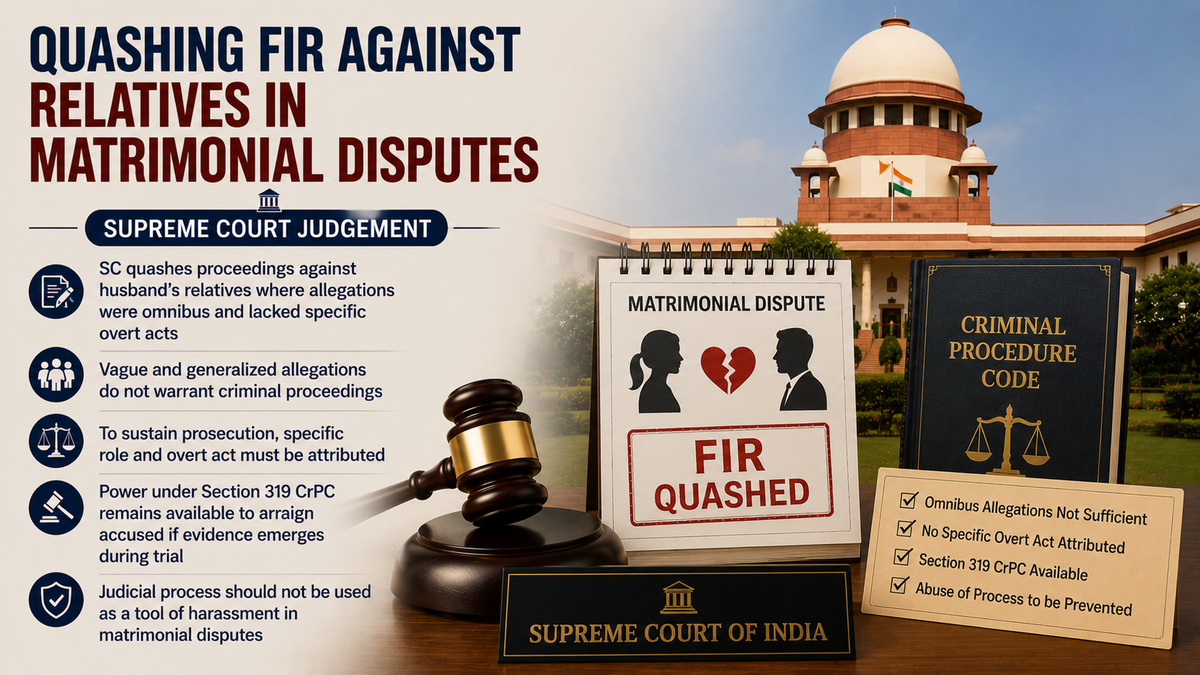
Where allegations in a matrimonial dispute are overwhelmingly directed against the husband, and the allegations against the husband's relatives (sister-in-law, mother-in-law, brother-in-law, and wife of brother-in-law) are generalised, omnibus, and lack specific overt acts, dates, or individual attribution, continuation of criminal proceedings against such relatives amounts to abuse of process of law. The court may quash such proceedings under Section 482 of the Code of Criminal Procedure, 1973. However, quashing under Section 482 does not amount to an acquittal on merits and does not bar the trial court from exercising its power under Section 319 of the Code of Criminal Procedure, 1973 to summon such relatives if evidence emerges during trial. The doctrine of double jeopardy under Article 20(2) of the Constitution of India does not apply as the appellants have never been subjected to a full trial.
Holding / Decision
The Supreme Court allowed both appeals and quashed the FIR/Crime No. 0041/2023 and all consequential proceedings under Sections 498A/34 IPC and Sections 3 and 4 of the Dowry Prohibition Act, 1961, as well as the proceedings under the Protection of Women from Domestic Violence Act, 2005, insofar as they related to the four appellants (Arti Mehta, Shrivati Bai Dhakad, Manisha Dhakad, and Vikram Dhakad). The Court held that the allegations against them were omnibus, generalised, and lacked specific overt acts, while the allegations against the husband were specific and detailed. The Court clarified that the quashing does not bar the trial court from exercising power under Section 319 CrPC to summon the appellants if evidence emerges during trial.
Background & Facts
The complainant (Sapna Dhakad) married Divyaraj Dhakad on 19 November 2019. She alleged that at the time of marriage, her father gave cash of Rs. 31 lakh, gold jewellery worth Rs. 10 lakh, and other household items as dowry. After six months, the husband allegedly started harassing her for more dowry. She named the husband and four relatives (sister-in-law Arti Mehta, mother-in-law Shrivati Bai Dhakad, brother-in-law Vikram Dhakad, and wife of brother-in-law Manisha Dhakad) as accused. FIR No. 0041/2023 was registered on 13 January 2023 under Sections 498A/34 IPC and Sections 3/4 of the Dowry Prohibition Act. The complainant also filed a complaint under Section 12 of the DV Act on 4 April 2023. The husband had also filed a petition for restitution of conjugal rights under Section 9 of the Hindu Marriage Act, 1955, and the complainant later filed for divorce. During the pendency of the proceedings, a decree of divorce was granted. The High Court dismissed the quashing petitions filed by the relatives. They appealed to the Supreme Court.
Statutes Involved
- Section 498A, Indian Penal Code, 1860 — Punishes cruelty by husband or relative of husband towards a woman
- Section 34, Indian Penal Code, 1860 — Provides for acts done by several persons in furtherance of common intention
- Section 3, Dowry Prohibition Act, 1961 — Penalises giving or taking of dowry
- Section 4, Dowry Prohibition Act, 1961 — Penalises demanding dowry directly or indirectly
- Section 12, Protection of Women from Domestic Violence Act, 2005 — Provides for filing complaint before Magistrate alleging domestic violence
- Section 2(f), Protection of Women from Domestic Violence Act, 2005 — Defines 'domestic relationship'
- Section 2(q), Protection of Women from Domestic Violence Act, 2005 — Defines 'respondent' to include female relatives
- Section 31, Protection of Women from Domestic Violence Act, 2005 — Provides for penal consequences for breach of protection orders
- Section 482, Code of Criminal Procedure, 1973 — Saves inherent powers of High Court to prevent abuse of process of any court or to secure ends of justice
- Section 319, Code of Criminal Procedure, 1973 — Empowers court to proceed against any person not being an accused before it if evidence discloses commission of offence
- Article 20(2), Constitution of India — Prohibits double jeopardy (no person shall be prosecuted and punished for the same offence more than once)
- Section 300, Code of Criminal Procedure, 1973 — Provides statutory bar against second prosecution after conviction or acquittal
Full Analysis
Premium Content
Subscribe to access the full analysis, practical implications, and related case mapping.
Subscribe — ₹99/monthAlready a subscriber? Sign inAdvocate's Note — Agarawal Associates
Professional insight for advocates on how to deploy this judgment in practice...
Subscribe to access the Advocate's Note.
Key Conditional Rule / Important Caveat
This judgment applies ONLY where (a) allegations in the FIR, DV complaint, and matrimonial pleadings are overwhelmingly directed against the husband, (b) allegations against the husband's relatives (sister-in-law, mother-in-law, brother-in-law, wife of brother-in-law) are generalised, omnibus, and lack specific overt acts, dates, or individual attribution, (c) the relatives are not alleged to have actively participated in acts of physical violence, specific dowry demands, or criminal intimidation, and (d) the allegations essentially proceed on broad assertions that they "supported" the husband or "failed to intervene". The judgment does NOT apply where (a) there are specific allegations of active participation by relatives in cruelty, dowry demands, or physical violence, (b) the relatives are alleged to have made specific demands on specific dates, (c) the relatives shared the matrimonial home and actively participated in harassment, or (d) the complainant has consistently alleged specific overt acts against each relative in all pleadings. The quashing under Section 482 is not a finding of acquittal, and the trial court retains power under Section 319 CrPC to summon the relatives if evidence emerges during trial.
Cases Cited
- State of Haryana v. Bhajan Lal 1992 Supp (1) SCC 335 — Laid down categories of cases where inherent power under Section 482 CrPC can be exercised to quash FIRs and criminal proceedings.
- Anand Kumar Mohatta v. State (NCT of Delhi) (2019) 11 SCC 706 — Held that Section 482 CrPC power can be exercised even after filing of charge-sheet; abuse of process stands aggravated if FIR has taken the form of a charge-sheet.
- MCD v. Ram Kishan Rohtagi (1983) 1 SCC 1 — Held that quashing of proceedings against some accused does not prevent trial court from exercising power under Section 319 CrPC if evidence emerges during trial.
- Hardeep Singh v. State of Punjab (2014) 3 SCC 92 — Constitution Bench explained the contours of Section 319 CrPC, holding that the court can summon any person if evidence discloses commission of an offence.
- Brijendra Singh v. State of Rajasthan (2017) 7 SCC 706 — Held that power under Section 319 CrPC can be exercised at any time after charge-sheet is filed and before pronouncement of judgment.
- S.A. Venkataraman v. Union of India (1954) 1 SCC 586 — Constitution Bench held that Article 20(2) requires both prosecution and punishment; quashing under Section 482 does not bar future proceedings.
- T.P. Gopalakrishnan v. State of Kerala (2022) 14 SCC 323 — Laid down three conditions for invocation of Article 20(2): previous prosecution, conviction/acquittal in force, and fresh proceeding for same offence.
Courtroom Arguments
For Petitioner
Omnibus Allegations Without Specific Overt Acts — (2026) INSC 533
The allegations against the appellants are generalised, omnibus, and lack any specific overt act, date, or individual attribution.
For Respondent
Allegations Are Specific and Disclose Offences — (2026) INSC 533
The FIR and DV complaint contain specific allegations that the appellants demanded dowry, subjected the complainant to cruelty, and harassed her.
More Criminal Law Judgments
View All →Found this useful? Share it with your colleagues.
One tap sends the case name, citation, key issue and link.
Take This Further in Court
2 courtroom argument frameworks available for this case — full submission structure, bench question simulator, and opposition rebuttals.
Disclaimer: This summary is prepared by Agarawal Associates for informational purposes only. It does not constitute legal advice. For legal matters, consult a qualified advocate. © 2026 Agarawal Associates — apexdigest.in