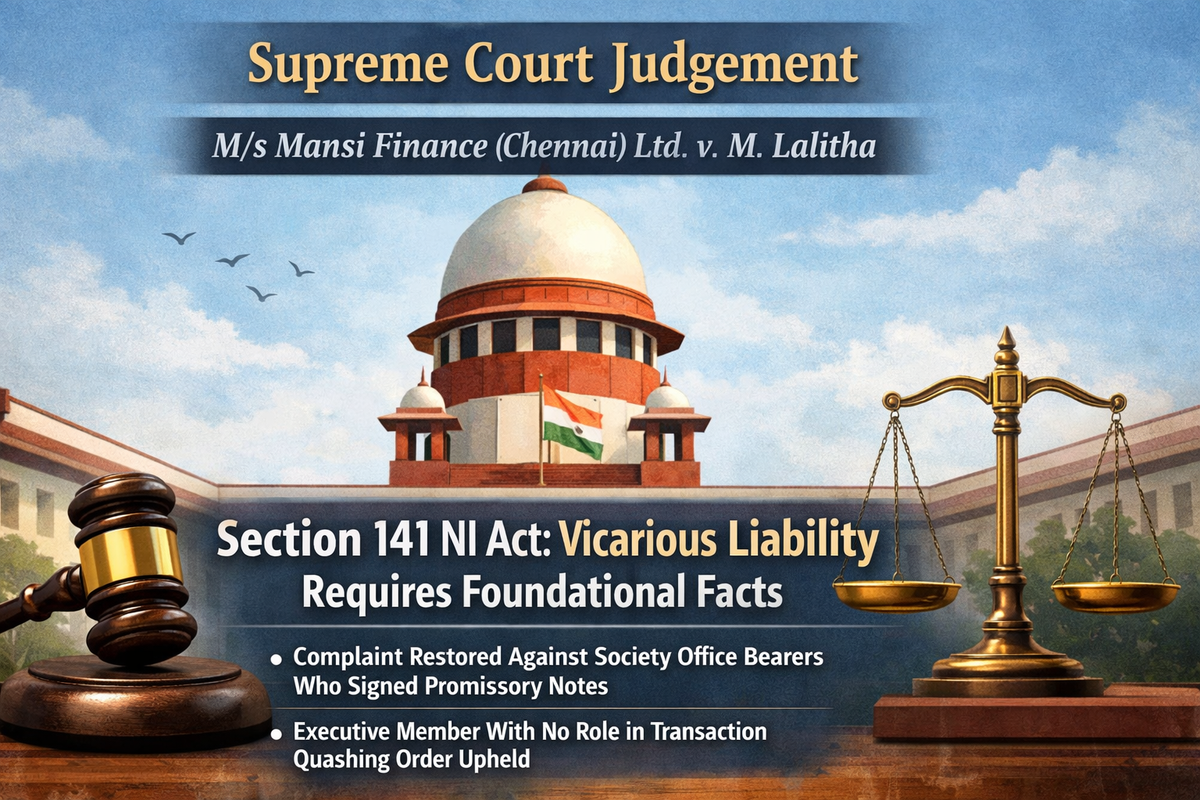
M/s Mansi Finance (Chennai) Ltd. v. M. Lalitha
(2026) INSC 542
Key Issue / Question of Law
Whether the High Court was justified in quashing criminal proceedings under Sections 138 and 141 of the Negotiable Instruments Act, 1881 against office bearers of a Society (Vice President, Treasurer, Executive Member, and Manager) where the complaint contained general averments that they were responsible for the conduct of the Society's affairs, but some of them had also signed antecedent financial documents (promissory notes, Memorandum of Understanding) related to the underlying transaction.
Ratio Decidendi
For vicarious liability under Section 141 of the Negotiable Instruments Act, 1881, the complaint must disclose sufficient factual foundation showing that the accused person was in charge of and responsible for the conduct of the business of the company or society at the time the offence was committed. Mere designation as an office bearer or a bald reproduction of the statutory language without factual foundation is insufficient. However, where the complaint read as a whole, along with antecedent documents (promissory notes, Memorandum of Understanding), discloses the participation of certain office bearers in the underlying financial transaction — such as signing promissory notes or the MoU — that constitutes prima facie material linking them to the transaction and justifies continuation of prosecution. The Court at the quashing stage does not adjudicate the truthfulness of allegations or appreciate evidence; it only examines whether foundational material exists. Each accused must be examined separately based on the role attributed to them in the complaint and supporting documents.
Holding / Decision
The Supreme Court partly allowed the appeal. It set aside the High Court's quashing order insofar as it related to respondent Nos. 1 (Vice President), 2 (Treasurer), and 4 (Manager), and restored the complaint proceedings against them. The Court held that these respondents had signed antecedent financial documents (promissory notes, Memorandum of Understanding) which constituted prima facie material linking them to the transaction. However, the quashing of proceedings against respondent No. 3 (Executive Member) was upheld, as there was no specific role attributed to him and no document bore his signature. The complaint was restored against respondent Nos. 1, 2 and 4.
Background & Facts
The appellant finance company lent Rs. 4.50 crores to the first accused Society between 2 July 2018 and 27 July 2018. Promissory notes were executed by the Society's President (accused No. 2) and some office bearers including respondent Nos. 1 (Vice President) and 4 (Manager). A Memorandum of Understanding dated 31 July 2018 was executed between the appellant and the Society, represented by its President and Vice President (respondent No. 1). A cheque for Rs. 5,12,61,500 drawn on the Society's account was issued on 18 November 2019, signed by the President (accused No. 2). The cheque was dishonoured with the endorsement 'Account Blocked'. The appellant filed a complaint under Sections 138 and 141 of the NI Act against the Society and its office bearers, including the four respondents. The High Court quashed the proceedings against all four respondents under Section 482 CrPC, holding that the averments were omnibus and lacked specificity. The appellant appealed to the Supreme Court.
Statutes Involved
- Section 138, Negotiable Instruments Act, 1881 — Penalises dishonour of cheque for insufficiency of funds or exceeding arrangement, punishable with imprisonment up to two years or fine or both
- Section 141, Negotiable Instruments Act, 1881 — Extends vicarious criminal liability to persons in charge of and responsible for the conduct of the business of a company or society at the time the offence was committed
- Section 482, Code of Criminal Procedure, 1973 — Saves inherent powers of High Court to prevent abuse of process of any court or to secure ends of justice
- Societies Registration Act, 1860 — Governs registration and functioning of societies (the first accused Society was registered under this Act)
Full Analysis
Premium Content
Subscribe to access the full analysis, practical implications, and related case mapping.
Subscribe — ₹99/monthAlready a subscriber? Sign inAdvocate's Note — Agarawal Associates
Professional insight for advocates on how to deploy this judgment in practice...
Subscribe to access the Advocate's Note.
Key Conditional Rule / Important Caveat
This judgment applies ONLY where (a) the complaint under Section 138 of the Negotiable Instruments Act, 1881 is accompanied by antecedent documents (promissory notes, Memorandum of Understanding, loan agreements) showing the participation of the accused in the underlying transaction, (b) the accused has signed such antecedent documents, and (c) the complaint, read as a whole, discloses a factual foundation linking the accused to the transaction. If the complaint contains only general averments reproducing the language of Section 141 without any factual foundation, and the accused has not signed any antecedent document, the proceedings are liable to be quashed. The judgment does NOT apply where (a) the accused is a Managing Director or Joint Managing Director (who are deemed to be in charge by virtue of their position), (b) the accused signed the dishonoured cheque, or (c) the complaint contains specific averments detailing the role of the accused in the conduct of the company's business even without antecedent documents. Mere designation as an office bearer (Vice President, Treasurer, Executive Member, Manager) without more is insufficient to attract vicarious liability.
Cases Cited
- S.M.S. Pharmaceuticals Ltd. v. Neeta Bhalla (2005) 8 SCC 89 — Three-Judge Bench held that for invoking vicarious liability under Section 141 of the NI Act, it is necessary to aver in the complaint that the accused was in charge of and responsible for the conduct of the business of the company; mere designation as director is insufficient.
- National Small Industries Corporation Ltd. v. Harmeet Singh Paintal (2010) 3 SCC 330 — Held that the complaint must spell out how and in what manner the accused was in charge of or responsible to the company for the conduct of its business; vicarious liability cannot be inferred merely from holding an office.
- Ashok Shewakramani v. State of Andhra Pradesh (2023) 8 SCC 473 — Quashed proceedings where the complaint contained only a reproduction of statutory requirements without disclosing factual nexus between the accused and the transaction.
- S.P. Mani and Mohan Dairy v. Dr. Snehalatha Elangovan (2023) 10 SCC 685 — Reiterated the requirement of foundational averments but also emphasised that a hyper-technical approach ought not to be adopted; where the factual foundation for the offence has been laid, quashing should be exercised sparingly.
- HDFC Bank Limited v. State of Maharashtra (2025) 9 SCC 653 — Clarified that the complaint need not mechanically reproduce the exact phraseology of Section 141 if the substance of the allegations, read as a whole, discloses the factual basis for vicarious liability.
Courtroom Arguments
For Petitioner
Specific Averments and Documents Support Vicarious Liability — (2026) INSC 542
The complaint, read along with the promissory notes and Memorandum of Understanding, provides sufficient factual foundation that the respondents were in charge of and responsible for the conduct of…
For Respondent
Omnibus Averments Insufficient to Attract Vicarious Liability — (2026) INSC 542
The complaint contains only omnibus and generalised averments that the respondents were 'in charge of and responsible for the conduct of the business' without specifying their individual roles.
More Criminal Law Judgments
View All →Found this useful? Share it with your colleagues.
One tap sends the case name, citation, key issue and link.
Take This Further in Court
2 courtroom argument frameworks available for this case — full submission structure, bench question simulator, and opposition rebuttals.
Disclaimer: This summary is prepared by Agarawal Associates for informational purposes only. It does not constitute legal advice. For legal matters, consult a qualified advocate. © 2026 Agarawal Associates — apexdigest.in