Agarawal Associates — Supreme Court of India  |  Legal Intelligence Platform

Agarawal Associates

Apex Digest

Supreme Court of India — Judgment Intelligence

6 judgments

Sorted by most recent

Chaya & Ors. v. State of Maharashtra & Anr.

(2026) INSC 277 | Civil Appeal Nos. of 2026 (@SLP(C) Nos. 14517–14539 of 2025)

A. Whether candidates who availed relaxation in a qualifying exam (TET) can migrate to the open category based on merit in the main exam (TAIT)? B. Whether reliance on Pradeep Kumar (2019) to deny such migration was legally correct?

23 Mar 2026
Justice P.S. Narasimha & Justice Alok Aradhe
ReservationMerit MigrationOpen Category

Dr. Sushil Kumar Purbey & Anr. v. State of Bihar & Ors.

2026 INSC 212 | 2026 LiveLaw (SC) 220

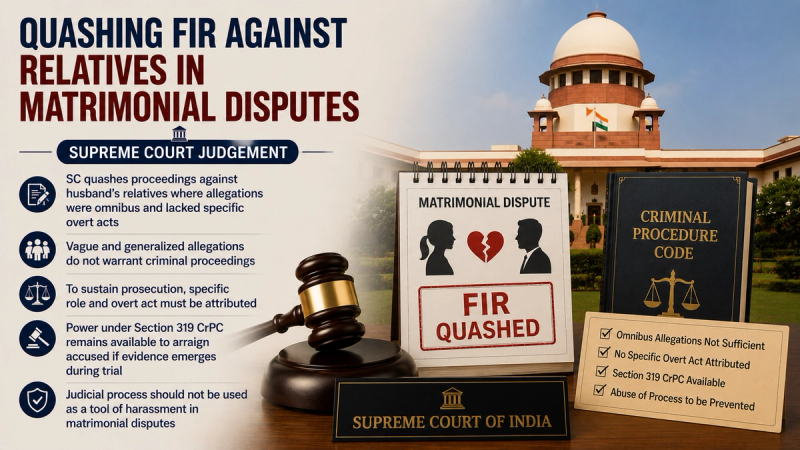
1. Whether general and omnibus allegations are sufficient to prosecute parents-in-law under 498A IPC and Dowry Act 2. Whether different treatment of similarly placed accused is legally sustainable 3. Whether delay (post-divorce filing) affects credibility of FIR

9 Mar 2026
Justice Vikram Nath & Justice Sandeep Mehta
498A IPCDowry ProhibitionOmnibus Allegations

Vishaka v. State of Rajasthan

(1997) 6 SCC 241

Whether the absence of legislation dealing with sexual harassment of women at the workplace amounts to a violation of the fundamental rights of working women under Articles 14, 19 and 21 of the Constitution, and what obligations the State and employers bear in the interim until Parliament enacts appropriate legislation. The Court was further called upon to determine the scope of the right to work in a safe environment as a component of the right to life and personal liberty under Article 21.

13 Aug 1997
J.S. Verma CJI
Sexual HarassmentWorkplace RightsArticle 14

S.R. Bommai v. Union of India

(1994) 3 SCC 1

Whether the proclamation of President's Rule under Article 356 of the Constitution is justiciable and subject to judicial review, and what limitations exist on the President's power to dismiss a State government and dissolve the Legislative Assembly. The Court was also called upon to determine whether secularism forms part of the basic structure of the Constitution and whether a State government that pursues an anti-secular agenda can be dismissed under Article 356.

11 Mar 1994
S. Ratnavel Pandian J
Article 356President's RuleFederalism

Kesavananda Bharati v. State of Kerala

(1973) 4 SCC 225

Whether the Parliament's power to amend the Constitution under Article 368 is absolute and unlimited, or whether there exist certain basic and essential features of the Constitution that are beyond the amending power of Parliament. The Court was also called upon to reconsider its earlier decision in Golak Nath v. State of Punjab which had held that Fundamental Rights could not be abridged by constitutional amendment.

24 Apr 1973
S.M. Sikri CJI
Basic Structure DoctrineArticle 368Constitutional Amendment

Maneka Gandhi v. Union of India

(1978) 1 SCC 248

Whether the right to personal liberty under Article 21 can be curtailed by any procedure established by law, or whether such procedure must itself satisfy the requirements of being fair, just and reasonable. The Court was further called upon to determine whether Articles 14, 19 and 21 operate in isolation or must be read together as an integrated code of fundamental rights.

25 Jan 1978
M.H. Beg CJI
Article 21Article 19Article 14