Apex Digest

Join Group
Agarawal Associates

Apex Digest

Supreme Court of India — Judgment Intelligence

22 judgments in Criminal law

Sorted by most recent

Sagar v. State of Haryana
Criminal

Sagar v. State of Haryana

(2026) INSC 692

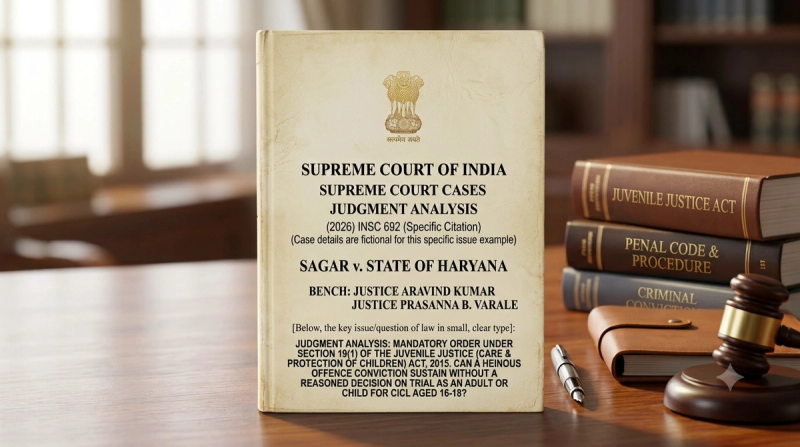
Whether the conviction and sentence of a child in conflict with law (aged 16-18 years) for a heinous offence can be sustained when the Children's Court proceeded with trial as an adult without passing a reasoned order under Section 19(1) of the Juvenile Justice (Care and Protection of Children) Act, 2015, determining whether the child should be tried as an adult or as a child.

13 Jul 2026
Aravind Kumar J.
Juvenile justiceChild in conflict with lawSection 19 JJ Act
Mehtab v. State of Uttarakhand
Criminal Premium

Mehtab v. State of Uttarakhand

(2026) INSC 578

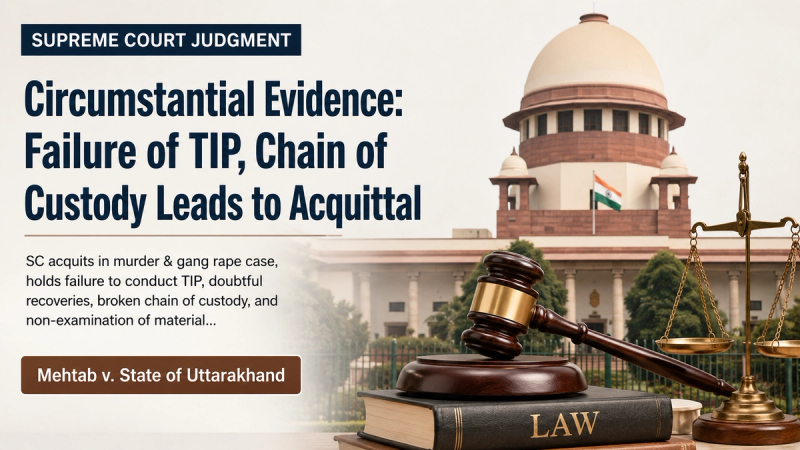
Whether the prosecution has established a complete chain of incriminating circumstances beyond reasonable doubt to convict the appellants for offences under Sections 302 and 376(2)(g) of the Indian Penal Code, 1860, where the case rests entirely on circumstantial evidence including (i) the appellants being seen enquiring about the deceased and proceeding towards the forest (last seen together), (ii) recovery of a torn shirt pocket matching the appellant's shirt, (iii) recovery of the deceased's salwar and ornaments at the instance of another appellant, and (iv) forensic evidence, but where there were serious infirmities including failure to conduct Test Identification Parade, non-examination of material witnesses, doubtful recoveries, and lack of chain of custody.

27 May 2026
Justice Vikram Nath
Circumstantial evidenceMurderRape
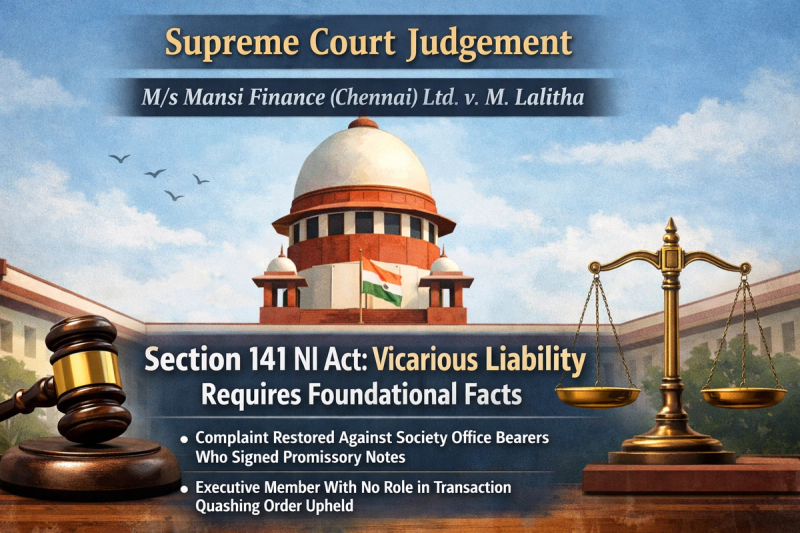
M/s Mansi Finance (Chennai) Ltd. v. M. Lalitha
Criminal Premium

M/s Mansi Finance (Chennai) Ltd. v. M. Lalitha

(2026) INSC 542

Whether the High Court was justified in quashing criminal proceedings under Sections 138 and 141 of the Negotiable Instruments Act, 1881 against office bearers of a Society (Vice President, Treasurer, Executive Member, and Manager) where the complaint contained general averments that they were responsible for the conduct of the Society's affairs, but some of them had also signed antecedent financial documents (promissory notes, Memorandum of Understanding) related to the underlying transaction.

26 May 2026
Justice Prashant Kumar Mishra
Negotiable Instruments ActSection 138Section 141
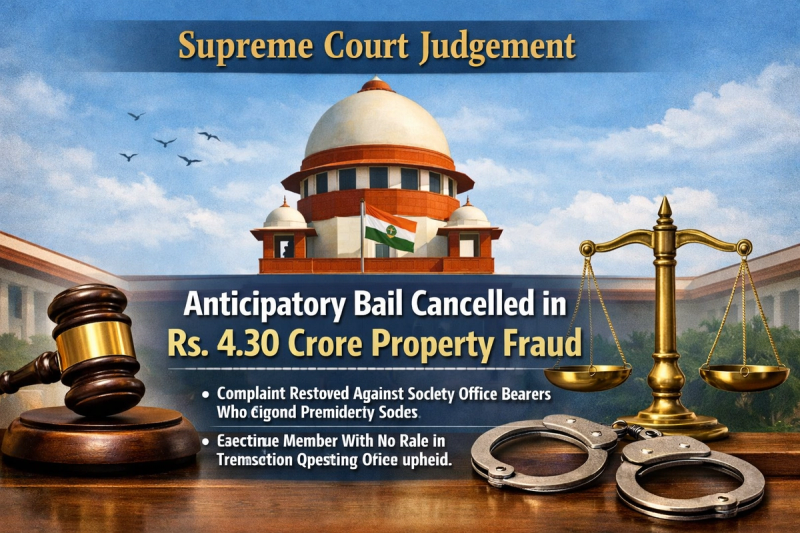
Saurabh Agrawal v. State of Uttar Pradesh
Criminal Premium

Saurabh Agrawal v. State of Uttar Pradesh

(2026) INSC 548

Whether the High Court was justified in granting anticipatory bail to an accused charged with cheating, forgery, and criminal conspiracy in a property transaction involving Rs. 4.30 crores, where the accused had criminal antecedents of a similar nature, the Sessions Court had rejected bail, and the High Court had earlier dismissed the quashing petition noting the prima facie case and antecedents, but the anticipatory bail order failed to consider these material factors.

26 May 2026
Justice Prashant Kumar Mishra
Anticipatory bailCancellation of bailEconomic offence
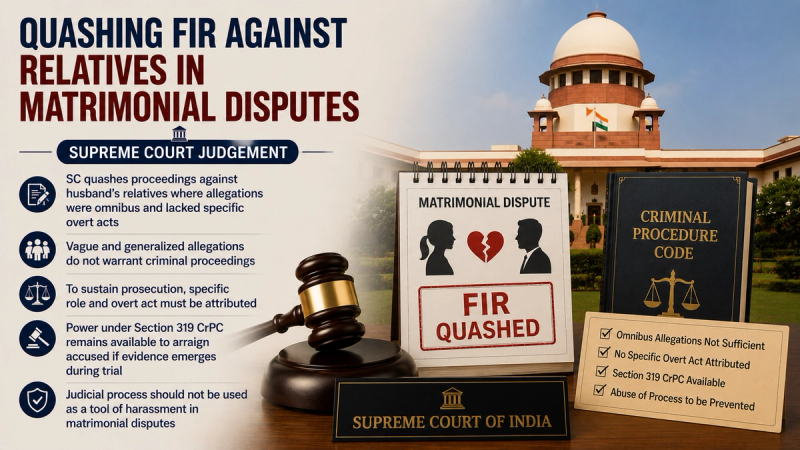
Arti Mehta v. State of Madhya Pradesh
Criminal Premium

Arti Mehta v. State of Madhya Pradesh

(2026) INSC 533

Whether criminal proceedings under Section 498A of the Indian Penal Code, 1860, Sections 3 and 4 of the Dowry Prohibition Act, 1961, and proceedings under the Protection of Women from Domestic Violence Act, 2005 can be quashed against the husband's relatives when the allegations against them are omnibus, generalised, and lack specific overt acts, while the husband faces specific allegations of cruelty and harassment.

25 May 2026
Justice Sanjay Karol
Quashing of FIRSection 482 CrPCSection 498A IPC
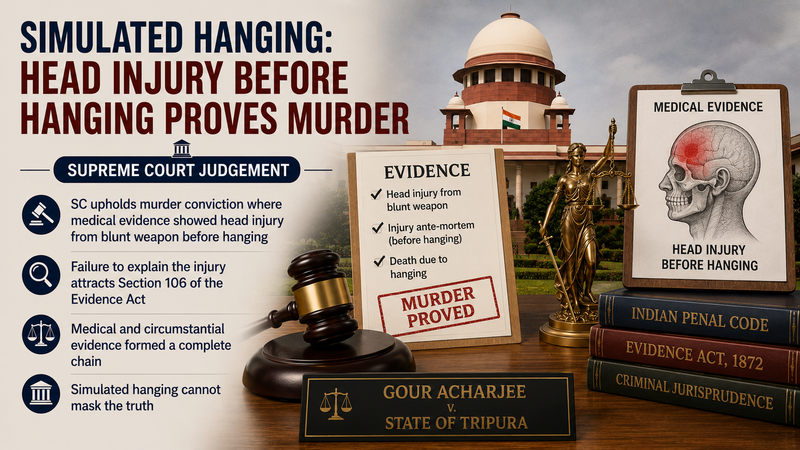
Gour Acharjee v. State of Tripura
Criminal Premium

Gour Acharjee v. State of Tripura

(2026) INSC 535

Whether the conviction of the husband under Section 302 of the Indian Penal Code, 1860 for the murder of his wife is sustainable when the medical evidence establishes that the death was caused by head injury from a blunt weapon (hammer) and the body was subsequently hanged to simulate suicide, and when the husband failed to offer any explanation under Section 106 of the Indian Evidence Act, 1872 for the injuries sustained by the deceased inside the matrimonial home.

25 May 2026
Justice Prashant Kumar Mishra
Dowry deathSection 302 IPCSection 498A IPC
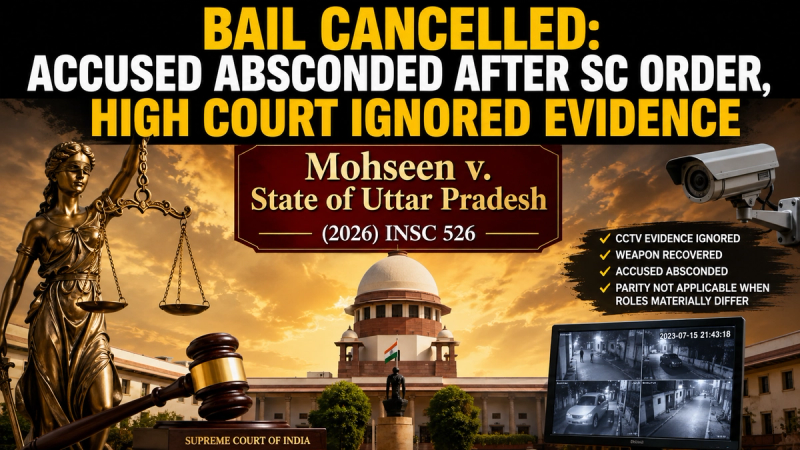
Mohseen v. State of Uttar Pradesh
Criminal Premium

Mohseen v. State of Uttar Pradesh

(2026) INSC 526

Whether the High Court was justified in granting bail to an accused charged with offences under Sections 307, 147, 148, 149, 323, 324, 452, 504, 506 IPC and Sections 3, 25, 27 of the Arms Act, 1959, where the accused had earlier been granted bail and that bail was cancelled by the Supreme Court, the accused absconded for 42 days after the cancellation order, CCTV footage showed him brandishing a pistol and gunshots were heard, a pistol and cartridge were recovered at his instance, and the co-accused whose bail was cited for parity had a materially different role.

22 May 2026
Justice Sanjay Karol
Bail cancellationSection 307 IPCArms Act
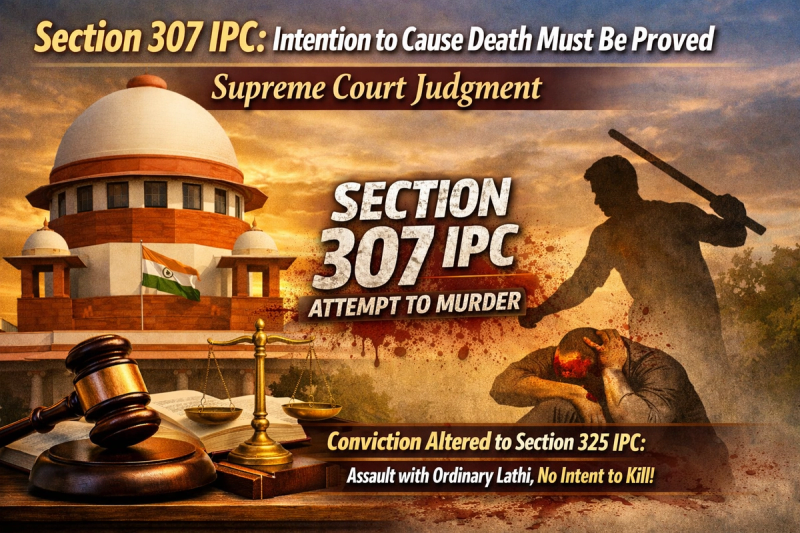
Roshan Lal v. State of Haryana
Criminal Premium

Roshan Lal v. State of Haryana

(2026) INSC 524

Whether the appellants, who inflicted lathi blows on the victim's head resulting in fractures and prolonged hospitalization, can be convicted under Section 307 of the Indian Penal Code, 1860 (attempt to murder) when the assault arose spontaneously without premeditation, and whether the conviction should be altered to Section 325 (voluntarily causing grievous hurt) in the absence of proven intention to cause death.

22 May 2026
Justice Sanjay Karol
Section 307 IPCAttempt to murderSection 325 IPC
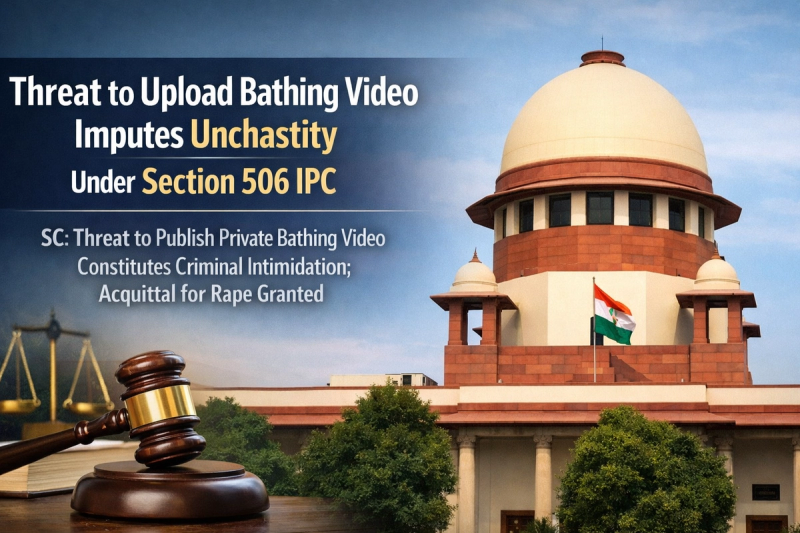
Vijayakumar v. State of Tamil Nadu
Criminal Premium

Vijayakumar v. State of Tamil Nadu

(2026) INSC 525

Whether the threat to upload a video of a woman taken while bathing constitutes criminal intimidation under Part II of Section 506 of the Indian Penal Code, 1860, by imputing unchastity, even when the video is not recovered; and whether the acquittal of the accused for rape and related charges automatically entitles him to acquittal for criminal intimidation arising from the same relationship.

22 May 2026
Justice Sanjay Karol
Criminal intimidationSection 506 IPCSection 503 IPC
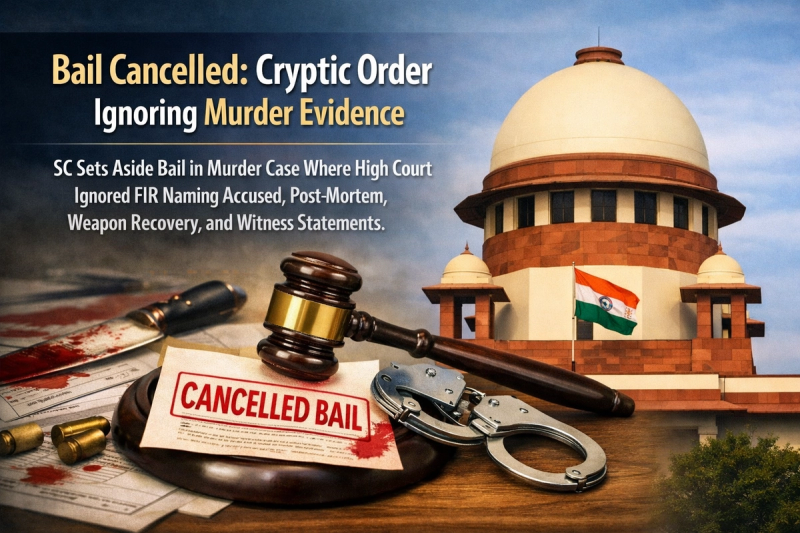
Bhagat Singh v. State of Uttar Pradesh
Criminal Premium

Bhagat Singh v. State of Uttar Pradesh

(2026) INSC 527

Whether the High Court was justified in granting bail to an accused charged with murder under Section 103(1) of the Bharatiya Nyaya Sanhita, 2023, where the accused was specifically named in the FIR with a direct overt act of firing, the post-mortem report confirmed firearm injuries, the murder weapon was recovered at his instance, and witness statements supported the prosecution, solely on the ground that the informant and another Panch witness did not name the accused during the inquest proceedings under Section 174 of the Code of Criminal Procedure, 1973.

22 May 2026
Justice Sanjay Karol
Bail cancellationMurderSection 103 BNS
Papan Sarkar @ Pranab v. State of West Bengal
Criminal Premium

Papan Sarkar @ Pranab v. State of West Bengal

(2026) INSC 528

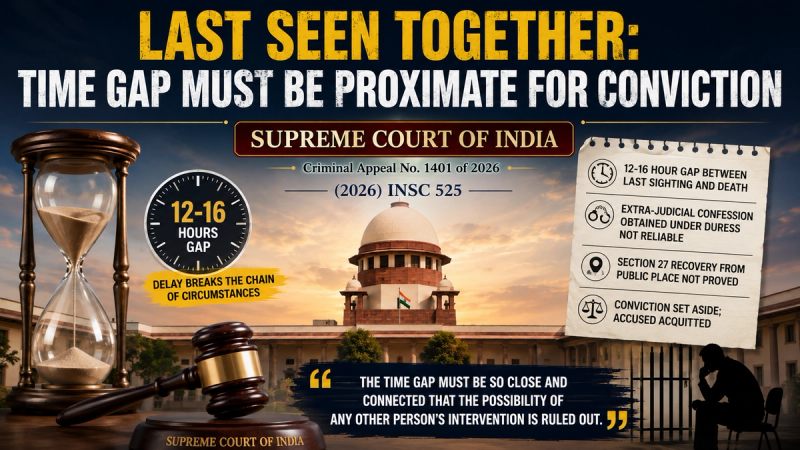
Whether the conviction of the appellants for murder under Section 302 of the Indian Penal Code, 1860 based on circumstantial evidence — including last seen together theory, extra-judicial confession, and recovery of weapons — is sustainable when the time gap between the last sighting and death is not proximate, the extra-judicial confession was made under duress and is inconsistent among witnesses, and the recoveries do not satisfy the requirements of Section 27 of the Indian Evidence Act, 1872.

22 May 2026
Justice Sanjay Kumar
MurderLast seen togetherExtra-judicial confession
Sri v. State Rep. by Inspector of Police, Q Branch, Ramanathapuram, Tamil Nadu
Criminal Premium

Sri v. State Rep. by Inspector of Police, Q Branch, Ramanathapuram, Tamil Nadu

(2026) INSC 516

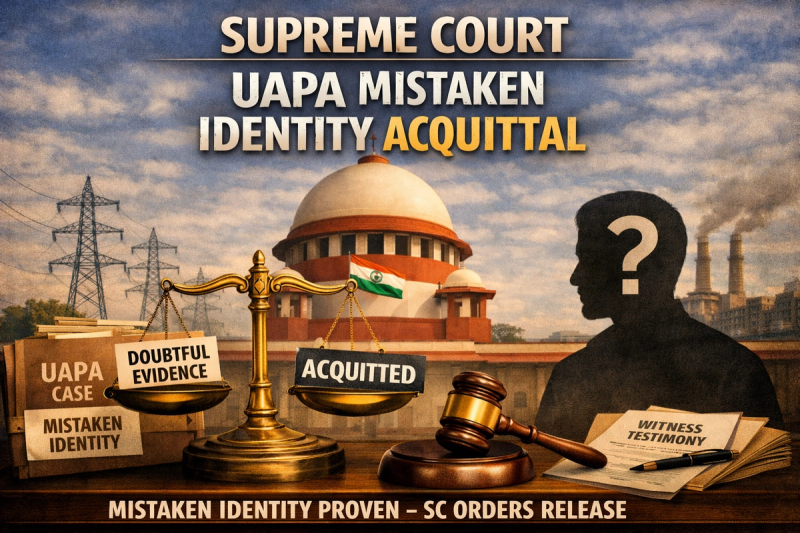
Whether the appellant — a Sri Lankan national residing openly in Trichy under the name 'Ranjan' — is the same as the absconding accused 'Sri' (A-5) who allegedly handed over cyanide capsules and poisonous substances to co-accused Krishnakumar in May 2015 for revival of the banned LTTE organisation, and whether the conviction based solely on the belated and improved testimonies of two witnesses (who were themselves illegally staying in India on forged documents) is sustainable.

20 May 2026
Justice Vikram Nath
Mistaken identityUAP ActSection 120B IPC
Ram Balak v. State of U.P.
Criminal Premium

Ram Balak v. State of U.P.

(2026) INSC 511

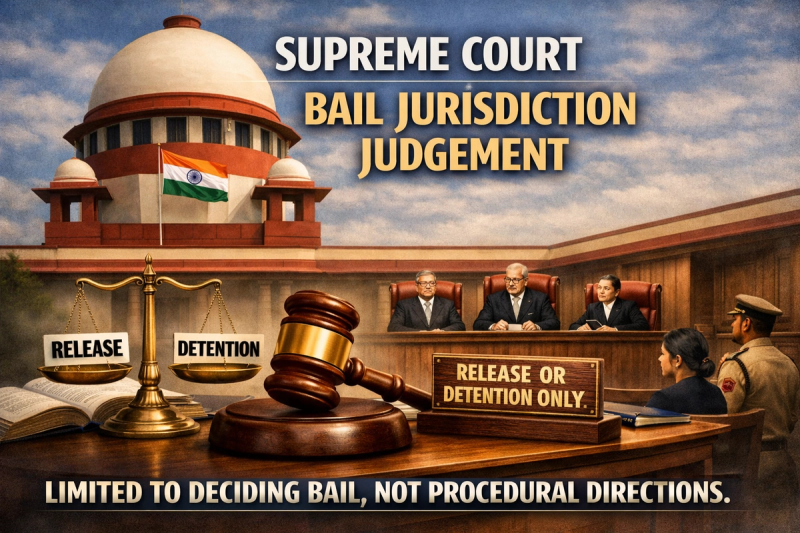
Whether the High Court, while exercising its statutory power under Section 483 of the Bharatiya Nagarik Suraksha Sanhita, 2023 (BNSS) (corresponding to Section 439 of the Code of Criminal Procedure, 1973) to grant or reject bail, can issue far-reaching directions mandating the State Government and police authorities to create departmental accountability systems for service of summons, execution of coercive measures, and production of witnesses, or whether such directions exceed the scope of the statutory power of bail jurisdiction.

19 May 2026
Justice Sanjay Karol
Bail jurisdictionSection 483 BNSS 2023Statutory power
State of Tamil Nadu v. Ponnusamy
Criminal Premium

State of Tamil Nadu v. Ponnusamy

(2026) INSC 507

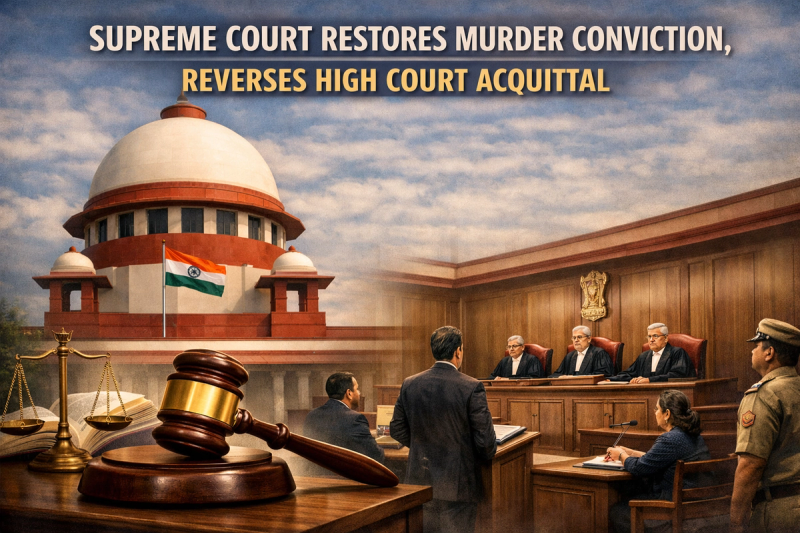
Whether the High Court was justified in reversing the Trial Court's conviction of nine accused for murder and criminal conspiracy, and acquitting them on the ground that the approver's evidence was unreliable, witnesses were chance witnesses with delayed disclosure, CDRs were not properly proved under Section 65-B of the Evidence Act, 1872, and electronic evidence (CCTV footage and gait analysis) was mishandled, despite the Trial Court having found the evidence credible and consistent.

19 May 2026
Justice M.M. Sundresh
MurderCriminal conspiracyApprover evidence
Criminal Premium

Syed Iftikhar Andrabi v. National Investigation Agency, Jammu

(2026) INSC 503

Whether the stringent bail conditions under Section 43-D(5) of the Unlawful Activities (Prevention) Act, 1967 (UAP Act) and Section 37 of the Narcotic Drugs and Psychotropic Substances Act, 1985 (NDPS Act) can be relaxed on the ground of prolonged incarceration and delayed trial, especially in light of the three-Judge Bench decision in K.A. Najeeb, and whether smaller Benches can dilute or circumvent the ratio of a larger Bench.

18 May 2026
Justice B.V. Nagarathna
BailUAP ActSection 43D(5)
Criminal Premium

Talari Naresh vs State of Telangana: Full Judgment PDF, Facts & Legal Analysis

(2026) INSC 486

Whether the prosecution proved its case beyond reasonable doubt against the appellant for offences under Sections 302 and 323 of the Indian Penal Code, 1860 and Sections 3(2)(v) and 3(1)(x) of the Scheduled Castes and Scheduled Tribes (Prevention of Atrocities) Act, 1989, where the sole eyewitness was the mother of the deceased (an interested witness), the other eyewitness turned hostile, witnesses on the Panchayat turned hostile, and the medical evidence contained unexplained discrepancies regarding the date and time of postmortem.

13 May 2026
Justice Prashant Kumar Mishra
Criminal appealAcquittalHostile witness
Criminal Premium

Yatin Narendra Oza v. Suo Motu, High Court of Gujarat

(2026) INSC 470

Whether a senior advocate and President of the High Court Bar Association, who made public statements terming the High Court a 'gambling den' and alleging corruption, favouritism, and nepotism against the Registry, is guilty of criminal contempt under Section 2(c)(i) of the Contempt of Courts Act, 1971, and whether his repeated unconditional apologies should be accepted given his history of similar conduct.

11 May 2026
Justice J.K. Maheshwari
Criminal contemptScandalising the courtApology
Criminal Premium

Gunjan @ Girija Kumari v. State (NCT of Delhi)

(2026) INSC 468

Whether the essential ingredient of 'any place within public view' under Sections 3(1)(r) and 3(1)(s) of the Scheduled Castes and Scheduled Tribes (Prevention of Atrocities) Act, 1989 is made out when the alleged caste-based abuses and insults occurred inside a residential house, where no independent members of the public were present, and whether the FIR and charge-sheet can be quashed on this ground at the threshold.

11 May 2026
Justice Prashant Kumar Mishra
SC/ST ActSection 3(1)(r)Section 3(1)(s)
Criminal Premium

In Re: Order Dated 17.03.2025 Passed by the High Court of Judicature at Allahabad in Criminal Revision No. 1449/2024 and Ancillary Issues v. We the Women of India

(2026) INSC 165

Whether the accused's actions of taking a minor victim on a motorcycle, dragging her near a culvert, and committing sexually offensive acts constituted 'preparation' or 'attempt' to commit rape. Additionally, whether guidelines are required to inculcate sensitivity and compassion in judicial approach while dealing with sexual offences.

10 Feb 2026
Chief Justice Surya Kant
Attempt to commit rapePreparation vs attemptJudicial sensitivity
Criminal Premium

State of U.P. v. Ajmal Beg

(2025) INSC 1435

Whether the High Court was justified in reversing a conviction under Section 304-B of the Indian Penal Code, 1860 for dowry death based on omissions, inconsistencies, and contradictions in witness testimonies, and whether the prosecution had established the essential ingredients of dowry death including demand 'soon before death'.

15 Dec 2025
Justice Sanjay Karol
Dowry deathSection 304-B Indian Penal CodePresumption under Evidence Act
Criminal Premium

Mihir Rajesh Shah v. State of Maharashtra

(2025) INSC 1288

Whether Section 47 of the Bharatiya Nagarik Suraksha Sanhita, 2023 (BNSS 2023) and Article 22(1) of the Constitution of India require that grounds of arrest be furnished in writing to every accused in every case, and what is the consequence of non-compliance, particularly in the context of offences under the Bharatiya Nyaya Sanhita, 2023 (BNS 2023).

6 Nov 2025
Justice Bhushan R. Gavai
Grounds of arrestArticle 22(1) Constitution of IndiaSection 47 Bharatiya Nagarik Suraksha Sanhita 2023
NaXXXX Kumar v. KaXXXX
Criminal Premium

NaXXXX Kumar v. KaXXXX

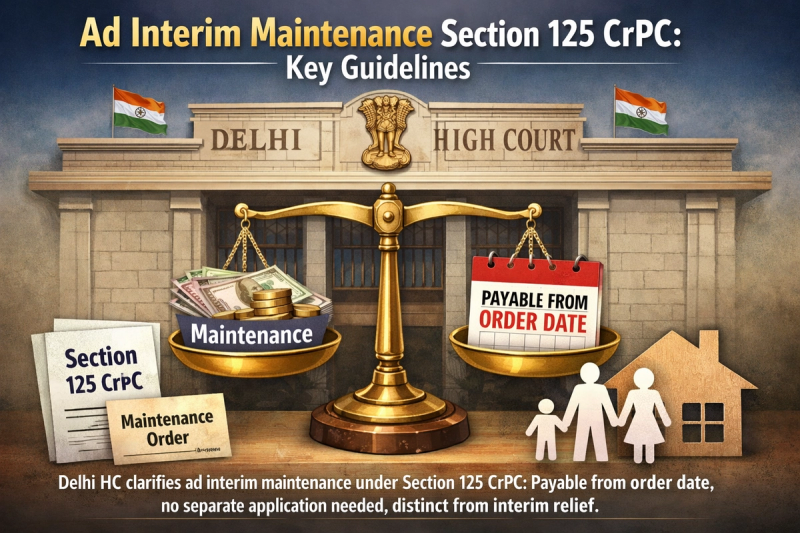
Whether ad-interim maintenance can be granted under Section 125 of the Code of Criminal Procedure, 1973 in the absence of a specific application, and whether such maintenance should be payable from the date of filing of the application or from the date of the order. Also, whether the dismissal of a maintenance application under the Protection of Women from Domestic Violence Act, 2005 bars a claim under Section 125 CrPC.

1 Jul 2025
Dr. Swarana Kanta Sharma J.
Ad interim maintenanceSection 125 CrPCInterim maintenance
Join Group