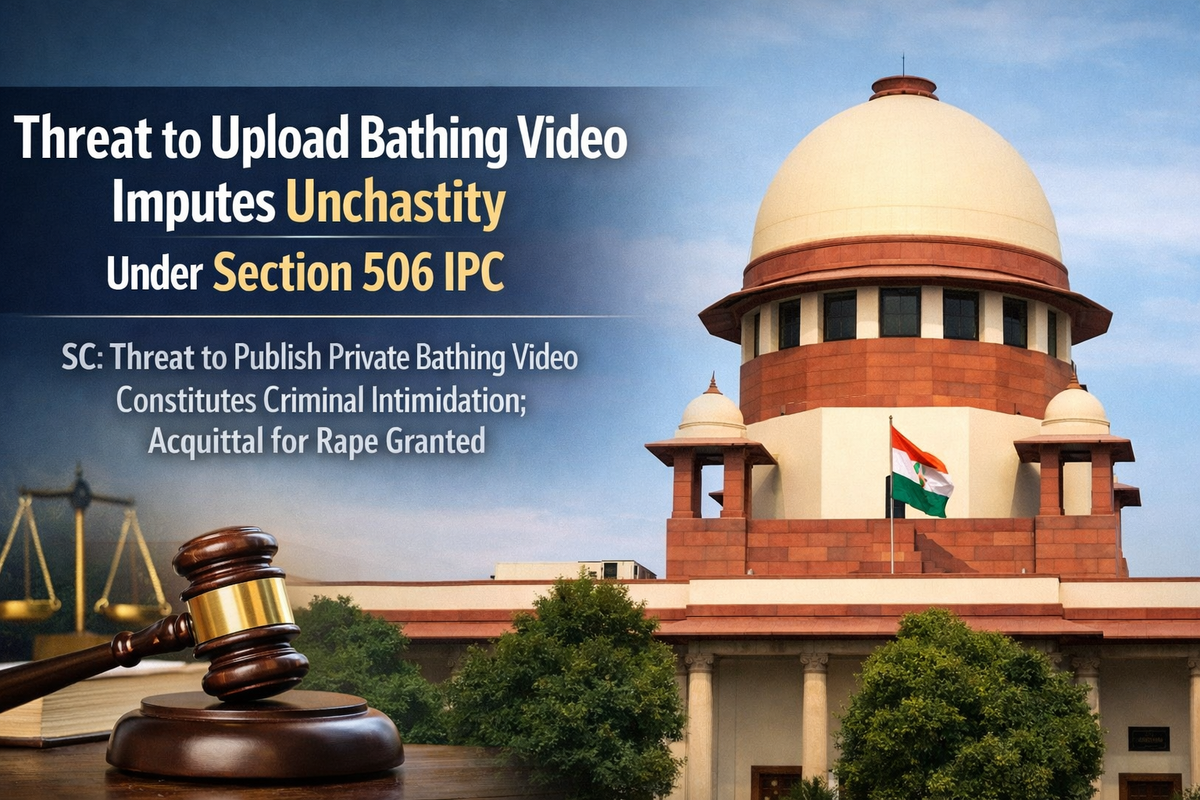
Vijayakumar v. State of Tamil Nadu
(2026) INSC 525
Key Issue / Question of Law
Whether the threat to upload a video of a woman taken while bathing constitutes criminal intimidation under Part II of Section 506 of the Indian Penal Code, 1860, by imputing unchastity, even when the video is not recovered; and whether the acquittal of the accused for rape and related charges automatically entitles him to acquittal for criminal intimidation arising from the same relationship.
Ratio Decidendi
Criminal intimidation under Section 503 IPC read with Part II of Section 506 IPC requires: (a) a threat to cause injury to person, reputation, or property; (b) intent to cause alarm; and (c) the threat must be to impute unchastity to a woman. Chastity in the modern constitutional framework must be understood from the prism of dignity and autonomy under Article 21, not merely from traditional moral perspectives. Any unwarranted interference with sexual autonomy, including the threat to publish private images taken without consent, amounts to imputing unchastity. Non-recovery of the video is not fatal if the victim genuinely believed in its existence and the threat was made. Each offence must be examined independently; acquittal for one offence does not automatically lead to acquittal for another, even if arising from the same transaction. Where a relationship is established and facts are within the especial knowledge of the accused, Section 106 of the Indian Evidence Act, 1872 shifts the burden to the accused to explain the incriminating circumstances.
Holding / Decision
The Supreme Court dismissed the appeal, upheld the conviction under Part II of Section 506 of the Indian Penal Code, 1860, but reduced the sentence to the period of custody already undergone. The Court held that the threat to upload a bathing video on social media imputes unchastity to a woman, violating her dignity and privacy under Article 21. Non-recovery of the video was not fatal as the prosecutrix genuinely believed in its existence. The acquittal for rape and related charges did not affect the conviction for criminal intimidation, as each offence requires independent examination.
Background & Facts
The appellant and the prosecutrix were in a romantic and physical relationship for about two years. The prosecutrix alleged that the appellant had a sexual relationship with her on a false promise of marriage. She further alleged that the appellant recorded a video of her while she was taking a bath and later threatened to upload it on Facebook if she continued to contact him. The Trial Court acquitted the appellant of charges under Sections 376, 493, and 354C of the IPC, holding that the sexual relationship was consensual. However, the Trial Court convicted him under Part II of Section 506 of the IPC for criminal intimidation by threatening to impute unchastity. The High Court confirmed the conviction. The appellant appealed to the Supreme Court, arguing that since he was acquitted of the other charges, and since the video was never recovered, the conviction under Section 506 IPC could not stand.
Statutes Involved
- Section 506, Indian Penal Code, 1860 — Punishes criminal intimidation; Part II imposes enhanced punishment (up to seven years) when the threat is to cause death, grievous hurt, destruction of property by fire, or to impute unchastity to a woman
- Section 503, Indian Penal Code, 1860 — Defines criminal intimidation as threatening another with injury to person, reputation, or property with intent to cause alarm, or to cause the person to do or omit to do any act
- Section 376, Indian Penal Code, 1860 — Punishes rape; the accused was acquitted of this charge
- Section 493, Indian Penal Code, 1860 — Punishes sexual intercourse by deceitfully inducing a belief of lawful marriage; the accused was acquitted of this charge
- Section 354C, Indian Penal Code, 1860 — Punishes voyeurism (watching or capturing images of a woman engaged in private acts); the accused was acquitted of this charge
- Section 106, Indian Evidence Act, 1872 — Provides that when any fact is especially within the knowledge of any person, the burden of proving that fact is upon him
- Section 114, Indian Evidence Act, 1872 — Allows the court to presume the existence of any fact which it thinks likely to have happened, regard being had to the common course of natural events and human conduct
- Section 145, Indian Evidence Act, 1872 — Provides the manner of contradicting a witness by proof of former statement in writing
- Section 162, Code of Criminal Procedure, 1973 — Provides that statements made to police during investigation cannot be used for any purpose except to contradict a witness in the manner provided by Section 145 of the Evidence Act
- Section 313, Code of Criminal Procedure, 1973 — Provides for examination of the accused to explain incriminating circumstances appearing in evidence
- Article 21, Constitution of India — Guarantees right to life and personal liberty, which includes the right to privacy, dignity, and autonomy over fundamental personal choices
Full Analysis
Premium Content
Subscribe to access the full analysis, practical implications, and related case mapping.
Subscribe — ₹99/monthAlready a subscriber? Sign inAdvocate's Note — Agarawal Associates
Professional insight for advocates on how to deploy this judgment in practice...
Subscribe to access the Advocate's Note.
Key Conditional Rule / Important Caveat
This judgment applies ONLY where (a) there is a threat to impute unchastity to a woman, (b) the threat relates to publication of private images/videos (including those taken without consent during bathing), (c) the victim genuinely believed in the existence of such images/videos, and (d) the threat was made with intent to cause alarm or to compel the victim to do or omit an act. Non-recovery of the actual images/videos is NOT fatal to the prosecution if the victim's belief is genuine and corroborated. The judgment does NOT apply where (a) the victim knew the video did not exist, (b) the threat was not made with intent to cause alarm, or (c) the threat was not to impute unchastity (e.g., a threat to cause property damage alone would not fall under Part II). The acquittal for rape under Section 376 IPC does NOT automatically lead to acquittal for criminal intimidation under Section 506 IPC; each charge must be examined independently.
Cases Cited
- Joseph Shine v. Union of India (2019) 3 SCC 39 — Constitution Bench held that Section 497 IPC (adultery) is unconstitutional, rejecting the gendered approach to morality and affirming the sexual autonomy of women.
- K.S. Puttaswamy v. Union of India (2017) 10 SCC 1 — Constitution Bench recognised the fundamental right to privacy, holding that dignity encompasses autonomy over fundamental personal choices and control over dissemination of personal information.
- Shambu Nath Mehra v. State of Ajmer (1956) 1 SCC 337 — Explained the scope of Section 106 of the Evidence Act: it applies to facts especially within the knowledge of the accused, but is not intended to relieve the prosecution of its primary burden.
- Anees v. State (NCT of Delhi) (2024) 15 SCC 48 — Held that once foundational facts are established, the court may draw reasonable inferences under Section 114 of the Evidence Act, and the burden shifts to the accused under Section 106.
- Tulshiram Sahadu Suryawanshi v. State of Maharashtra (2012) 10 SCC 373 — Reiterated that Section 106 applies where the prosecution has succeeded in proving facts from which a reasonable inference can be drawn, unless the accused offers an explanation.
- Vadivelu Thevar v. State of Madras 1957 AIR SC 614 — Classified oral testimony into three categories: wholly reliable, wholly unreliable, and neither wholly reliable nor wholly unreliable; courts must look for corroboration in the third category.
- Goverdhan v. State of Chhattisgarh (2025) 3 SCC 378 — Held that non-recovery of the weapon of crime is not fatal to the prosecution case if there are direct reliable witnesses available.
- Balu Sudam Khalde v. State of Maharashtra (2023) 13 SCC 365 — Held that suggestions made to the witness by the defence counsel and the reply to such suggestions form part of the evidence and can be relied upon.
- Sohrab v. State of M.P. (1972) 3 SCC 751 — Held that the maxim falsus in uno falsus in omnibus is not a sound rule; a witness may be reliable in part even if not entirely reliable.
- Mekala Sivaiah v. State of A.P. (2022) 8 SCC 253 — Held that under Article 136, this Court does not ordinarily interfere with concurrent findings of fact unless there is manifest illegality or grave miscarriage of justice.
Courtroom Arguments
For Petitioner
No Video Recovered, Acquittal for Rape Must Lead to Acquittal for Criminal Intimidation — (2026) INSC 525
The appellant was acquitted of all charges including rape, voyeurism, and deceitful sexual intercourse. The alleged video was never recovered.
For Respondent
Threat to Upload Bathing Video Imputes Unchastity, Conviction Valid — (2026) INSC 525
The threat to upload a video of a woman bathing on social media imputes unchastity, violating her dignity and privacy under Article 21.
More Criminal Law Judgments
View All →Found this useful? Share it with your colleagues.
One tap sends the case name, citation, key issue and link.
Take This Further in Court
2 courtroom argument frameworks available for this case — full submission structure, bench question simulator, and opposition rebuttals.
Disclaimer: This summary is prepared by Agarawal Associates for informational purposes only. It does not constitute legal advice. For legal matters, consult a qualified advocate. © 2026 Agarawal Associates — apexdigest.in