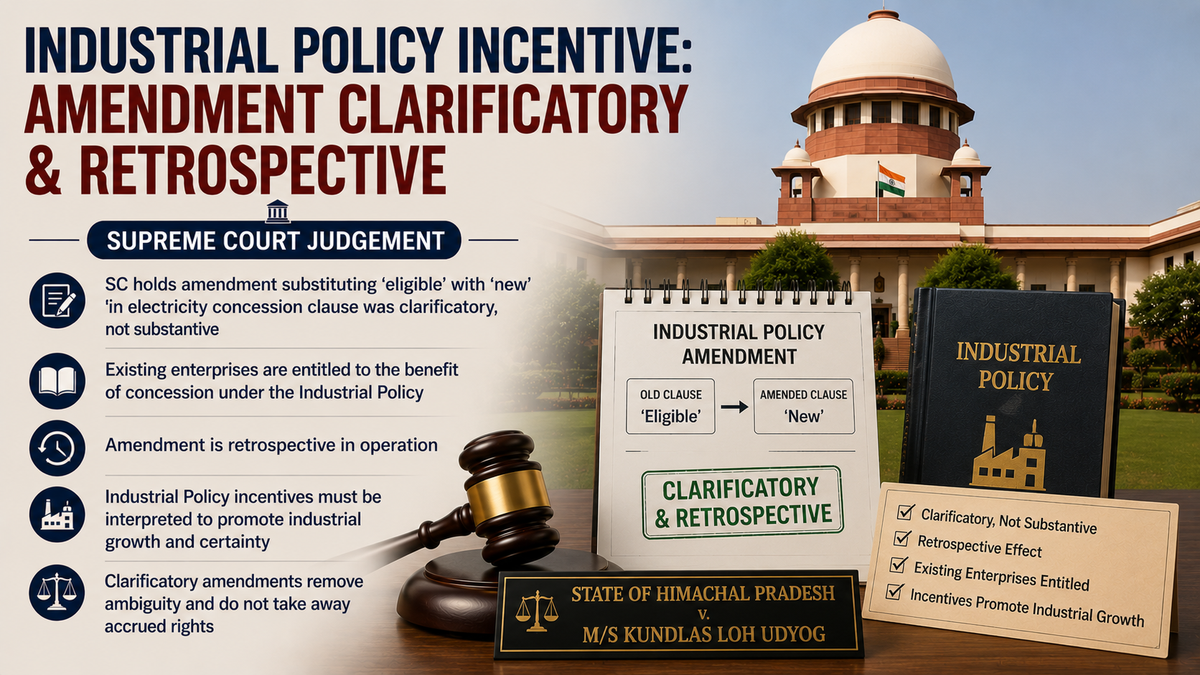
State of Himachal Pradesh v. M/S Kundlas Loh Udyog
(2026) INSC 534
Key Issue / Question of Law
Whether Clause 16(a) of the Himachal Pradesh Industrial Policy, 2019, which provided that 'eligible enterprises' would receive a 15% discount on energy charges for 3 years, was intended to apply to existing industrial enterprises undertaking substantial expansion or only to new industrial enterprises, and whether the amendment notification dated 29.04.2022 substituting 'eligible' with 'new' was clarificatory and retrospective or substantive and prospective.
Ratio Decidendi
Clause 16(a) of the Industrial Policy, 2019 was always intended to apply exclusively to new industrial enterprises, not to existing industrial enterprises undergoing substantial expansion. Clause 16(b) separately provided a rebate for existing industrial consumers on additional power consumption. The contemporaneous tariff orders issued by the Electricity Board prior to and subsequent to the Policy consistently treated new and existing industries differently, with new industries receiving concessional rates and existing industries receiving rebates on additional consumption. The amendment notification dated 29.04.2022 substituting the word 'eligible' with 'new' in Clause 16(a) and Rule 16(i)(a) was clarificatory in nature and therefore retrospective, because it did not introduce a new class of beneficiaries but merely corrected an inadvertent drafting error. The doctrine of promissory estoppel does not apply to create an entitlement contrary to the true scope and intent of the Policy, especially when the respondent has already received the benefit intended for its category under Clause 16(b).
Holding / Decision
The Supreme Court allowed the appeal, set aside the impugned judgment of the Himachal Pradesh High Court dated 7 May 2025, and dismissed the respondent's writ petition. The Court held that Clause 16(a) of the Industrial Policy, 2019 was intended only for new industrial enterprises, not for existing enterprises undergoing substantial expansion. The amendment dated 29.04.2022 was clarificatory and retrospective. The respondent, being an existing enterprise, was only entitled to the rebate under Clause 16(b), which it had already received. The doctrine of promissory estoppel was held inapplicable.
Background & Facts
The State of Himachal Pradesh notified the Industrial Policy, 2019 on 16 August 2019 to attract industrial investment. Clause 5(A) made both new industrial enterprises and existing industrial enterprises undertaking substantial expansion eligible for incentives. Clause 5(B) provided that incentives would be admissible from the date of commencement of commercial production or from the date of enabling notification, whichever was later. Clause 16(a) stated that 'eligible enterprises' would be charged energy charges 15% lower than approved rates for 3 years. Clause 16(b) provided a 15% rebate for existing industrial consumers on additional power consumption. The respondent, an existing industrial enterprise established in 2006, applied for substantial expansion on 1 June 2020, which was approved on 13 July 2020. A Certificate of Commercial Production was issued on 12 February 2021. The respondent claimed the 15% concessional rate under Clause 16(a). The State amended the Policy on 29 April 2022, substituting 'eligible' with 'new' in Clause 16(a) and inserting 'substantial expansion' in Clause 16(b). The High Court allowed the respondent's writ petition. The State appealed to the Supreme Court.
Statutes Involved
- Section 49, Electricity Act, 2003 — Provides for the tariff regulations and powers of State Electricity Regulatory Commissions
- Electricity Act, 1948 (repealed) — Originally constituted State Electricity Boards (under which the Himachal Pradesh State Electricity Board was constituted)
- Himachal Pradesh Industrial Policy, 2019 — Policy notification dated 16.08.2019 providing incentives, concessions and facilities for industrial development
- Rules regarding Grant of Incentives, Concessions & Facilities for Investment Promotion in Himachal Pradesh, 2019 — Framed under the Industrial Policy, 2019 to operationalize the incentives
Full Analysis
Premium Content
Subscribe to access the full analysis, practical implications, and related case mapping.
Subscribe — ₹99/monthAlready a subscriber? Sign inAdvocate's Note — Agarawal Associates
Professional insight for advocates on how to deploy this judgment in practice...
Subscribe to access the Advocate's Note.
Key Conditional Rule / Important Caveat
This judgment applies ONLY where (a) an industrial policy or fiscal incentive scheme contains an ambiguous or erroneous provision, (b) a clarificatory amendment is issued correcting the error without altering the substance, (c) the claimant is an existing industrial enterprise undergoing expansion, (d) the policy separately provides different incentives for new and existing enterprises, (e) the claimant has received the incentive intended for its category, and (f) no specific sanction or approval of the claimed incentive was ever issued. The amendment will be treated as clarificatory and retrospective. The doctrine of promissory estoppel will NOT apply to create an entitlement contrary to the true intent of the policy. The judgment does NOT apply where (a) the amendment introduces a new substantive requirement (e.g., a time limit that did not exist before), (b) the claimant is a new industrial enterprise, (c) a specific sanction of the incentive was issued and relied upon, or (d) the policy did not contain separate incentives for different categories of enterprises.
Cases Distinguished
- IFGL Refractories Ltd. v. Orissa State Financial Corporation 2026 SCC OnLine SC 28 — Distinguished on the ground that in that case a specific sanction of incentive had been issued in favour of the enterprise, whereas in the present case no such sanction was ever granted.
- State of Rajasthan v. J.K. Udaipur Udyog Ltd. (2004) 7 SCC 673 — Relied upon for the proposition that what is granted under an incentive scheme may ordinarily be withdrawn in public interest, unless the Government is precluded by promissory estoppel.
- Arvind Industries v. State of Gujarat (1995) 6 SCC 53 — Relied upon for the proposition that the Government is entitled to modify its industrial policy and grant, modify or withdraw fiscal benefits from time to time, and in such circumstances the principle of promissory estoppel would not be attracted.
Cases Cited
- Motilal Padampat Sugar Mills Co. Ltd. v. State of U.P. (1979) 2 SCC 409 — Landmark decision establishing the doctrine of promissory estoppel in India, holding that the Government is bound by its promises and cannot resile from them if a party has acted upon them to its detriment.
- IFGL Refractories Ltd. v. Orissa State Financial Corporation 2026 SCC OnLine SC 28 — Reaffirmed the principles of promissory estoppel, holding that where a specific sanction of incentive has been issued and acted upon, the Government cannot arbitrarily withdraw it. Distinguished in the present case.
- State of Rajasthan v. J.K. Udaipur Udyog Ltd. (2004) 7 SCC 673 — Held that the recipient of a concession acquires no legally enforceable right against the Government except to avail the concession during its currency, and the right is defeasible in public interest.
- Shree Sidhbali Steels Ltd. v. State of U.P. (2011) 3 SCC 193 — Held that the State Government was competent to modify or withdraw electricity rebate in public interest, and the doctrine of promissory estoppel would not prevent such withdrawal where the concession was granted under statutory authority.
Courtroom Arguments
For Petitioner
Clause 16(a) Intended Only for New Industrial Enterprises — (2026) INSC 534
Clause 16(a) of the Industrial Policy, 2019 was always intended to apply exclusively to new industrial enterprises, not to existing enterprises undertaking substantial expansion.
For Respondent
Policy Intended for All Eligible Enterprises Including Existing Ones — (2026) INSC 534
Clause 5(A) of the Industrial Policy, 2019 explicitly states that existing industrial enterprises undertaking substantial expansion are eligible for incentives.
More Commercial Law Judgments
View All →State of Haryana & Ors. v. M/s. Faridabad Gurgaon Minerals & Anr.
(2026) INSC 690
13 Jul 2026
H.D.F.C. Bank Limited v. Kishore K. Mehta (Dead) Through L.Rs.
(2026) INSC 688
13 Jul 2026
State of Haryana & Ors. v. M/s. Jai Durgaa Finvest P. Ltd.
(2026) INSC 678
13 Jul 2026
Punjab State Power Corporation Limited v. Talwandi Sabo Power Limited
(2026) INSC 515
20 May 2026
Found this useful? Share it with your colleagues.
One tap sends the case name, citation, key issue and link.
Take This Further in Court
2 courtroom argument frameworks available for this case — full submission structure, bench question simulator, and opposition rebuttals.
Disclaimer: This summary is prepared by Agarawal Associates for informational purposes only. It does not constitute legal advice. For legal matters, consult a qualified advocate. © 2026 Agarawal Associates — apexdigest.in