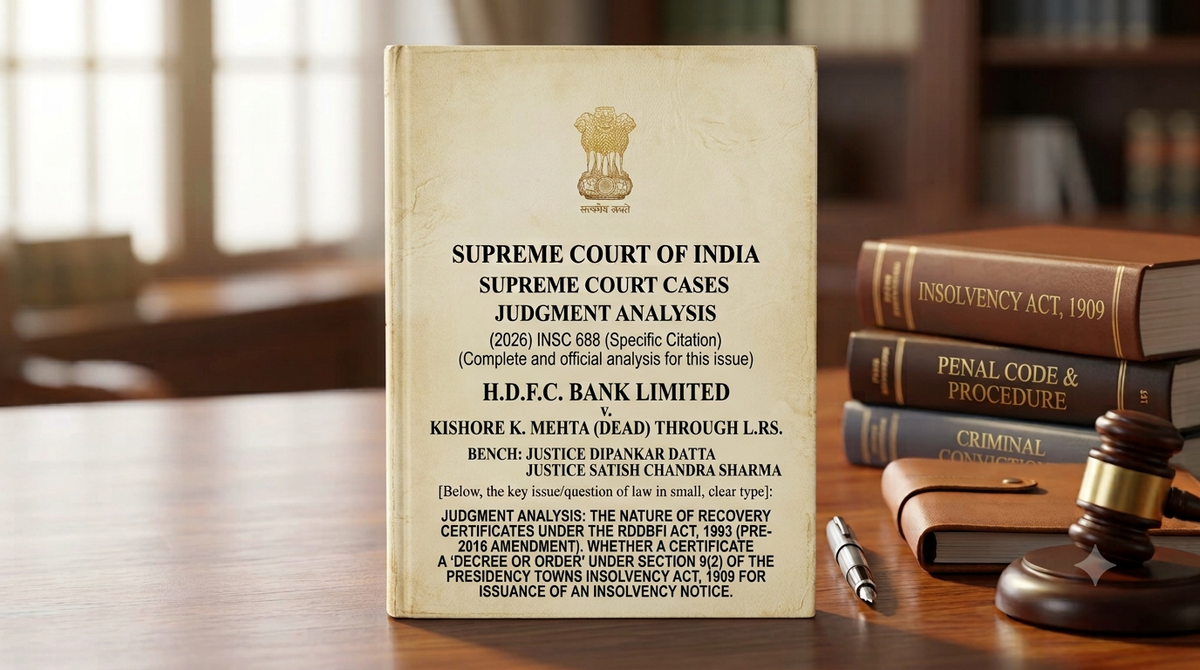
H.D.F.C. Bank Limited v. Kishore K. Mehta (Dead) Through L.Rs.
(2026) INSC 688
Key Issue / Question of Law
Whether a recovery certificate issued by a Debts Recovery Tribunal under the Recovery of Debts Due to Banks and Financial Institutions Act, 1993 (pre-2016 amendment) constitutes a 'decree or order' within the meaning of Section 9(2) of the Presidency Towns Insolvency Act, 1909, so as to form the basis for issuance of an insolvency notice.
Ratio Decidendi
A recovery certificate issued by a DRT under the pre-amended RDB Act, 1993 does not constitute a 'decree or order' for the purposes of Section 9(2) of the Presidency Towns Insolvency Act, 1909. The Insolvency Act must be strictly construed as it has grave civil consequences. The term 'decree or order' refers to decrees and orders of civil courts, not orders of statutory tribunals. The 2016 amendment to Section 19(22A) of the RDB Act, which deems a recovery certificate to be a decree or order for insolvency proceedings, is prospective and does not apply to recovery certificates issued prior to the amendment. The law as it stood on the date of institution of proceedings governs the rights of the parties.
Holding / Decision
The Supreme Court dismissed the appeal. It held that the insolvency notice issued on the basis of a pre-2016 recovery certificate was invalid. The Court affirmed the High Court's decision, following Paramjeet Singh Patheja v. ICDS Ltd. (2006) 13 SCC 322. The Court noted that the 2016 amendment to Section 19(22A) of the RDB Act was prospective and did not apply to the present case. The appeal was dismissed, and the proceedings in the notice of motion were closed qua the deceased original respondent.
Background & Facts
The original respondent, Kishore K. Mehta, was a director of Beautiful Diamonds Ltd., which had availed credit facilities from a consortium of 15 banks, including HDFC Bank. He executed personal guarantees. Upon default, HDFC Bank approached the DRT, Mumbai, which issued a recovery certificate for Rs. 14.74 crores on 30.11.2004. Based on this recovery certificate, the Insolvency Registrar issued an insolvency notice under Section 9(2) of the Presidency Towns Insolvency Act, 1909. The respondent challenged the notice before the Bombay High Court, which held that a recovery certificate could not form the basis of an insolvency notice. The Division Bench affirmed. HDFC Bank appealed to the Supreme Court. During the pendency of the appeal, the original respondent died, and his legal representatives were substituted.
Statutes Involved
- Section 9(2), Presidency Towns Insolvency Act, 1909 — defines act of insolvency where creditor obtains a decree or order for payment of money and debtor fails to comply with insolvency notice
- Section 19(22A), Recovery of Debts Due to Banks and Financial Institutions Act, 1993 (inserted in 2016) — deems recovery certificate issued by DRT to be decree or order for initiation of insolvency proceedings
- Section 2(2), Code of Civil Procedure, 1908 — defines 'decree' as formal expression of adjudication by a court in a suit
- Section 2(14), Code of Civil Procedure, 1908 — defines 'order' as formal expression of any decision of a civil court
Full Analysis
The Supreme Court began by noting the core issue: whether a recovery certificate issued by a DRT under the pre-amended RDB Act, 1993 constitutes a 'decree or order' under Section 9(2) of the Presidency Towns Insolvency Act, 1909. The Court observed that the High Court had relied on Paramjeet Singh Patheja v. ICDS Ltd. (2006) 13 SCC 322, where this Court held that an arbitral award is not a 'decree or order' for the purposes of Section 9(2).
The Court first examined the language of Section 9(2). It noted that the provision uses the words 'decree or order' but does not explicitly say 'decree or order of a court'. The appellant argued that this omission indicated a legislative intent to include orders of statutory tribunals. However, the Court rejected this argument, holding that the Insolvency Act must be strictly construed because it has grave civil consequences, effectively amounting to 'civil death' for the debtor. The Court relied on the definition of 'decree' and 'order' under the Code of Civil Procedure, 1908, which are formal expressions of adjudication by a civil court. The Court noted that the Insolvency Act itself uses the phrase 'decree of any court' in Section 9(1)(e) and (h), indicating that Parliament was conscious of the distinction between court decrees and other orders. The 1978 amendment introducing Section 9(2) did not change this fundamental meaning.
The Court then addressed the appellant's reliance on the 2016 amendment to Section 19(22A) of the RDB Act, which explicitly deems a recovery certificate to be a 'decree or order' for the purposes of insolvency proceedings. The Court held that this amendment actually undermined the appellant's case. The fact that Parliament found it necessary in 2016 to insert this provision was clear legislative recognition that such equivalence did not exist earlier. The amendment was prospective, not retrospective. The Court relied on the principle that the rights of parties must be determined on the basis of the law as it stood on the date of institution of proceedings. Citing Rameshwar v. Jot Ram (AIR 1976 SC 49) and Beg Raj Singh v. State of U.P. (2003) 1 SCC 726, the Court held that a claim which was untenable on the date of institution cannot become tenable due to a subsequent amendment.
The Court also addressed the appellant's submission that Paramjeet Singh Patheja was doubted in Sundaram Finance Ltd. v. Ashok D. Soniminde, but noted that a 3-Judge Bench had subsequently held that the judgment does not require reconsideration.
The Court further noted that even if Section 19(22A) were to apply, it would not aid the appellant because the stage of 'initiation of proceedings' did not fructify, as the insolvency notice itself was quashed. The Court dismissed the appeal and closed the proceedings in the notice of motion qua the deceased original respondent. The Court clarified that the appellant could pursue remedies against the other certificate debtors (the deceased's sons) if not barred by limitation.
This judgment reinforces the strict interpretation of insolvency statutes and clarifies that recovery certificates from DRTs, prior to the 2016 amendment, cannot form the basis of insolvency notices. It also affirms the prospective application of amendments that create new rights or remedies.
Practical Implications for Advocates
1. For banks and financial institutions: Before issuing an insolvency notice under Section 9(2) of the Presidency Towns Insolvency Act, 1909, check whether the recovery certificate was issued before or after the 2016 amendment to Section 19(22A) of the RDB Act, 1993. Pre-2016 certificates cannot support insolvency proceedings.
2. For debtors facing insolvency notices: If the notice is based on a DRT recovery certificate issued before 2016, immediately challenge the notice on the ground that a recovery certificate is not a 'decree or order' under Section 9(2). The judgment in Paramjeet Singh Patheja and this case provide a complete defence.
3. For counsel advising on post-2016 certificates: While this judgment did not decide the validity of post-2016 certificates, the insertion of Section 19(22A) appears to permit such certificates to be treated as decrees. However, the exact scope and applicability remain to be tested.
4. For litigants: The principle that rights are determined on the date of institution of proceedings is now firmly reaffirmed. A subsequent amendment cannot revive a claim that was untenable at the time of filing.
5. For insolvency practitioners: This judgment reinforces that insolvency statutes must be strictly construed. Any ambiguity in the definition of 'decree or order' must be resolved in favour of the debtor, given the grave consequences of insolvency.
Advocate's Note — Agarawal Associates
As senior counsel at Agarawal Associates, this judgment offers critical guidance on the interplay between recovery proceedings and insolvency. First, for banks and financial institutions, this is a stark reminder that a DRT recovery certificate, by itself, is not a 'decree or order' for insolvency purposes unless the recovery certificate was issued after the 2016 amendment to Section 19(22A) of the RDB Act. If you are relying on a pre-2016 certificate, you cannot issue an insolvency notice under the Presidency Towns Insolvency Act, 1909. Second, for debtors, this judgment provides a strong defence against insolvency notices based on DRT recovery certificates issued before 2016. Raise the Paramjeet Singh Patheja principle at the earliest opportunity. Third, the Court's reliance on the prospective application of amendments is a reminder that you must always check the date of the certificate. A post-2016 certificate may now support insolvency proceedings, but the Court did not decide that question. Fourth, the judgment underscores the strict construction of insolvency statutes. The Insolvency Act has grave consequences, and courts will not expand its scope by implication. Fifth, tactically, if you are representing a bank, consider whether you can obtain a fresh recovery certificate post-2016 to avail of the new provision. If you are representing a debtor, any pre-2016 certificate is a complete answer to an insolvency notice. The dismissal of the appeal, despite the death of the respondent, also confirms that insolvency proceedings do not abate on death, but the Court left the issue of substitution of other certificate debtors open.
Key Conditional Rule / Important Caveat
This judgment applies where a recovery certificate was issued by a DRT prior to the 2016 amendment to Section 19(22A) of the RDB Act, 1993. Such a certificate is NOT a 'decree or order' under Section 9(2) of the Presidency Towns Insolvency Act, 1909, and cannot form the basis of an insolvency notice. If the recovery certificate was issued after the 2016 amendment, it may be deemed a decree or order, subject to the specific facts and applicability of the amendment. The law as it stood on the date of institution of proceedings governs.
Cases Cited
- Paramjeet Singh Patheja v. ICDS Ltd. (2006) 13 SCC 322 — Held that an arbitral award is not a 'decree or order' under Section 9(2) of the Presidency Towns Insolvency Act, 1909; applied in this case to hold that a DRT recovery certificate is also not a 'decree or order'.
- Sundaram Finance Ltd. v. Ashok D. Soniminde — Doubted Paramjeet Singh Patheja but a 3-Judge Bench later held that reconsideration was not required.
- Rameshwar v. Jot Ram AIR 1976 SC 49 — Cited for the principle that the right to relief must be judged on the date the action is instituted.
- Beg Raj Singh v. State of U.P. (2003) 1 SCC 726 — Cited for the principle that rights crystallise on the date of commencement of litigation.
Courtroom Arguments
For Petitioner
Recovery Certificate Is a Decree or Order — (2026) INSC 688
A recovery certificate issued by the DRT under the RDB Act, 1993 is a statutory order that is equivalent to a decree, and Parliament's deliberate omission of the phrase 'of any court' in Section 9(2)…
For Respondent
Recovery Certificate Is Not a Decree or Order — (2026) INSC 688
A recovery certificate issued by the DRT is not a 'decree or order' under Section 9(2) of the Insolvency Act. The term 'decree or order' refers only to decrees and orders of civil courts.
More Commercial Law Judgments
View All →State of Haryana & Ors. v. M/s. Faridabad Gurgaon Minerals & Anr.
(2026) INSC 690
13 Jul 2026
State of Haryana & Ors. v. M/s. Jai Durgaa Finvest P. Ltd.
(2026) INSC 678
13 Jul 2026
State of Himachal Pradesh v. M/S Kundlas Loh Udyog
(2026) INSC 534
25 May 2026
Punjab State Power Corporation Limited v. Talwandi Sabo Power Limited
(2026) INSC 515
20 May 2026
Found this useful? Share it with your colleagues.
One tap sends the case name, citation, key issue and link.
Take This Further in Court
2 courtroom argument frameworks available for this case — full submission structure, bench question simulator, and opposition rebuttals.
Disclaimer: This summary is prepared by Agarawal Associates for informational purposes only. It does not constitute legal advice. For legal matters, consult a qualified advocate. © 2026 Agarawal Associates — apexdigest.in