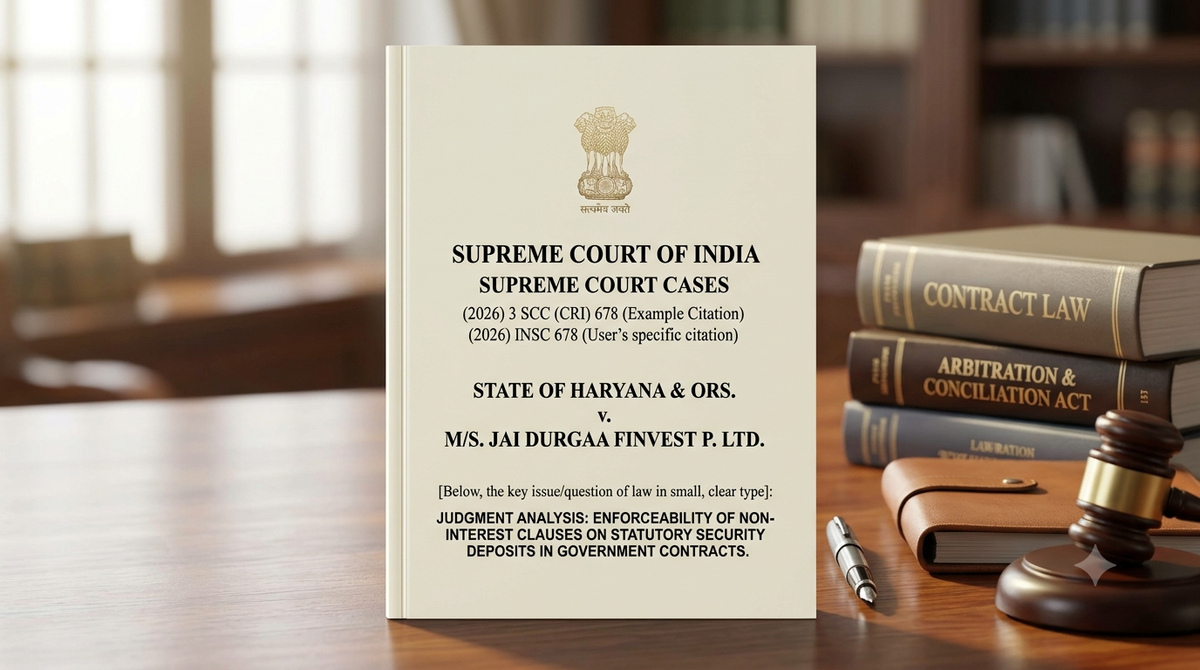
State of Haryana & Ors. v. M/s. Jai Durgaa Finvest P. Ltd.
(2026) INSC 678
Key Issue / Question of Law
Whether the security deposit furnished by a contractor under a statutory contract will carry interest despite a specific contractual clause (Clause 19 of Form-L) that expressly states the deposit shall not carry any interest, and whether a High Court can declare such a clause unsustainable in law or against public policy.
Ratio Decidendi
A court will not rewrite a commercial contract merely because a term appears onerous; parties are bound by unambiguous terms voluntarily accepted with open eyes. Clause 19 of Form-L, which states that the security deposit shall carry no interest, is valid and binding. However, Clause 19 must be read as a whole: while no interest is payable during the subsistence of the contract, the State is obligated to refund the deposit within three months of determination or expiry. If the State retains the deposit beyond that three-month period, the contractor is entitled to interest from the expiry of that period until refund or adjustment.
Holding / Decision
The Supreme Court partly allowed the appeals. It set aside the High Court's declaration that Clause 19 was unsustainable in law and the direction for interest from the date of deposit. The Court held that Clause 19 is valid and no interest is payable on the security deposit up to the expiry of three months from the date of termination (i.e., up to 09.06.2000). The Respondent is entitled to simple interest at 9% per annum on the security deposit from 09.06.2000 until the date the amount was appropriated towards dues or refunded. No order as to costs.
Background & Facts
The Respondent was the highest bidder in an auction held on 06.04.1998 for extraction of sand from Bega Murthal Sand Zone, and executed a contract in Form-L under the Punjab Minor Minerals Concession Rules, 1964. The contract was for three years up to 31.03.2001. The Respondent defaulted on monthly instalments from September 1999, leading to termination of the contract on 09.03.2000 and forfeiture of the security deposit. The Respondent challenged the termination and sought interest on the security deposit, contending Clause 19 was unconscionable. The High Court declared Clause 19 unsustainable in law and directed interest at 9% from the date of deposit. The State appealed to the Supreme Court.
Statutes Involved
- Rule 33, Punjab Minor Minerals Concession Rules, 1964 — provides for execution of an agreement in Form-L upon confirmation of a bid or acceptance of a tender
- Clause 1, Form-L, Punjab Minor Minerals Concession Rules, 1964 — requires contractor to pay contract money in advance to the Government on a monthly basis
- Clause 2, Form-L, Punjab Minor Minerals Concession Rules, 1964 — imposes interest at 24% per annum on delayed payment of contract money
- Clause 16, Form-L, Punjab Minor Minerals Concession Rules, 1964 — provides for termination of contract and forfeiture of security deposit for default
- Clause 19, Form-L, Punjab Minor Minerals Concession Rules, 1964 — states that security deposit shall carry no interest and shall be refunded within three months from expiry or sooner determination of contract
Full Analysis
The Supreme Court began by framing the sole issue: whether the security deposit would carry interest despite Clause 19 of Form-L expressly stating otherwise. The Court noted that Form-L is a statutory form prescribed under Rules 28A and 33 of the Punjab Minor Minerals Concession Rules, 1964, and the Respondent had voluntarily participated in the open auction, emerged as the highest bidder, and executed the contract with full knowledge of its terms, including Clause 19.
The Court reaffirmed the well-settled principle that courts will not rewrite commercial contracts or substitute their own terms for those agreed upon by the parties. It cited National Highways Authority of India v. Ganga Enterprises (2003) 7 SCC 410 and Shri Hanuman Cotton Mills v. Tata Aircraft Ltd. (1969) 3 SCC 522 for the proposition that agreed forfeiture/security stipulations must be enforced according to their terms. The Court further relied on Venkataraman Krishnamurthy v. Lodha Crown Buildmart (2024) 4 SCC 230, which held that courts must interpret contracts as expressed by the parties and cannot make a new contract however reasonable.
The Court rejected the High Court's reasoning that Clause 19 was unsustainable in law or against public policy. It held that the clause was neither immoral nor unlawful, and public policy could not be invoked to override a commercial contract voluntarily entered into. The Court distinguished Clause 2 (interest on delayed payment) from Clause 19 (no interest on security deposit), noting they operate in different fields: Clause 2 is compensation for the contractor's default, while Clause 19 is a performance guarantee held by the State, with no reciprocal obligation to pay interest.
However, the Court gave a purposive interpretation to Clause 19 by reading its two limbs together. The first limb states the deposit shall carry no interest; the second limb requires refund within three months from expiry or sooner determination. The Court held that while no interest accrues during the subsistence of the contract, the State cannot retain the deposit in perpetuity. Once the contract is determined, the State must refund within three months. If it retains beyond that period, the contractor is entitled to interest from the expiry of that three-month period until refund or adjustment.
The Court noted that the termination of the contract on 09.03.2000 was due to the Respondent's own defaults, and this finding had attained finality, as the Respondent's earlier SLP had been dismissed. Therefore, the State was justified in retaining the deposit and adjusting it against outstanding dues, but only within the three-month period stipulated. For the period beyond 09.06.2000, the Respondent was entitled to interest.
The Court upheld the rate of 9% per annum fixed by the High Court as reasonable, but modified the period for which interest would be payable. The appeal was partly allowed, with the declaration that Clause 19 is valid and binding, and interest is payable only from 09.06.2000, not from the date of deposit. This judgment clarifies the distinction between the validity of a no-interest clause during the contract and the State's obligation to refund promptly upon termination, balancing contractual freedom with fairness.
Practical Implications for Advocates
1. For counsel representing contractors: Always examine the contract for a specified refund period for security deposits. Even if the contract says 'no interest', a delay beyond the refund period entitles your client to interest from that date onward.
2. For government departments: Ensure security deposits are refunded within the stipulated period after contract determination. Failure to do so will result in interest liability, even if the contract contains a 'no interest' clause.
3. For drafting government contracts: Include clear time limits for refund of security deposits. If the intention is to retain the deposit beyond determination for adjustment against dues, specify that clearly and ensure the adjustment is completed within the refund period.
4. For advocates challenging contractual clauses: Avoid relying on broad 'public policy' grounds unless the clause is clearly illegal or unconscionable. Courts will not rewrite commercial contracts merely because a term appears onerous. Focus on the text and context.
5. For counsel appearing in writ petitions: Where a party has voluntarily entered into a contract with open eyes, courts are reluctant to interfere. The challenge to the contract must be raised at the time of execution, not after major part of the contract has expired.
Advocate's Note — Agarawal Associates
As senior counsel at Agarawal Associates, this judgment offers critical tactical guidance for government contract disputes. First, when advising clients on statutory tenders, always flag clauses like Clause 19 that waive interest on security deposits. While the Court upheld the clause as valid, it also read a time limit into it — the State must refund within three months. This is a powerful lever: if the State delays refund beyond the stipulated period, interest becomes payable. Second, the Court reaffirmed that courts will not rewrite commercial contracts. Therefore, in drafting or challenging such clauses, focus on the text and the statutory context. Do not rely on vague 'public policy' arguments unless the clause is manifestly illegal or unconscionable in a substantive sense. The Court rejected the High Court's attempt to impose reciprocity merely because the State charges interest for default. Third, for government bodies, this judgment is a reminder that standard form contracts must be implemented strictly. If the clause says 'no interest', it is enforceable, but only for the duration of the contract; post-determination, the State must act promptly. Fourth, the Court's purposive interpretation — reading the two limbs of Clause 19 together — demonstrates that even a seemingly absolute clause can be interpreted to impose time-bound obligations on the State. Tactically, if you are representing a contractor, always argue that the refund period is a substantive obligation, and any delay beyond it entitles your client to interest, regardless of the 'no interest' stipulation. Conversely, if you are representing the State, ensure prompt refunds within the stipulated period to avoid interest liability. This judgment strengthens the position that contractual terms must be enforced as written, but also imposes a duty on the State not to retain money indefinitely without compensation.
Key Conditional Rule / Important Caveat
This judgment applies where a contract contains an express clause that the security deposit shall carry no interest and a separate clause requiring refund within a specified period after determination. The 'no interest' stipulation is valid during the subsistence of the contract and for the refund period specified. If the State retains the deposit beyond the refund period, interest is payable from the expiry of that period. If the contract does not specify a refund period, or if the delay is attributable to the contractor's own conduct, this judgment may not apply.
Cases Cited
- National Highways Authority of India v. Ganga Enterprises (2003) 7 SCC 410 — Used to support the principle that agreed forfeiture/security stipulations are to be enforced according to contract terms.
- Shri Hanuman Cotton Mills v. Tata Aircraft Ltd. (1969) 3 SCC 522 — Cited for the proposition that courts will not rewrite contracts.
- Venkataraman Krishnamurthy v. Lodha Crown Buildmart Pvt. Ltd. (2024) 4 SCC 230 — Cited to reaffirm that courts interpret contracts as expressed and cannot create new contracts.
Courtroom Arguments
For Petitioner
Clause 19 Valid Binding Contract Term No Interest — (2026) INSC 678
Clause 19 of Form-L, which stipulates that the security deposit shall carry no interest, is a valid and binding contractual term voluntarily accepted by the Respondent.
For Respondent
Clause 19 Unconscionable State Must Pay Interest — (2026) INSC 678
Clause 19 is unconscionable and against public policy because it allows the State to retain the contractor's security deposit without any interest while charging 24% interest on delayed payments.
More Commercial Law Judgments
View All →State of Haryana & Ors. v. M/s. Faridabad Gurgaon Minerals & Anr.
(2026) INSC 690
13 Jul 2026
H.D.F.C. Bank Limited v. Kishore K. Mehta (Dead) Through L.Rs.
(2026) INSC 688
13 Jul 2026
State of Himachal Pradesh v. M/S Kundlas Loh Udyog
(2026) INSC 534
25 May 2026
Punjab State Power Corporation Limited v. Talwandi Sabo Power Limited
(2026) INSC 515
20 May 2026
Found this useful? Share it with your colleagues.
One tap sends the case name, citation, key issue and link.
Take This Further in Court
2 courtroom argument frameworks available for this case — full submission structure, bench question simulator, and opposition rebuttals.
Disclaimer: This summary is prepared by Agarawal Associates for informational purposes only. It does not constitute legal advice. For legal matters, consult a qualified advocate. © 2026 Agarawal Associates — apexdigest.in