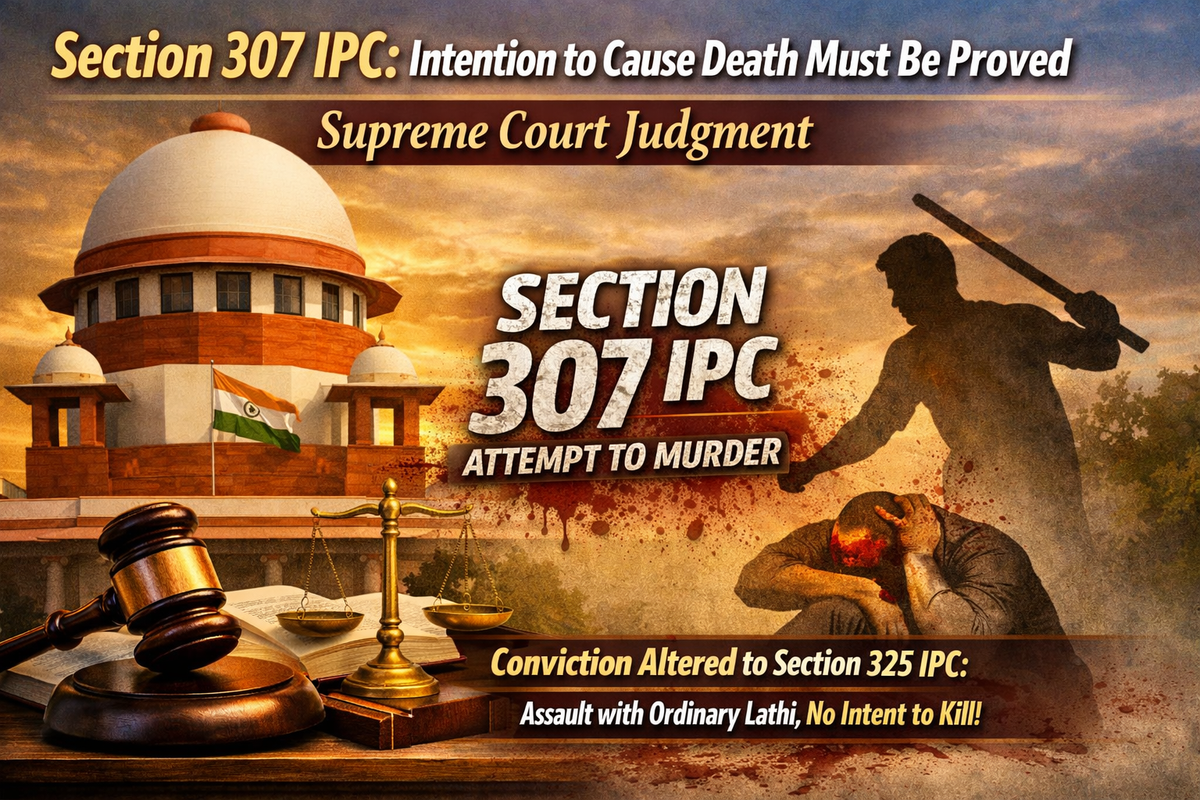
Roshan Lal v. State of Haryana
(2026) INSC 524
Key Issue / Question of Law
Whether the appellants, who inflicted lathi blows on the victim's head resulting in fractures and prolonged hospitalization, can be convicted under Section 307 of the Indian Penal Code, 1860 (attempt to murder) when the assault arose spontaneously without premeditation, and whether the conviction should be altered to Section 325 (voluntarily causing grievous hurt) in the absence of proven intention to cause death.
Ratio Decidendi
To sustain a conviction under Section 307 of the Indian Penal Code, 1860, the prosecution must establish the requisite intention or knowledge to commit murder, not merely that the injuries were grievous or dangerous to life. Intention can be inferred from surrounding circumstances — the type of weapon, words spoken, motive, body parts targeted, nature of injuries, and force of blows. Where there is no history of enmity, the assault arises spontaneously from an intervention in an altercation, the weapon is an ordinary lathi (not inherently deadly), and there is no evidence of persistent brutal assault or premeditation, the intention to cause death cannot be presumed. However, where the injuries include fractures of parietal bones, neurological complications, and prolonged hospitalization, the offence falls under Section 325 IPC (grievous hurt) as per Clauses Seventhly and Eighthly of Section 320 IPC. The conviction under Section 307 read with Section 34 IPC can be altered to Section 325 read with Section 34 IPC.
Holding / Decision
The Supreme Court partly allowed the appeals, altering the conviction of the appellants from Section 307 read with Section 34 of the Indian Penal Code, 1860 to Section 325 read with Section 34 IPC. The Court held that the prosecution failed to prove the requisite intention to commit murder under Section 307 IPC, as the assault arose spontaneously without premeditation, the weapons were ordinary lathis, and there was no evidence of persistent brutal assault. However, the appellants voluntarily caused grievous hurt, including fractures of parietal bones, satisfying Section 325 IPC. The sentence was reduced to the period already undergone (ranging from 1 year 1 month to 2 years 8 months) with a fine of Rs. 50,000 each to be paid to the victim.
Background & Facts
On 5 June 2000, Amar Singh (PW3), a night watchman, intervened when he saw a group of persons assaulting an individual. The accused persons — Roshan Lal, Sajjan Singh, and Satya Prakash — acting in furtherance of common intention, turned upon him. Sajjan Singh inflicted a lathi blow on his head, Satya Prakash struck his right hand with a lathi, and Roshan Lal also delivered a lathi blow on his head. The victim suffered fractures in both parietal bones near the midline, neurological complications, multi-organ failure, and prolonged hospitalization. The Trial Court convicted the three accused under Section 307 read with Section 34 IPC and Section 506 IPC. The High Court affirmed the conviction. The accused appealed to the Supreme Court, arguing that the intention to cause death was not established.
Statutes Involved
- Section 307, Indian Penal Code, 1860 — Punishes attempt to murder; requires intention or knowledge to cause death under circumstances that, if death ensued, would constitute murder
- Section 325, Indian Penal Code, 1860 — Punishes voluntarily causing grievous hurt with imprisonment up to seven years and fine
- Section 320, Indian Penal Code, 1860 — Defines 'grievous hurt', including fracture or dislocation of a bone (Clause Seventhly) and any hurt which endangers life or causes severe pain or inability to follow ordinary pursuits for twenty days (Clause Eighthly)
- Section 34, Indian Penal Code, 1860 — Provides for acts done by several persons in furtherance of common intention
- Section 506, Indian Penal Code, 1860 — Punishes criminal intimidation
- Probation of Offenders Act, 1958 — Provides for release of offenders on probation for good conduct (relied upon by the appellant but not granted)
- Section 313, Code of Criminal Procedure, 1973 — Provides for examination of accused
Full Analysis
Premium Content
Subscribe to access the full analysis, practical implications, and related case mapping.
Subscribe — ₹99/monthAlready a subscriber? Sign inAdvocate's Note — Agarawal Associates
Professional insight for advocates on how to deploy this judgment in practice...
Subscribe to access the Advocate's Note.
Key Conditional Rule / Important Caveat
This judgment applies ONLY where (a) the accused is charged with attempt to murder under Section 307 IPC, (b) the assault is spontaneous without premeditation, (c) the weapon used is not inherently deadly (e.g., ordinary lathi, not a knife, gun, or sharp weapon), (d) there is no evidence of prior enmity or intention to kill, and (e) the injuries, though grievous, do not clearly establish an intention to cause death. In such circumstances, the conviction under Section 307 IPC may be altered to Section 325 IPC (grievous hurt). The judgment does NOT apply where (a) the weapon is inherently deadly (knife, gun, sword), (b) there is evidence of premeditation or prior enmity, (c) the accused made statements indicating intention to kill, or (d) the assault was on a vital part with repeated brutal blows demonstrating a clear intention to cause death. The severity of the injury alone is not sufficient to prove intention under Section 307 IPC.
Cases Cited
- Dalbir Kaur v. State of Punjab (1976) 4 SCC 158 — Laid down principles for interference by Supreme Court in criminal appeals with concurrent findings of fact.
- State of Madhya Pradesh v. Saleem @ Chamaru (2005) 5 SCC 554 — Held that to justify conviction under Section 307 IPC, it is not essential that bodily injury capable of causing death should have been inflicted; intention may be deduced from other circumstances.
- Bipin Bihari v. State of M.P. (2006) 8 SCC 799 — Reiterated that an attempt in order to be criminal need not be the penultimate act; intention coupled with some overt act is sufficient.
- Prakash Chandra Yadav v. State of Bihar 2007 (4) RCR (Crl.) 860 — Cited by High Court for the proposition that nature or extent of injury is not determinative for Section 307 IPC.
Courtroom Arguments
For Petitioner
No Intention to Cause Death, Conviction Under Section 307 Unsustainable — (2026) INSC 524
The appellants caused injuries in a spontaneous altercation without premeditation or intention to kill. The weapons used were ordinary lathis, not deadly weapons.
For Respondent
Lathi Blows on Head Show Intention to Cause Death Under Section 307 IPC — (2026) INSC 524
The appellants inflicted multiple lathi blows on the victim's head, a vital part of the body.
More Criminal Law Judgments
View All →Found this useful? Share it with your colleagues.
One tap sends the case name, citation, key issue and link.
Take This Further in Court
2 courtroom argument frameworks available for this case — full submission structure, bench question simulator, and opposition rebuttals.
Disclaimer: This summary is prepared by Agarawal Associates for informational purposes only. It does not constitute legal advice. For legal matters, consult a qualified advocate. © 2026 Agarawal Associates — apexdigest.in