Papan Sarkar @ Pranab v. State of West Bengal
(2026) INSC 528
Key Issue / Question of Law
Whether the conviction of the appellants for murder under Section 302 of the Indian Penal Code, 1860 based on circumstantial evidence — including last seen together theory, extra-judicial confession, and recovery of weapons — is sustainable when the time gap between the last sighting and death is not proximate, the extra-judicial confession was made under duress and is inconsistent among witnesses, and the recoveries do not satisfy the requirements of Section 27 of the Indian Evidence Act, 1872.
Ratio Decidendi
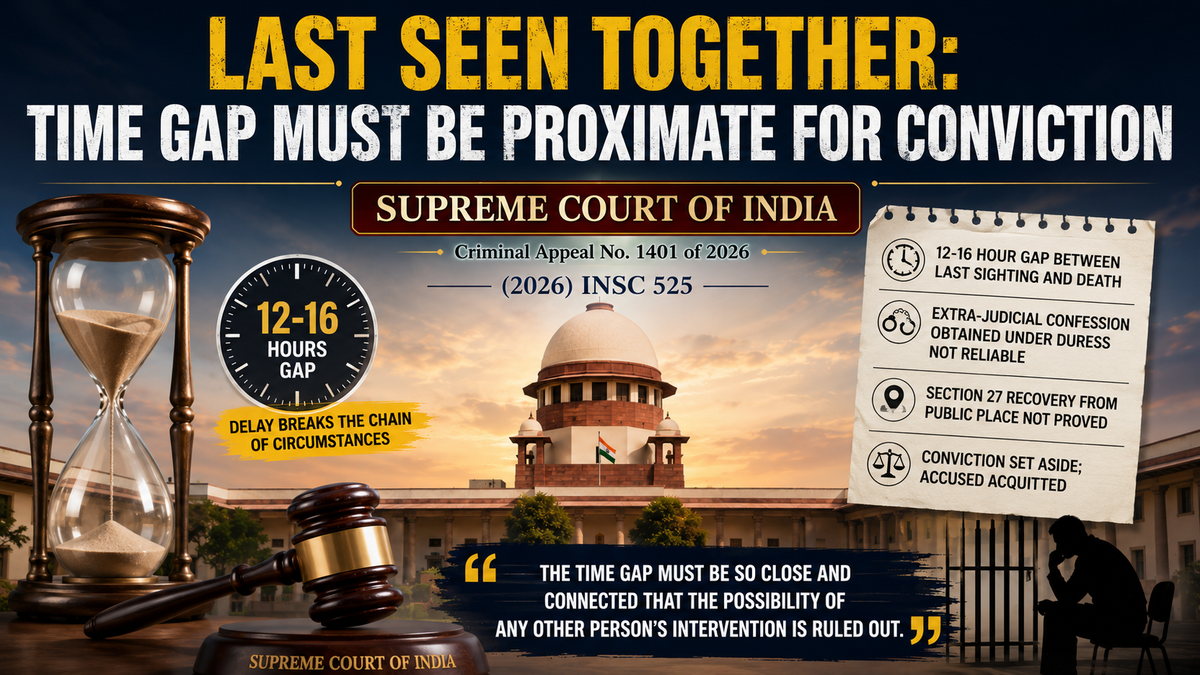
For the last seen together theory to be an incriminating circumstance, the time gap between the accused and the deceased being last seen together and the death must be proximate. If the time gap is large, there could be intervening circumstances that snap the link and prevent an adverse inference against the accused. An extra-judicial confession is a weak piece of evidence; when made under duress (such as when the accused is detained by a mob and has injuries on his body), it loses credibility. Inconsistent statements among witnesses regarding the confession further weaken it. For a recovery to be admissible under Section 27 of the Indian Evidence Act, 1872, there must be a statement from the accused indicating concealment and knowledge of the concealed object, and the recovery must be made pursuant to that statement. Mere recovery of objects from a public place with free access does not satisfy Section 27. The chain of circumstances must be complete and must exclude every hypothesis of innocence. The absence of motive, though not imperative when the chain is complete, is an additional factor raising reasonable doubt when other circumstances are weak.
Holding / Decision
The Supreme Court allowed the appeals of A1 and A2, set aside the judgments of the Trial Court and the High Court, and acquitted them. The Court held that the last seen together theory failed due to the non-proximate time gap between last sighting (5 PM on 30 October 2012) and death (anytime between 5 PM and discovery at 10 AM on 31 October 2012). The extra-judicial confession was inconsistent among witnesses and made under duress. The recoveries did not satisfy Section 27 of the Indian Evidence Act, 1872 as there was no evidence of concealment. The Court directed the National Legal Services Authority to assist A3 (who had not appealed) to file an appeal.
Background & Facts
The son of the de-facto complainant (PW1) went missing on the evening of 30 October 2012. On the next day, his dead body was found in a field, head down with legs sticking up from a ditch. Three companions who were seen drinking and roaming with the deceased were arrested as accused. The prosecution relied on the last seen together theory (PW1, PW14), extra-judicial confession (PW3, PW8, PW12, PW14), recovery of a stone and glass piece from the place of occurrence, and recovery of the deceased's motorcycle. The trial court convicted all three accused under Section 302 read with Section 34 IPC. The High Court confirmed the conviction. Two accused (A1 and A2) appealed to the Supreme Court. The third accused (A3) did not file an appeal.
Statutes Involved
- Section 302, Indian Penal Code, 1860 — Punishes murder with death or imprisonment for life and fine
- Section 34, Indian Penal Code, 1860 — Provides for acts done by several persons in furtherance of common intention
- Section 27, Indian Evidence Act, 1872 — Provides that when a fact is deposed to as discovered in consequence of information received from an accused person in police custody, so much of such information as relates distinctly to the fact thereby discovered may be proved
- Section 24, Indian Evidence Act, 1872 — Provides that a confession made by an accused under inducement, threat or promise is irrelevant in a criminal proceeding
- Section 25, Indian Evidence Act, 1872 — Provides that no confession made to a police officer shall be proved against a person accused of any offence
- Section 26, Indian Evidence Act, 1872 — Provides that no confession made by a person while in police custody shall be proved against him unless made in immediate presence of a Magistrate
- Article 136, Constitution of India — Confers discretionary power on the Supreme Court to grant special leave to appeal
Full Analysis
Premium Content
Subscribe to access the full analysis, practical implications, and related case mapping.
Subscribe — ₹99/monthAlready a subscriber? Sign inAdvocate's Note — Agarawal Associates
Professional insight for advocates on how to deploy this judgment in practice...
Subscribe to access the Advocate's Note.
Key Conditional Rule / Important Caveat
This judgment applies ONLY where (a) the prosecution relies on circumstantial evidence including last seen together theory, (b) the time gap between the last sighting of the accused with the deceased and the death is not proximate (e.g., more than a few hours), (c) the extra-judicial confession is inconsistent among witnesses or made under duress, (d) the recoveries under Section 27 do not establish concealment, or (e) the weapons recovered are not linked to the injuries through medical evidence. If the time gap is very short (e.g., the deceased was last seen with the accused minutes before death), the last seen together theory may be sufficient. If the extra-judicial confession is consistent, voluntary, and made to a credible witness, it may be relied upon. If the recovery is from a concealed location and the accused's statement leads to the discovery of unknown facts, Section 27 may be satisfied. The judgment does NOT apply where the chain of circumstances is complete and excludes every hypothesis of innocence.
Cases Cited
- State of Goa v. Sanjay Thakran (2007) 3 SCC 755 — Held that for the last seen together theory to be incriminating, the time gap between the last sighting and death must be proximate; if the gap is large, intervening circumstances may snap the link.
Courtroom Arguments
For Petitioner
Time Gap Too Large, Confession Under Duress, Recovery Invalid — (2026) INSC 528
The time gap between the last sighting of the deceased with the accused (5 PM) and the death (anytime between 5 PM and 10 AM next day) is not proximate.
For Respondent
Complete Chain of Circumstances Establishes Guilt — (2026) INSC 528
The last seen together theory, extra-judicial confession, recovery of weapons and motorcycle form a complete chain of circumstances pointing only to the guilt of the accused.
More Criminal Law Judgments
View All →Found this useful? Share it with your colleagues.
One tap sends the case name, citation, key issue and link.
Take This Further in Court
2 courtroom argument frameworks available for this case — full submission structure, bench question simulator, and opposition rebuttals.
Disclaimer: This summary is prepared by Agarawal Associates for informational purposes only. It does not constitute legal advice. For legal matters, consult a qualified advocate. © 2026 Agarawal Associates — apexdigest.in