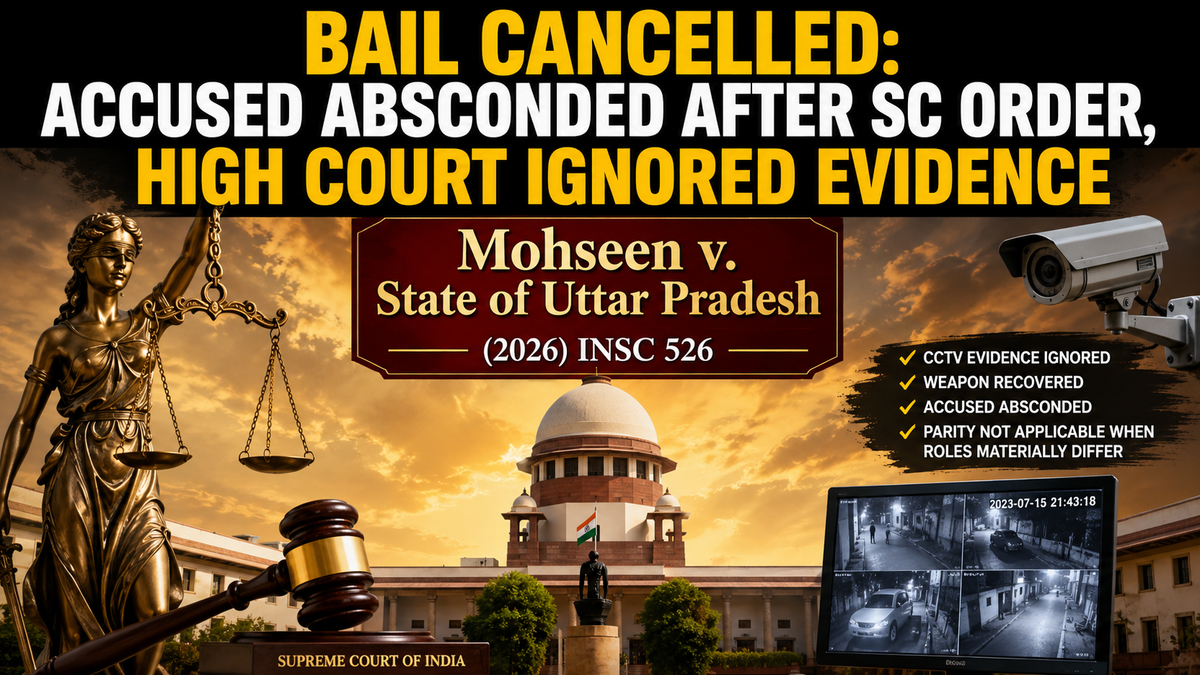
Mohseen v. State of Uttar Pradesh
(2026) INSC 526
Key Issue / Question of Law
Whether the High Court was justified in granting bail to an accused charged with offences under Sections 307, 147, 148, 149, 323, 324, 452, 504, 506 IPC and Sections 3, 25, 27 of the Arms Act, 1959, where the accused had earlier been granted bail and that bail was cancelled by the Supreme Court, the accused absconded for 42 days after the cancellation order, CCTV footage showed him brandishing a pistol and gunshots were heard, a pistol and cartridge were recovered at his instance, and the co-accused whose bail was cited for parity had a materially different role.
Ratio Decidendi
When a High Court grants bail to an accused whose bail was previously cancelled by the Supreme Court, the grant must be supported by reasons demonstrating either a change in circumstances or the existence of fresh grounds not considered at the time of cancellation. The conduct of the accused after cancellation of bail — including failure to surrender and absconding — is a crucial factor weighing against fresh grant of bail. The principle of parity in bail is not an inflexible rule and cannot be mechanically applied when the roles of accused persons are materially different. Bail orders must be reasoned and engage with material evidence such as CCTV footage, recovery of weapons, and witness statements. Mere delay in lodging FIR or absence of firearm injuries does not negate a charge under Section 307 IPC if the act was done with intent or knowledge that it could cause death.
Holding / Decision
The Supreme Court allowed the appeal, set aside the impugned order of the Allahabad High Court dated 22 September 2025 granting bail to Respondent No. 2 (Jeeshan), and cancelled the bail. The Court held that the High Court failed to engage with the earlier bail cancellation order of the Supreme Court, ignored the conduct of the accused in absconding for 42 days, overlooked CCTV evidence and recovery of the weapon, and erroneously applied the principle of parity without considering the materially different role of the co-accused. The Respondent No. 2 was directed to surrender forthwith.
Background & Facts
The appellant's brother was murdered, and co-accused Aabaad and Aurangzeb were convicted and sentenced to life imprisonment in that murder case. On 12 May 2024, when the appellant's uncle and cousin were returning home, the accused persons (Aurangzeb, Aabaad, Jeeshan, Arbaz, Shahnawaz) intercepted them and demanded withdrawal of the murder case. They assaulted the victims with lathi, danda, knife, and tamancha (country-made pistol). CCTV footage showed Jeeshan arriving on a motorcycle, entering his house, retrieving a pistol, brandishing it, and gunshots being heard. A .315 bore pistol and a live cartridge were recovered at his instance. The High Court granted bail. This Court had previously cancelled Jeeshan's earlier bail on 27 January 2025, after which he absconded for 42 days before surrendering. The informant appealed to the Supreme Court.
Statutes Involved
- Section 307, Indian Penal Code, 1860 — Punishes attempt to murder with imprisonment up to ten years or life imprisonment if hurt is caused
- Section 147, Indian Penal Code, 1860 — Punishes rioting
- Section 148, Indian Penal Code, 1860 — Punishes rioting armed with deadly weapon
- Section 149, Indian Penal Code, 1860 — Provides for constructive liability for unlawful assembly
- Section 323, Indian Penal Code, 1860 — Punishes voluntarily causing hurt
- Section 324, Indian Penal Code, 1860 — Punishes voluntarily causing hurt by dangerous weapons or means
- Section 452, Indian Penal Code, 1860 — Punishes house-trespass after preparation for hurt, assault, or wrongful restraint
- Section 504, Indian Penal Code, 1860 — Punishes intentional insult with intent to provoke breach of peace
- Section 506, Indian Penal Code, 1860 — Punishes criminal intimidation
- Section 3, Arms Act, 1959 — Provides for licence for manufacture, sale, etc., of arms and ammunition
- Section 25, Arms Act, 1959 — Provides for punishment for certain offences under the Act
- Section 27, Arms Act, 1959 — Provides for punishment for using arms, etc.
- Section 82, Code of Criminal Procedure, 1973 — Provides for proclamation for person absconding
- Article 136, Constitution of India — Confers discretionary power on Supreme Court to grant special leave to appeal
Full Analysis
Premium Content
Subscribe to access the full analysis, practical implications, and related case mapping.
Subscribe — ₹99/monthAlready a subscriber? Sign inAdvocate's Note — Agarawal Associates
Professional insight for advocates on how to deploy this judgment in practice...
Subscribe to access the Advocate's Note.
Key Conditional Rule / Important Caveat
This judgment applies ONLY where (a) the accused's bail was previously cancelled by the Supreme Court, (b) the High Court grants fresh bail without identifying any change in circumstances or fresh grounds, (c) the accused failed to surrender or absconded after the cancellation order, (d) there is material evidence (CCTV, recovery of weapon, witness statements) establishing a prima facie case, and (e) the High Court's order is cryptic or fails to engage with crucial evidence. The judgment does NOT apply where (a) the Supreme Court's earlier order was not a cancellation of bail but a dismissal of a bail application, (b) there is a genuine change in circumstances (e.g., completion of investigation, change in witness testimony), (c) the accused surrendered immediately after the cancellation order, or (d) the High Court's order is detailed and engages with all material evidence. The principle of parity is not an absolute bar; if the co-accused's role is identical, parity may be applicable, but if the roles are materially different, it is not.
Cases Cited
- Ajwar v. Waseem (2024) 10 SCC 768 — Held that an unreasoned or perverse order of bail is always open to interference by a superior court; bail can be revoked if courts below have ignored relevant material or the gravity of the offence.
- Prasanta Kumar Sarkar v. Ashis Chatterjee (2010) 14 SCC 496 — Laid down the principles for assessing the correctness of a bail order, including prima facie case, nature and gravity of accusation, severity of punishment, danger of absconding, likelihood of influencing witnesses, etc.
- Neeru Yadav v. State of U.P. (2014) 16 SCC 508 — Held that the principle of parity in bail is not an inflexible rule and cannot be mechanically applied when the roles of the accused are materially different.
- Mahipal v. Rajesh Kumar (2020) 2 SCC 118 — Held that bail orders must reveal the factors that weighed with the Court for granting relief; a mere recitation of 'facts and circumstances' does not constitute a reasoned order.
- Sudha Singh v. State of Uttar Pradesh (2021) 4 SCC 781 — Held that courts must recognise the potential threat to the life and liberty of victims and witnesses if the accused is released on bail.
Courtroom Arguments
For Petitioner
High Court Ignored SC Order, Evidence, and Accused's Absconding — (2026) INSC 526
The High Court granted bail without engaging with the Supreme Court's earlier bail cancellation order, ignored CCTV evidence and recovery of the weapon, overlooked the accused's conduct of absconding…
For Respondent
No Firearm Injuries, Parity with Co-Accused, Bail Properly Granted — (2026) INSC 526
The High Court correctly granted bail considering the absence of firearm injuries, the delay in lodging FIR, the fact that the CCTV footage does not show the accused firing, and the principle of…
More Criminal Law Judgments
View All →Found this useful? Share it with your colleagues.
One tap sends the case name, citation, key issue and link.
Take This Further in Court
2 courtroom argument frameworks available for this case — full submission structure, bench question simulator, and opposition rebuttals.
Disclaimer: This summary is prepared by Agarawal Associates for informational purposes only. It does not constitute legal advice. For legal matters, consult a qualified advocate. © 2026 Agarawal Associates — apexdigest.in