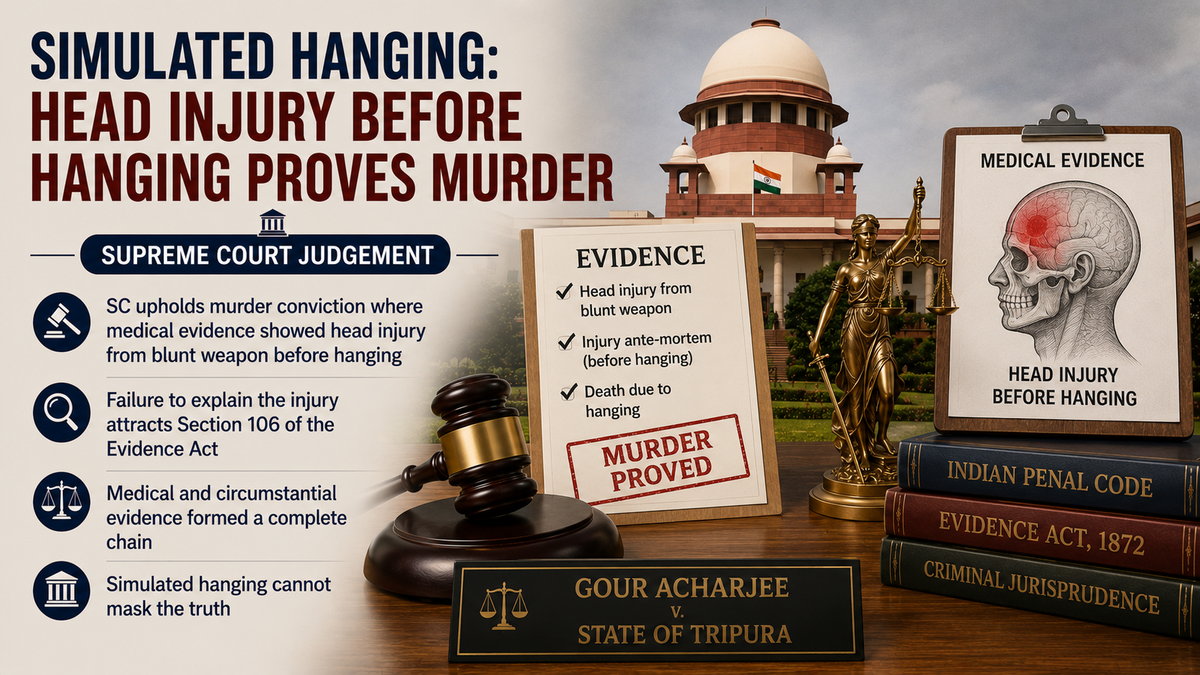
Gour Acharjee v. State of Tripura
(2026) INSC 535
Key Issue / Question of Law
Whether the conviction of the husband under Section 302 of the Indian Penal Code, 1860 for the murder of his wife is sustainable when the medical evidence establishes that the death was caused by head injury from a blunt weapon (hammer) and the body was subsequently hanged to simulate suicide, and when the husband failed to offer any explanation under Section 106 of the Indian Evidence Act, 1872 for the injuries sustained by the deceased inside the matrimonial home.
Ratio Decidendi
Where an offence like murder is committed in secrecy inside a house, the initial burden to establish the case is on the prosecution, but the nature and amount of evidence required is of a comparatively lighter character. In view of Section 106 of the Indian Evidence Act, 1872, there is a corresponding burden on the inmates of the house to give a cogent explanation as to how the crime was committed. If the accused does not offer any explanation for the injuries sustained by the deceased or offers an explanation that is found to be false, it is a strong circumstance indicating guilt. Medical evidence showing injuries inconsistent with suicidal hanging (absence of typical ligature mark, absence of congestion in conjunctiva and face, presence of ante-mortem head injury) and consistent with homicidal or simulated hanging is sufficient to establish homicidal death. Repeated dowry demands and torture, corroborated by multiple witnesses and panchayat resolutions, establish motive and cruelty under Section 498A IPC.
Holding / Decision
The Supreme Court dismissed the appeal, upholding the conviction of the appellant-husband under Section 302 IPC (life imprisonment) and Section 498A IPC (three years rigorous imprisonment). The Court held that the medical evidence clearly established homicidal hanging — the deceased died due to head injury caused by a blunt weapon (hammer) and was then put on hanging to simulate suicide. The appellant, who was present in the house at the time of death and who informed the father that the deceased had committed suicide, failed to offer any explanation under Section 106 of the Indian Evidence Act, 1872. The Court noted that the appellant was absconding and directed the Director General of Police, Tripura to take immediate steps to apprehend him.
Background & Facts
Soma Acharjee married the appellant about fifteen months before her death on 16 June 2007. She was subjected to persistent dowry demands — a motorcycle and cash — and was tortured by her husband, mother-in-law, and brother-in-law. Multiple panchayats were held where resolutions were passed, but the torture continued. On 16 June 2007, the appellant informed the father of the deceased that Soma had committed suicide by hanging. The postmortem revealed injuries on the chest, jaw, and head, with a depressed fracture of the occipital area. The doctor opined that the cause of death was head injury caused by a blunt weapon (hammer) and that the body was subsequently put on hanging — a case of homicidal hanging. The trial court convicted the appellant under Section 302 and Section 498A IPC. The High Court confirmed the conviction. The appellant appealed to the Supreme Court.
Statutes Involved
- Section 302, Indian Penal Code, 1860 — Punishes murder with death or imprisonment for life and fine
- Section 498A, Indian Penal Code, 1860 — Punishes cruelty by husband or relative of husband towards a woman
- Section 304B, Indian Penal Code, 1860 — Defines dowry death (charged but not ultimately applied by trial court)
- Section 34, Indian Penal Code, 1860 — Provides for acts done by several persons in furtherance of common intention
- Section 106, Indian Evidence Act, 1872 — Provides that when any fact is especially within the knowledge of any person, the burden of proving that fact is upon him
- Section 313, Code of Criminal Procedure, 1973 — Provides for examination of accused to explain incriminating circumstances
Full Analysis
Premium Content
Subscribe to access the full analysis, practical implications, and related case mapping.
Subscribe — ₹99/monthAlready a subscriber? Sign inAdvocate's Note — Agarawal Associates
Professional insight for advocates on how to deploy this judgment in practice...
Subscribe to access the Advocate's Note.
Key Conditional Rule / Important Caveat
This judgment applies ONLY where (a) the death occurs inside the matrimonial home, (b) the husband was present at the time of death or was the last person seen with the deceased, (c) the medical evidence establishes that the death was homicidal (e.g., head injury from blunt weapon, simulated hanging), (d) the accused fails to offer any explanation under Section 313 CrPC or Section 106 of the Evidence Act, and (e) there is evidence of prior dowry harassment. If the accused offers a plausible explanation (e.g., suicide, accidental death) and the medical evidence does not rule it out, the burden may not shift. The judgment does NOT apply where (a) the death occurred in a public place or where multiple persons had access, (b) the medical evidence is inconclusive or consistent with suicide, or (c) the accused provides a credible explanation under Section 313 CrPC. The principle of lighter burden on prosecution applies only in cases where the offence is committed in secrecy inside a house; it does not apply to open spaces.
Cases Cited
- Trimukh Maroti Kirkan v. State of Maharashtra (2006) 10 SCC 681 — Laid down the principle that in offences committed in secrecy inside a house, the burden on the prosecution is of a lighter character, and Section 106 of the Evidence Act places a corresponding burden on the inmates to give a cogent explanation.
- Ganeshlal v. State of Maharashtra (1992) 3 SCC 106 — Held that when death occurs in the custody of the husband, the appellant is under an obligation to give a plausible explanation under Section 313 CrPC; mere denial coupled with absence of explanation is inconsistent with innocence.
- State of U.P. v. Dr. Ravindra Prakash Mittal (1992) 3 SCC 300 — Held that where a wife died of strangulation during late night hours in the matrimonial home and the husband's explanation was false, the chain of circumstances was complete, leading to conviction under Section 302 IPC.
- State of T.N. v. Rajendran (1999) 8 SCC 679 — Held that where a wife was found dead in a hut that caught fire, and medical evidence showed strangulation before burns, and the husband was present, he was held guilty of murder.
Courtroom Arguments
For Petitioner
Death by Suicide, Not Homicide; No Direct Evidence — (2026) INSC 535
The deceased was found hanging. The prosecution failed to prove that the appellant caused the head injury. The medical evidence does not conclusively rule out suicide.
For Respondent
Homicidal Hanging Established, Section 106 Shifts Burden — (2026) INSC 535
The medical evidence clearly establishes that the deceased died due to head injury and was then hanged to simulate suicide.
More Criminal Law Judgments
View All →Found this useful? Share it with your colleagues.
One tap sends the case name, citation, key issue and link.
Take This Further in Court
2 courtroom argument frameworks available for this case — full submission structure, bench question simulator, and opposition rebuttals.
Disclaimer: This summary is prepared by Agarawal Associates for informational purposes only. It does not constitute legal advice. For legal matters, consult a qualified advocate. © 2026 Agarawal Associates — apexdigest.in