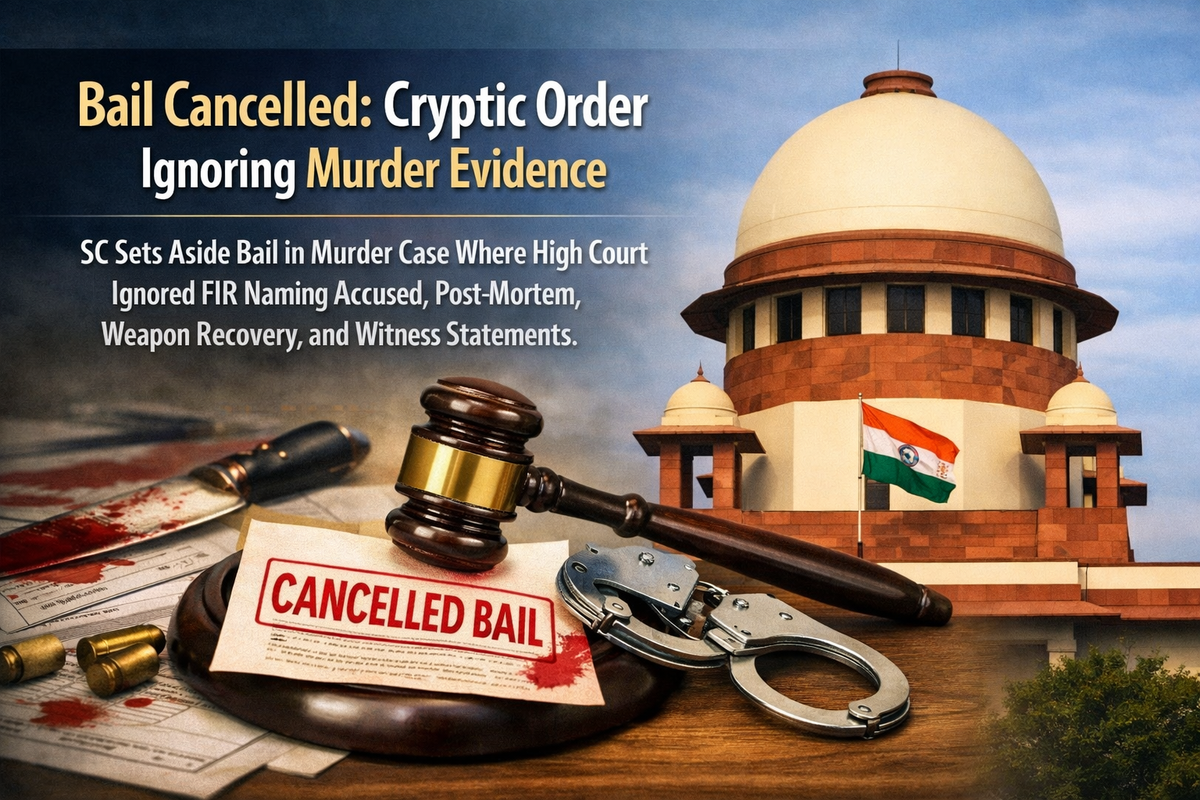
Bhagat Singh v. State of Uttar Pradesh
(2026) INSC 527
Key Issue / Question of Law
Whether the High Court was justified in granting bail to an accused charged with murder under Section 103(1) of the Bharatiya Nyaya Sanhita, 2023, where the accused was specifically named in the FIR with a direct overt act of firing, the post-mortem report confirmed firearm injuries, the murder weapon was recovered at his instance, and witness statements supported the prosecution, solely on the ground that the informant and another Panch witness did not name the accused during the inquest proceedings under Section 174 of the Code of Criminal Procedure, 1973.
Ratio Decidendi
The scope of an inquiry under Section 174 of the Code of Criminal Procedure, 1973 (corresponding to Section 194 of the Bharatiya Nagarik Suraksha Sanhita, 2023) is a preliminary enquiry of a limited and specific character confined to ascertaining the apparent cause of death. It is not intended to record a detailed account of the incident or the names of the accused persons. Non-mentioning of the author of the crime in the inquest report cannot, by itself, be a reason to doubt the involvement of the accused who may be subsequently named during investigation. A bail order that fails to consider material circumstances — such as specific overt act in the FIR, post-mortem findings, recovery of the murder weapon at the accused's instance, and witness statements — and is cryptic and bereft of substantial reasoning, suffers from non-application of mind and is unsustainable. The judicial discretion to grant bail must be exercised in a judicious and reasoned manner, particularly where accusations are grave.
Holding / Decision
The Supreme Court allowed the appeal, set aside the impugned order of the Allahabad High Court dated 22 January 2026 granting bail to the accused-respondent, and remanded the matter back to the High Court for fresh consideration of the bail application in accordance with law. The Court held that the High Court had passed a cryptic, non-speaking order without adverting to material facts including the specific overt act attributed to the accused in the FIR, the post-mortem report confirming firearm injuries, the recovery of the murder weapon at his instance, and the statements of witnesses. The accused-respondent was directed to surrender within one week to the concerned jail authorities and remain in judicial custody pending fresh consideration.
Background & Facts
On 8 March 2025, the appellant (nephew of the deceased) and his uncle Bharat Singh alias Pappu were proceeding towards their agricultural field when the respondent-accused (Kunwarpal Singh) along with two co-accused emerged from concealment, armed with country-made pistols, surrounded the deceased, abused him, and fired multiple shots causing his instantaneous death. FIR No. 118 of 2025 was registered on the same day. The respondent was arrested on 9 March 2025, and pursuant to his disclosure statement, a country-made .315 bore pistol along with a spent/empty cartridge was recovered from his uncle's room. The Trial Court rejected the bail application on 26 September 2025. The High Court, by a cryptic order dated 22 January 2026, granted bail primarily on the ground that the informant and another Panch witness had not made any allegation against the respondent during the inquest proceedings. The informant (appellant) appealed to the Supreme Court.
Statutes Involved
- Section 103(1), Bharatiya Nyaya Sanhita, 2023 — Punishes murder with death or imprisonment for life and fine; corresponds to Section 302 of the Indian Penal Code, 1860
- Section 352, Bharatiya Nyaya Sanhita, 2023 — Punishes intentional insult with intent to provoke breach of peace; corresponds to Section 504 of the Indian Penal Code, 1860
- Section 351(2), Bharatiya Nyaya Sanhita, 2023 — Punishes criminal intimidation with imprisonment up to two years or fine or both; corresponds to Section 506 of the Indian Penal Code, 1860
- Section 3(5), Bharatiya Nyaya Sanhita, 2023 — Provides for constructive liability when a criminal act is done by several persons in furtherance of common intention; corresponds to Section 34 of the Indian Penal Code, 1860
- Section 55, Arms Act, 1959 — Provides for licence for manufacture, sale, etc., of arms and ammunition
- Section 56, Arms Act, 1959 — Provides for punishment for certain offences under the Act
- Section 77, Arms Act, 1959 — Provides for punishment for using arms, etc.
- Section 180, Bharatiya Nagarik Suraksha Sanhita, 2023 — Provides for examination of witnesses by police during investigation; corresponds to Section 161 of the Code of Criminal Procedure, 1973
- Section 194, Bharatiya Nagarik Suraksha Sanhita, 2023 — Provides for police to enquire and report on suicide, etc.; corresponds to Section 174 of the Code of Criminal Procedure, 1973
- Section 174, Code of Criminal Procedure, 1973 — Provided for police to enquire and report on suicide, etc. (predecessor to Section 194 BNSS)
Full Analysis
Premium Content
Subscribe to access the full analysis, practical implications, and related case mapping.
Subscribe — ₹99/monthAlready a subscriber? Sign inAdvocate's Note — Agarawal Associates
Professional insight for advocates on how to deploy this judgment in practice...
Subscribe to access the Advocate's Note.
Key Conditional Rule / Important Caveat
This judgment applies ONLY where (a) the accused is charged with a serious offence (e.g., murder under Section 103 BNS), (b) the High Court grants bail based primarily or solely on the ground that the accused was not named in the inquest report under Section 174 CrPC / Section 194 BNSS, (c) there is other material evidence against the accused (e.g., specific overt act in FIR, post-mortem confirming injuries, recovery of weapon at accused's instance, witness statements), and (d) the High Court's order is cryptic, non-speaking, or fails to consider these material circumstances. If the High Court's order is reasoned and considers all material circumstances, this judgment does not mandate interference. The judgment does NOT apply where (a) the accused was not named in the FIR and the inquest report is the only material, (b) the prosecution has no other evidence, or (c) the High Court's order is detailed and addresses all material circumstances.
Cases Cited
- Pedda Narayana v. State of A.P. (1975) 4 SCC 153 — Held that the object of proceedings under Section 174 CrPC is merely to ascertain whether a person has died under suspicious circumstances and the apparent cause of death; details of who assaulted the deceased are foreign to the scope of Section 174.
- Amar Singh v. Balwinder Singh (2003) 2 SCC 518 — Held that Section 174 CrPC does not contemplate that the manner in which the incident took place or the names of the accused should be mentioned in the inquest report; the basic purpose is to report the apparent cause of death.
Courtroom Arguments
For Petitioner
High Court Granted Bail Ignoring Material Evidence — (2026) INSC 527
The High Court passed a cryptic, non-speaking order granting bail to an accused charged with murder, ignoring the specific overt act in the FIR, the post-mortem report confirming firearm injuries,…
For Respondent
Bail Granted After Considering All Material Circumstances — (2026) INSC 527
The High Court, after considering the facts and circumstances, including the fact that the Panch witnesses did not name the respondent during the inquest, exercised its discretion to grant bail.
More Criminal Law Judgments
View All →Found this useful? Share it with your colleagues.
One tap sends the case name, citation, key issue and link.
Take This Further in Court
2 courtroom argument frameworks available for this case — full submission structure, bench question simulator, and opposition rebuttals.
Disclaimer: This summary is prepared by Agarawal Associates for informational purposes only. It does not constitute legal advice. For legal matters, consult a qualified advocate. © 2026 Agarawal Associates — apexdigest.in