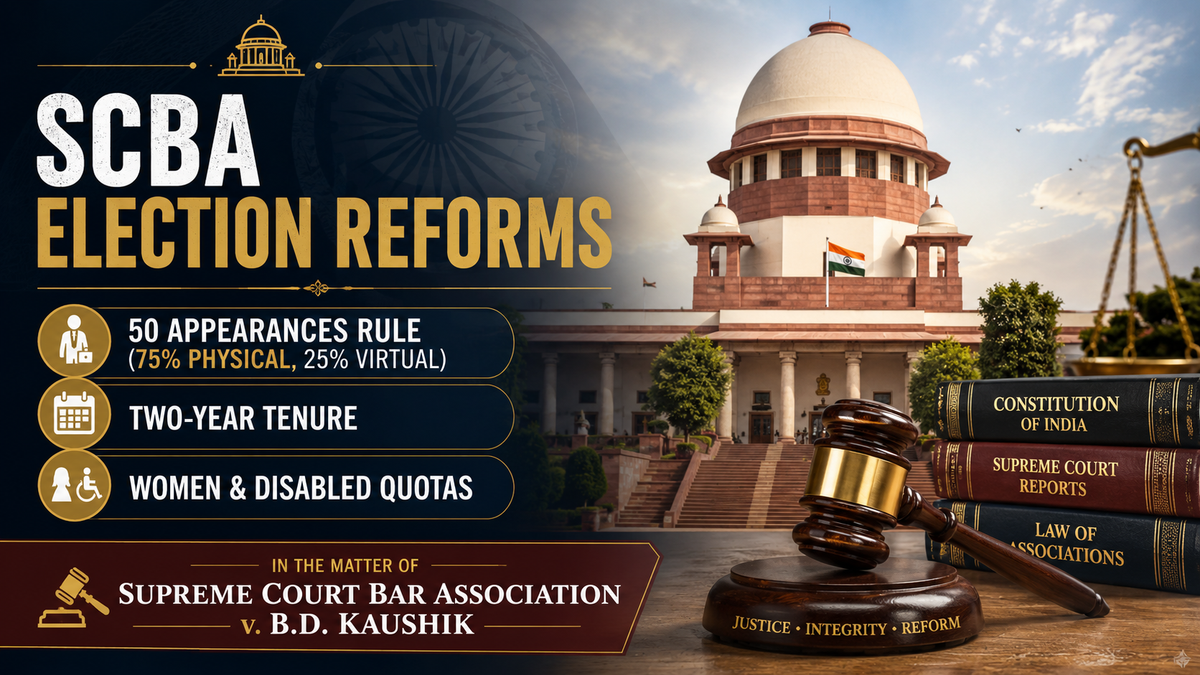
Supreme Court Bar Association v. B.D. Kaushik (M.A. Diary No. 13992/2023 arising out of C.A. Nos. 3401-3402/2003)
Key Issue / Question of Law
Whether the eligibility criteria for voting and contesting elections in the Supreme Court Bar Association (SCBA) require revision to reflect the paradigm shift brought about by COVID-19, including the adoption of virtual hearings, and to ensure that the SCBA Rules are aligned with the judicial directions issued by the Supreme Court over the years, while also addressing issues of reservation for women and disabled members, disqualification for inducement, tenure of the Executive Committee, and other electoral reforms.
Ratio Decidendi
The Supreme Court, exercising its powers under Articles 141 and 144 of the Constitution, can issue binding directions to align the Rules of the Supreme Court Bar Association with judicial pronouncements and to effect necessary reforms in the election process. In light of the paradigm shift caused by the COVID-19 pandemic, which accelerated the adoption of virtual hearings, the concept of a 'regular practitioner' must be re-evaluated. Advocates with 50 appearances (30 for women, 5 for disabled) in the preceding two years, with 75% physical and 25% virtual appearances, are eligible to vote. Senior Advocates residing in NCR remain eligible. Advocates-on-Record require an average of 20 filings per year (5 for disabled). The tenure of the Executive Committee is increased from one to two years with a one-term cooling-off period. One-third reservation for women in the Executive Committee is maintained, with additional posts reservable annually. Posts may also be reserved for advocates with disabilities. A Model Code of Conduct must include disqualification for providing inducement in any form, with prohibition from contesting the present and next election.
Holding / Decision
The Supreme Court issued comprehensive directions for the reform of SCBA elections, including: (i) incorporating judicial directions into SCBA Rules; (ii) revising voting eligibility to require 50 appearances (30 for women, 5 for disabled) in preceding two years, with 75% physical and 25% virtual appearances; (iii) eligibility criteria for contesting various posts (President, Vice President, Secretary, Joint Secretary, Treasurer, Executive Members) with specific appearance requirements; (iv) refundable security deposit with refund at 15% votes; (v) increasing Executive Committee tenure from 1 to 2 years effective 2027 with cooling-off period; (vi) reservation for women (one-third) and for disabled advocates (posts as directed annually); (vii) disqualification for inducement; and (viii) other reforms including manifestos on SCBA website and self-appraisal reports. Elections for 2026-2027 shall be held in the week beginning 24 August 2026.
Background & Facts
The Supreme Court Bar Association (SCBA) Rules provided for two categories of membership: temporary and regular. Regular membership required fulfillment of appearance criteria. The Supreme Court in SCBA v. B.D. Kaushik (2011) 13 SCC 774 held that court-annexed bar associations constitute a separate class and that the right to vote and contest could be restricted to regular practitioners. Subsequently, in SCBA v. B.D. Kaushik (2012) 8 SCC 589, the Court accepted suggestions for eligibility criteria based on appearances, filings, and proximity card usage. Due to the COVID-19 pandemic, the Court in In Re: Guidelines for Court Functioning Through Video Conferencing During Covid-19 Pandemic authorized virtual hearings, which necessitated a relook at what constitutes a 'regular practitioner'. The present Miscellaneous Application sought relaxation of rules due to COVID-19 conditions, and the Court broadened the scope to invite suggestions for comprehensive electoral reforms. Justice L. Nageswara Rao chaired a Committee that submitted recommendations, and suggestions were also received from the SCBA Executive Committee and Election Committee.
Statutes Involved
- Article 141, Constitution of India — Provides that law declared by the Supreme Court shall be binding on all courts within the territory of India
- Article 142, Constitution of India — Empowers the Supreme Court to pass any decree or order necessary for doing complete justice in any cause or matter pending before it
- Article 144, Constitution of India — Provides that all authorities, civil and judicial, in the territory of India shall act in aid of the Supreme Court
- Rule 5(c), Supreme Court Bar Association Rules — Provides for conversion of temporary membership to regular membership based on appearances
- Rule 18, Supreme Court Bar Association Rules — Provides for voting eligibility of regular members
- Section 138, Indian Evidence Act, 1872 — Provides for examination-in-chief, cross-examination, and re-examination
- Article 21, Constitution of India — Guarantees right to life and personal liberty, includes access to justice
- Article 14, Constitution of India — Guarantees equality before law and equal protection of laws
Full Analysis
Constitutional Framework: Supreme Court's Power Over Court-Annexed Bar Associations
The Supreme Court, in SCBA v. B.D. Kaushik (2011) 13 SCC 774, held that court-annexed bar associations constitute a separate class different from other lawyers' associations. They are always recognised by the court concerned. The very nature of such a Bar Association necessarily means and implies that it is an association representing members regularly practising in the court and responsible for proper conduct of its members in the court and for ensuring proper assistance to the court. Therefore, the right to vote and contest elections could be restricted and made subject to rules, and could be limited to 'regular practitioners' before the Supreme Court.
Paradigm Shift: COVID-19 and Virtual Hearings
The Court noted that even prior to COVID-19, several institutional and technological reforms had begun reshaping the justice delivery system. However, the pandemic significantly accelerated this process, compelling courts across the country to adopt virtual functioning. In In Re: Guidelines for Court Functioning Through Video Conferencing During Covid-19 Pandemic (Suo Motu Writ (Civil) No. 5/2020), the Court observed that access to justice is fundamental to preserve the rule of law, and that modern technology has enabled courts to enhance the quality and effectiveness of the administration of justice. The Court held that video conferencing is an advancement in science and technology that permits one to see, hear and talk with someone far away with the same facility and ease as if he is present before you.
The Court noted that it is safe to say that the changes are here to stay. The very changes that allow greater flexibility to advocates and parties in appearing before this Court as well as in marking appearances have necessitated a relook as to what it means to be a 'regular practitioner.'
Voting Eligibility – Revised Criteria
The Court accepted the recommendation that advocates with 50 appearances in the Supreme Court in the preceding two years would be eligible to vote. Female advocates were given a reduced threshold of 30 appearances. Advocates with disabilities were given a threshold of 5 appearances. The Court held that 75% of such appearances must be physical, while 25% of appearances may be virtual. Appearances shall be proved from the Record of Proceedings and may also be proved through court orders. Virtual appearances must be marked separately from physical appearance, and the portal must be amended accordingly. Proximity card entries are to be treated as corroborative only; eligibility cannot be determined solely on the basis of proximity card entries.
Advocates-on-Record (AOR) Eligibility
Advocates-on-Record with an average of 20 filings per year in the preceding two years will be eligible. AORs with disabilities with an average of 5 filings per year will be eligible.
Mediators and Veteran Members
Non-AOR members on the panel of mediators in the Supreme Court Mediation Centre, for two years with 20 mediation cases in two years, shall be eligible. Veteran members holding SCBA membership for more than 25 years will be eligible to vote. Veteran members with more than 25 years membership will be eligible to contest only if they have voted at least once in the immediately preceding 5 years.
Categories Removed
The Court removed the following categories as eligibility criteria: chamber allotment, being waitlisted for chamber allotment, fifty appearances in preceding three years for government counsel, use of proximity card for 60 days in the preceding year (now only corroborative), and empanelment of non-AOR members on the Amicus Curiae panel.
Senior Advocates
Senior Advocates residing in NCR (Delhi, Gurugram, Noida, Faridabad, Ghaziabad), including Senior Advocates designated by the Supreme Court, will be eligible to vote.
Eligibility to Contest Elections
A member must have a minimum of five years permanent membership of SCBA for contesting any post.
- President: 10 lead appearances in reported judgments in preceding 10 years, or 25 lead appearances in reported judgments in preceding 20 years.
- Vice President: 10 lead appearances in reported judgments in preceding 10 years.
- Secretary: 50 appearances in preceding two years (30 for women, 5 for disabled).
- Joint Secretary/Treasurer/Joint Treasurer: 40 appearances in preceding two years (25 for women, 5 for disabled).
- Executive Members: 50 appearances in preceding two years (30 for women, 5 for disabled).
Security Deposit
Candidates must make a refundable security deposit along with nomination fee. The security deposit would be refunded to all those who have received 15% or more of the valid votes.
Tenure of Executive Committee and Cooling-Off Period
The Court held that in one year, the elected body has an effective mandate of 8-9 months, which is too short to ensure meaningful improvements. Moreover, the logistical challenges and significant expenditure of resources and personnel in the conduct of elections was also noted. To prevent concentration of power, the tenure of the Executive Committee was increased from 1 to 2 years, effective from 2027. A cooling-off period of 1 term shall be applied after each term.
Reservation for Women and Disabled
The Court had already ordered one-third reservation for women in the Executive Committee and a post of Office Bearer for a woman candidate vide order dated 02.05.2024. The Court further directed that the Supreme Court may, on an annual basis, further reserve for women such additional posts as it may direct, but other than the post of President. Posts may also be reserved for advocates with disabilities as the Court may, by order, direct in a given year, but other than the post of President.
Disqualification
The Court held that a 'Model Code of Conduct' should contain a categorical disqualification for providing inducement in any form, cash or kind, in lieu of votes. A candidate found to have provided inducements must not only be disqualified from contesting the present election but the next election also. Mobile phones must not be permitted in the polling booth. A person convicted and sentenced to a term of imprisonment or barred from practice by the Bar Council is prohibited from contesting elections.
Other Recommendations
The Court directed that a common platform must be hosted on the SCBA website with the manifesto of all candidates. Members must be allowed to opt out of campaign messaging. Elected members must submit a self-appraisal report of their achievements and failures vis-à-vis respective manifestos on the conclusion of their term.
Significance for Development of Law
This judgment is of monumental significance for the governance of court-annexed bar associations in India. First, it recognises the paradigm shift brought about by virtual hearings and adapts the definition of 'regular practitioner' accordingly, allowing virtual appearances to count towards eligibility (up to 25%). Second, it reduces the threshold for women and disabled advocates, promoting inclusivity. Third, it increases the tenure of the Executive Committee to two years, allowing elected bodies more time to implement meaningful reforms. Fourth, it introduces a cooling-off period to prevent concentration of power. Fifth, it provides for reservation for disabled advocates, a progressive step. Sixth, it introduces strict disqualification for inducement, including a ban from the next election, to curb electoral malpractices. Seventh, it mandates transparency through manifestos on a common platform and self-appraisal reports. Eighth, it reaffirms the Supreme Court's power under Articles 141 and 144 to issue binding directions to court-annexed bar associations to align their rules with judicial pronouncements and to effect necessary reforms.
Practical Implications for Advocates
1. For SCBA members: Maintain accurate records of your appearances (both physical and virtual) in the Record of Proceedings. The new eligibility criteria require 50 appearances (30 for women, 5 for disabled) in the preceding two years, with 75% physical and 25% virtual. Verify your appearance count well before the election deadline.
2. For advocates with disabilities: The reduced threshold of 5 appearances for voting and for contesting various posts is a significant benefit. Ensure that your disability status is properly documented and registered with the SCBA to avail of this benefit.
3. For advocates aspiring to contest elections: Familiarise yourself with the specific appearance requirements for each post. For President, you need 10 lead appearances in reported judgments in preceding 10 years (or 25 in 20 years). Start tracking your reported judgments now. For other posts, the requirements range from 40 to 50 appearances in preceding two years.
4. For the SCBA Executive Committee: The two-year tenure (effective 2027) provides a longer mandate. Use this time to implement meaningful reforms. The self-appraisal report requirement at the end of the term means you will be held publicly accountable for your manifesto promises. Document your achievements carefully.
5. For all advocates: The Model Code of Conduct strictly prohibits inducement in any form. Avoid providing any cash, kind, or lavish parties to voters. Violation will result in disqualification from the current election and the next election. Mobile phones are banned in polling booths. Co-operate with the Election Committee to ensure free and fair elections.
Advocate's Note — Agarawal Associates
At Agarawal Associates, this judgment is essential reading for every advocate practicing before the Supreme Court, particularly those who are members of the SCBA. The key tactical lesson for advocates seeking voting rights: ensure that your appearances are properly recorded in the Record of Proceedings. With the new 75-25 split between physical and virtual appearances, maintain a log of both. Virtual appearances must be marked separately; ensure that the portal is updated accordingly. For female advocates, the threshold is lower (30 appearances), making it easier to qualify. For advocates with disabilities, the threshold is significantly lower (5 appearances). Second, for those aspiring to contest elections, plan your career accordingly. If you aim for President, you need 10 lead appearances in reported judgments in the preceding 10 years (or 25 in 20 years). Start building your reported judgment portfolio early. Third, note the cooling-off period of one term after each term. This prevents concentration of power but also means you cannot serve consecutive terms. Plan your political career accordingly. Fourth, the refundable security deposit (refunded at 15% votes) may discourage frivolous candidates. If you are serious about contesting, ensure you have a genuine base of support. Fifth, the Model Code of Conduct with disqualification for inducement is strict — any form of inducement (cash, kind, lavish parties) will disqualify you not only from the current election but also the next. Advise clients to strictly avoid any behaviour that could be construed as inducement. Sixth, for the SCBA Executive Committee, the two-year tenure (effective 2027) means longer time to implement reforms but also greater accountability. The self-appraisal report requirement means members will be publicly accountable for their manifesto promises. Finally, the Court has granted one month more time for conducting elections (to be held in the week beginning 24 August 2026) to implement the reforms. This is a tight timeline; advocates should ensure their records are updated and their eligibility status is verified well in advance.
Key Conditional Rule / Important Caveat
This judgment applies ONLY to elections of the Supreme Court Bar Association (SCBA) and, by analogy, to other court-annexed bar associations that are recognised by and function within the precincts of the respective courts. The eligibility criteria for voting (50 appearances in preceding two years, 75% physical, 25% virtual) and contesting (specific appearance thresholds for each post) are binding on the SCBA. The reforms regarding tenure (two years, effective 2027), cooling-off period (one term), reservation for women (one-third plus additional posts annually), reservation for disabled (as directed annually), disqualification for inducement, refundable security deposit, manifestos on SCBA website, and self-appraisal reports are also binding. The judgment does NOT apply to bar associations that are not court-annexed (e.g., All India Advocates' Association, Lawyers' Forum, or bar associations of High Courts or District Courts unless they adopt similar reforms). The virtual appearance counting (25%) is specific to the SCBA and may not automatically apply to other bar associations without similar judicial directions.
Cases Cited
- Supreme Court Bar Assn. v. B.D. Kaushik (2011) 13 SCC 774 — Held that court-annexed Bar Associations constitute a separate class different from other lawyers' associations; the right to vote and contest elections could be restricted to regular practitioners.
- Supreme Court Bar Assn. v. B.D. Kaushik (2012) 8 SCC 589 — Upheld the mandate of a three-member Implementation Committee to identify members eligible to vote in SCBA elections.
- In Re: Guidelines for Court Functioning Through Video Conferencing During Covid-19 Pandemic (Suo Motu Writ (Civil) No. 5/2020) — Authorised courts to adopt virtual functioning and held that video conferencing is an advancement that permits remote presence with the same facility as physical presence.
Courtroom Arguments
For Petitioner
Strict Eligibility Criteria Essential for SCBA Voting Rights — Supreme Court Bar Association
The SCBA is a court-annexed bar association representing regular practitioners before the Supreme Court.
For Respondent
Virtual Appearances Must Count Equally for Voting Eligibility — Supreme Court Bar Association
The COVID-19 pandemic has permanently transformed court functioning. Virtual hearings are here to stay and should count equally with physical appearances for SCBA voting eligibility.
More Service Law Judgments
View All →Found this useful? Share it with your colleagues.
One tap sends the case name, citation, key issue and link.
Take This Further in Court
2 courtroom argument frameworks available for this case — full submission structure, bench question simulator, and opposition rebuttals.
Disclaimer: This summary is prepared by Agarawal Associates for informational purposes only. It does not constitute legal advice. For legal matters, consult a qualified advocate. © 2026 Agarawal Associates — apexdigest.in