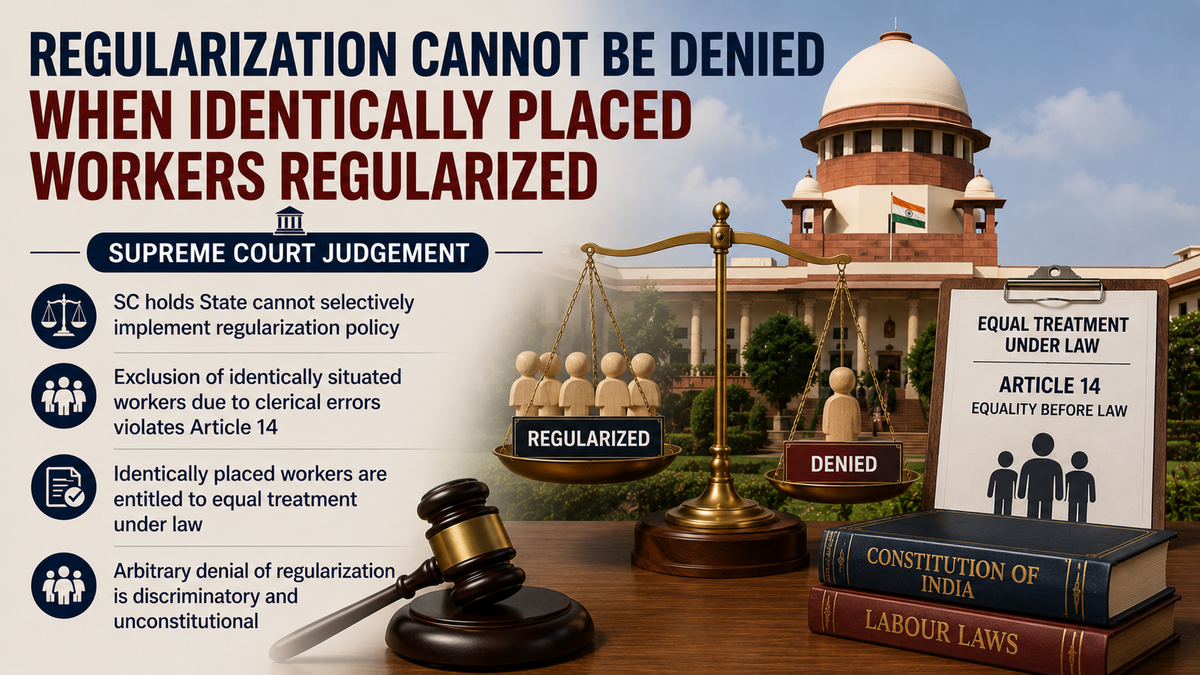
Sukhendu Bhattacharjee v. State of Assam
(2026) INSC 523
Key Issue / Question of Law
Whether Muster Roll and Work Charged workers engaged prior to 1st April 1993, who were left out of the State's Cabinet decision dated 22nd July 2005 due to administrative lapses and clerical errors, are entitled to regularization and consequential benefits under Article 14 of the Constitution, despite not being appointed against sanctioned posts, given that nearly 30,000 similarly situated workers were regularized pursuant to that Cabinet decision.
Ratio Decidendi
The State cannot take shelter under the strictures of Umadevi to deny regularization to workers who were left out of a Cabinet policy due to administrative lapses, when identically situated workers have already been regularized. The principle of equal treatment under Article 14 requires that once the State frames a policy and implements it for a large class of workers, it cannot arbitrarily exclude others who are similarly situated. The State's repeated undertakings before the High Court to regularize left-out workers gave rise to a legitimate expectation. The State, as a model employer, cannot resile from its commitments and must act with fairness and consistency. The exception in Umadevi was intended to prevent backdoor entries, not to penalize long-serving employees who have performed essential functions for decades.
Holding / Decision
The Supreme Court allowed the appeals, set aside the impugned judgment of the Division Bench of the Gauhati High Court dated 8 June 2017, and affirmed the judgment of the learned Single Judge dated 20 December 2013. The Court directed the State of Assam to regularize the appellants in terms of the Cabinet decision dated 22 July 2005 from the date when similarly placed 30,000 employees were given benefit, and to grant all consequential benefits including pay fixation, continuity of service, and pensionary benefits. The Court clarified that Work Charged employees are a distinct class and their pensionary claims shall not be foreclosed by the impugned judgment. The Court also set aside the orders in connected appeals that had relied on the impugned judgment.
Background & Facts
Since 1980, the Government of Assam engaged Muster Roll and Work Charged workers across various departments. On 23 September 1983, the State Cabinet decided to regularize Muster Roll workers with 15 years of service. On 20 April 1995, the Chief Secretary reiterated the need for regularization of workers engaged prior to 1 April 1993. On 22 July 2005, the Cabinet decided to regularize Work Charged and Muster Roll workers engaged prior to 1 April 1993, and pursuant to this decision, approximately 30,000 workers were regularized by creating 5,892 Work Charged grade posts and 25,069 Grade-IV posts. However, due to clerical errors and administrative lapses, several eligible workers, including the appellants, were left out. The State gave undertakings before the High Court to regularize left-out workers. In 2012, the State issued an O.M. stopping further regularization, citing Umadevi. The Single Judge quashed the 2012 O.M. and directed regularization. The Division Bench reversed, holding that regularization was barred by Umadevi. The workers appealed to the Supreme Court.
Statutes Involved
- Article 14, Constitution of India — Guarantees equality before the law and equal protection of laws; prohibits arbitrary and discriminatory treatment
- Article 16, Constitution of India — Guarantees equality of opportunity in matters of public employment
- Article 21, Constitution of India — Guarantees right to life and personal liberty, including right to livelihood and dignity
- Rule 31 proviso, Assam Services (Pension) Rules, 1969 — Provides for creation of supernumerary posts for conferring pensionary benefits
- Assam Financial Rules — Recognises Work Charged and Muster Roll as permissible modes of engagement
- PWD Code — Governs engagement of Work Charged employees in Public Works Department
Full Analysis
Premium Content
Subscribe to access the full analysis, practical implications, and related case mapping.
Subscribe — ₹99/monthAlready a subscriber? Sign inAdvocate's Note — Agarawal Associates
Professional insight for advocates on how to deploy this judgment in practice...
Subscribe to access the Advocate's Note.
Key Conditional Rule / Important Caveat
This judgment applies ONLY where (a) the State has framed a policy decision to regularize a defined class of workers, (b) the State has actually implemented that policy for a substantial number of workers from that class, (c) the appellants are identically situated to those who were regularized (same cut-off date, nature of work, length of service), (d) the exclusion of the appellants is attributable to administrative lapses, clerical errors, or oversights on the part of the State, not to any fault of the appellants, and (e) the State gave undertakings before a court to regularize left-out workers. If the State has not implemented the policy for anyone, or if the appellants are not identically situated, or if the exclusion was due to the appellants' own fault (e.g., they did not meet eligibility criteria), this judgment does not mandate regularization. The judgment does NOT create a general right to regularization for all temporary workers; it is specifically based on the principle of equal treatment and the State's own policy and undertakings.
Cases Cited
- Secretary, State of Karnataka v. Umadevi (2006) 4 SCC 1 — Constitution Bench held that regularization of temporary, ad-hoc, daily-wage or casual employees appointed de hors constitutional scheme is impermissible, except for limited one-time measure for irregularly appointed employees in sanctioned posts for ten years or more.
- State of Karnataka v. M.L. Kesari (2010) 9 SCC 247 — Clarified that the one-time measure under Umadevi applies to all daily-wage/ad-hoc/casual employees who had put in ten years of continuous service as on 10.4.2006 without court protection, working in vacant posts, possessing requisite qualification.
- Jaggo v. Union of India 2024 SCC OnLine SC 3826 — Held that Umadevi does not intend to penalize long-serving employees performing essential functions; the State cannot take mechanical shelter under Umadevi to deny equitable treatment.
- Bhola Nath v. State of Jharkhand 2026 INSC 99 — Reiterated that the State as a model employer must act with probity, fairness, and candour, and cannot exploit employees under narrow technical grounds.
- National Buildings Construction Corporation v. S. Raghunathan (1998) 7 SCC 66 — Explained the doctrine of legitimate expectation — government must honour its statements of policy and intention; unfairness in form of unreasonableness is akin to violation of natural justice.
- Azam Jahi Mill Workers Association v. National Textile Corporation Ltd. (2022) 17 SCC 797 — Held that equals must be treated equally; if persons similarly placed are treated differently without rational basis, it violates Article 14.
- Shripal v. Nagar Nigam 2025 SCC OnLine SC 221 — Cautioned against mechanical and blind reliance on Umadevi to deny regularization to temporary employees in absence of statutory rules.
- Dharam Singh v. State of Uttar Pradesh 2025 SCC OnLine SC 1735 — Deprecated the culture of 'ad-hocism' adopted by States to evade regular employment obligations.
- Pawan Kumar v. Union of India 2026 INSC 156 — Held that when certain employees have been regularized but others similarly placed were left out, such differential treatment is discriminatory, and the same relief must be granted to excluded employees.
Courtroom Arguments
For Petitioner
Identically Placed Workers Regularized, Exclusion Arbitrary — (2026) INSC 523
The appellants are identically situated to nearly 30,000 Muster Roll and Work Charged workers who were regularized pursuant to the Cabinet decision dated 22 July 2005.
For Respondent
Umadevi Bars Regularization Without Sanctioned Posts — (2026) INSC 523
The appellants were never appointed against sanctioned posts and were not selected through any recognized recruitment process. Under Umadevi, regularization is impermissible.
More Service Law Judgments
View All →Supreme Court Bar Association v. B.D. Kaushik (M.A. Diary No. 13992/2023 arising out of C.A. Nos. 3401-3402/2003)
29 May 2026
Vice Chancellor, Rajiv Gandhi National Aviation University v. Jitendra Singh
(2026) INSC 520
21 May 2026
State of Odisha v. Sreepati Ranjan Dash
(2026) INSC 505
18 May 2026
Dr Sohail Malik v. Union of India
(2025) INSC 1415
10 Dec 2025
Found this useful? Share it with your colleagues.
One tap sends the case name, citation, key issue and link.
Take This Further in Court
2 courtroom argument frameworks available for this case — full submission structure, bench question simulator, and opposition rebuttals.
Disclaimer: This summary is prepared by Agarawal Associates for informational purposes only. It does not constitute legal advice. For legal matters, consult a qualified advocate. © 2026 Agarawal Associates — apexdigest.in