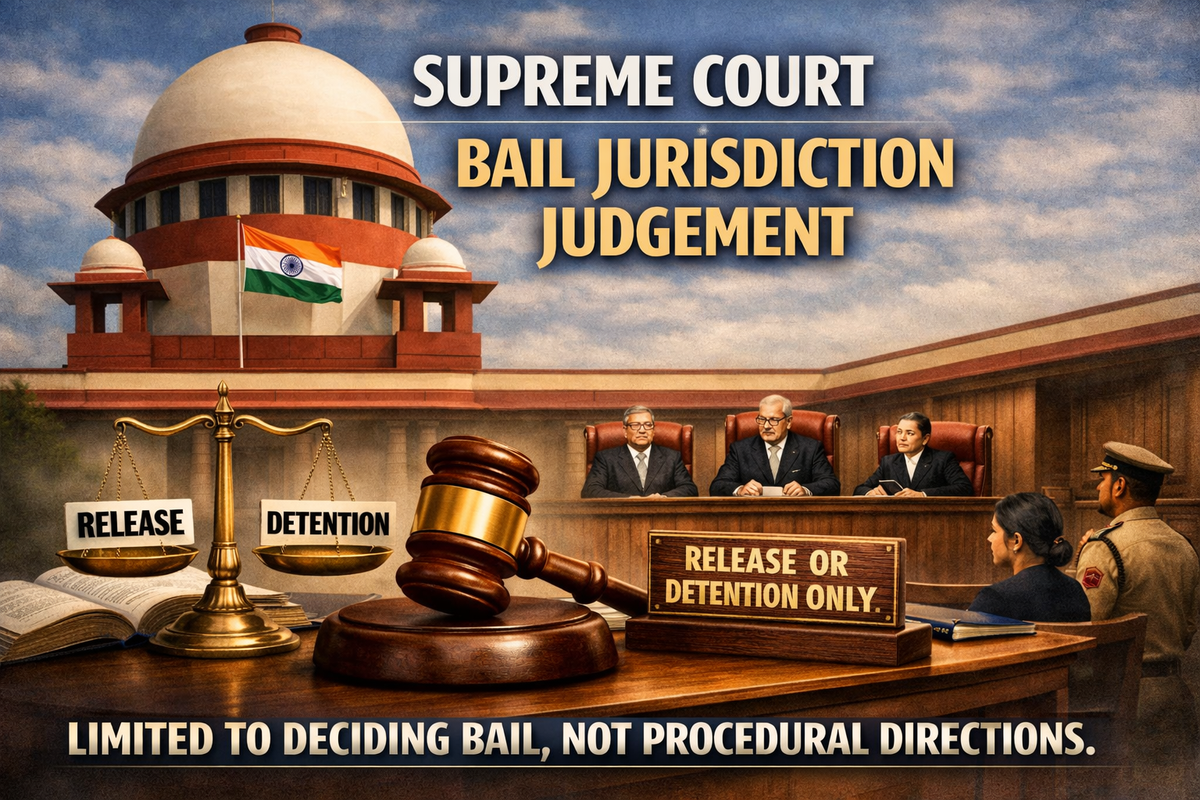
Ram Balak v. State of U.P.
(2026) INSC 511
Key Issue / Question of Law
Whether the High Court, while exercising its statutory power under Section 483 of the Bharatiya Nagarik Suraksha Sanhita, 2023 (BNSS) (corresponding to Section 439 of the Code of Criminal Procedure, 1973) to grant or reject bail, can issue far-reaching directions mandating the State Government and police authorities to create departmental accountability systems for service of summons, execution of coercive measures, and production of witnesses, or whether such directions exceed the scope of the statutory power of bail jurisdiction.
Ratio Decidendi
The power of a High Court under Section 483 of the BNSS, 2023 (Section 439 of the CrPC, 1973) is limited to adjudicating the question of whether an accused should be released on bail or continue to be incarcerated. The Court cannot, in exercise of this statutory power, issue directions of a general nature that require the State Government and police authorities to restructure departmental accountability systems, appoint nodal officers, create central registers, or mandate penal consequences for laxity in service of summons and production of witnesses. Constitutional powers are distinct from statutory powers. A constitutional power emanates directly from the Constitution and is self-sustaining; a statutory power is derivative and conditional, existing only within the four corners of the enabling statute. The constitutional power of a High Court cannot overshadow or enlarge the scope of its statutory power. While a High Court is a constitutional court, when it exercises a statutory power, it must act within the parameters of that statute. Any direction that travels beyond the scope of the statute is ultra vires and void, even if the Court claims to be acting under Article 21 of the Constitution of India.
Holding / Decision
The Supreme Court allowed the appeal and set aside the impugned order of the Allahabad High Court insofar as it had issued far-reaching directions regarding service of summons, execution of coercive measures, and creation of departmental accountability systems. The Court held that such directions were beyond the scope of the High Court's power under Section 483 of the BNSS, 2023 (bail jurisdiction). The Court clarified that the steps already taken by the State authorities pursuant to these directions shall remain unaffected and may continue, and the State is at liberty to modify them as per law. The Court confirmed its interim order dated 26 November 2025 by which the appellant had been released on bail.
Background & Facts
The appellant, Ram Balak, was an accused in Case Crime No. 175/2002 under Sections 419, 420, 467, 468 and 471 of the Indian Penal Code, 1860 at PS Hamirpur. His second bail application was rejected by the Allahabad High Court on 1 April 2025. While dismissing the bail application, the High Court issued directions that the Trial Court should issue summons under Sections 62 and 69 of the Code of Criminal Procedure, 1973 and take coercive measures against those who delay or impede proceedings. The High Court also directed that the Trial Court was obliged to follow earlier judgments in Bhanwar Singh @ Karamvir v. State of U.P. and Jitendra v. State of U.P., as well as the directions issued by the Director General of Police and Home Secretary, Government of Uttar Pradesh, regarding creation of departmental accountability systems for service of summons and execution of coercive measures. The appellant challenged these directions before the Supreme Court. By interim order dated 26 November 2025, the Supreme Court released the appellant on bail and posted the matter to consider the issue of the power of a court to issue such directions while exercising bail jurisdiction.
Statutes Involved
- Section 483, Bharatiya Nagarik Suraksha Sanhita, 2023 — Confers special powers on the High Court or Court of Session regarding bail, including directing that any accused in custody be released on bail with or without conditions, setting aside or modifying bail conditions imposed by a Magistrate, and directing arrest of a person released on bail
- Section 439, Code of Criminal Procedure, 1973 (repealed) — Corresponding provision to Section 483 of BNSS, 2023, which dealt with special powers of High Court and Court of Session regarding bail
- Section 480, Bharatiya Nagarik Suraksha Sanhita, 2023 — Provides for direction for grant of bail to person apprehending arrest
- Section 62, Code of Criminal Procedure, 1973 — Provided for summons to produce document or other thing
- Section 69, Code of Criminal Procedure, 1973 — Provided for service of summons on witness by post
- Article 21, Constitution of India — Guarantees right to life and personal liberty, which includes the right to a speedy trial
- Article 32, Constitution of India — Confers power on Supreme Court to issue writs for enforcement of fundamental rights (constitutional power)
- Article 226, Constitution of India — Confers power on High Courts to issue writs for enforcement of fundamental rights and for any other purpose (constitutional power)
- Article 368, Constitution of India — Provides for amendment of the Constitution
Full Analysis
Premium Content
Subscribe to access the full analysis, practical implications, and related case mapping.
Subscribe — ₹99/monthAlready a subscriber? Sign inAdvocate's Note — Agarawal Associates
Professional insight for advocates on how to deploy this judgment in practice...
Subscribe to access the Advocate's Note.
Key Conditional Rule / Important Caveat
This judgment applies ONLY where (a) a High Court or Court of Session is exercising its statutory power under Section 483 BNSS (or Section 439 CrPC) to grant or reject bail, and (b) the court issues directions that go beyond the scope of determining whether the accused should be released on bail or remain in custody — such as directions to the State Government or police authorities regarding systemic reforms in service of summons, witness production, departmental accountability, or creation of new administrative mechanisms. If the court issues such directions, they are ultra vires and void. The judgment does NOT apply where (a) the High Court is exercising its constitutional power under Article 226 of the Constitution of India in a properly constituted writ petition or public interest litigation, or (b) the directions are incidental and necessary to secure the release of the accused (e.g., directions to produce the accused before the trial court, directions to ensure the accused's safety while on bail). The distinction is between directions that are ancillary to the bail decision (permissible) and directions that are general policy directions (impermissible).
Cases Cited
- State of U.P. v. Anurudh 2026 SCC OnLine SC 40 — Supreme Court held that the High Court's directions in a bail matter mandating scientific age determination under POCSO Act were beyond the scope of Section 439 CrPC; distinguished between constitutional power and statutory power.
- Bhanwar Singh @ Karamvir v. State of U.P. (CRMBA 16871 of 2023) — High Court order that was followed in the impugned judgment; the Supreme Court set aside the directions issued therein.
- Jitendra v. State of U.P. (CRMBA 9126 of 2023) — High Court order that was followed in the impugned judgment; the Supreme Court set aside the directions issued therein.
Courtroom Arguments
For Petitioner
High Court Exceeded Bail Jurisdiction under Section 483 BNSS — (2026) INSC 511
The High Court's power under Section 483 BNSS is limited to deciding whether an accused should be released on bail or remain in custody.
For Respondent
High Court Acted to Ensure Speedy Trial Under Article 21 — (2026) INSC 511
The High Court has the power to issue directions to ensure the speedy trial of cases under Article 21 of the Constitution of India.
More Criminal Law Judgments
View All →Found this useful? Share it with your colleagues.
One tap sends the case name, citation, key issue and link.
Take This Further in Court
2 courtroom argument frameworks available for this case — full submission structure, bench question simulator, and opposition rebuttals.
Disclaimer: This summary is prepared by Agarawal Associates for informational purposes only. It does not constitute legal advice. For legal matters, consult a qualified advocate. © 2026 Agarawal Associates — apexdigest.in