Raj Kumar Das (Dead) Through LRs v. National Insurance Co. Ltd.
(2026) INSC 541
Key Issue / Question of Law
Whether a claim petition under Section 163A of the Motor Vehicles Act, 1988 can be dismissed on the ground that the occurrence of the accident was not proved beyond reasonable doubt, when the claimant's testimony, FIR, chargesheet, and medical evidence establish the accident on a preponderance of probabilities, despite minor discrepancies in the medical history (recording 'fall from lorry'), delay in lodging FIR, and variation in vehicle registration number in oral testimony.
Ratio Decidendi
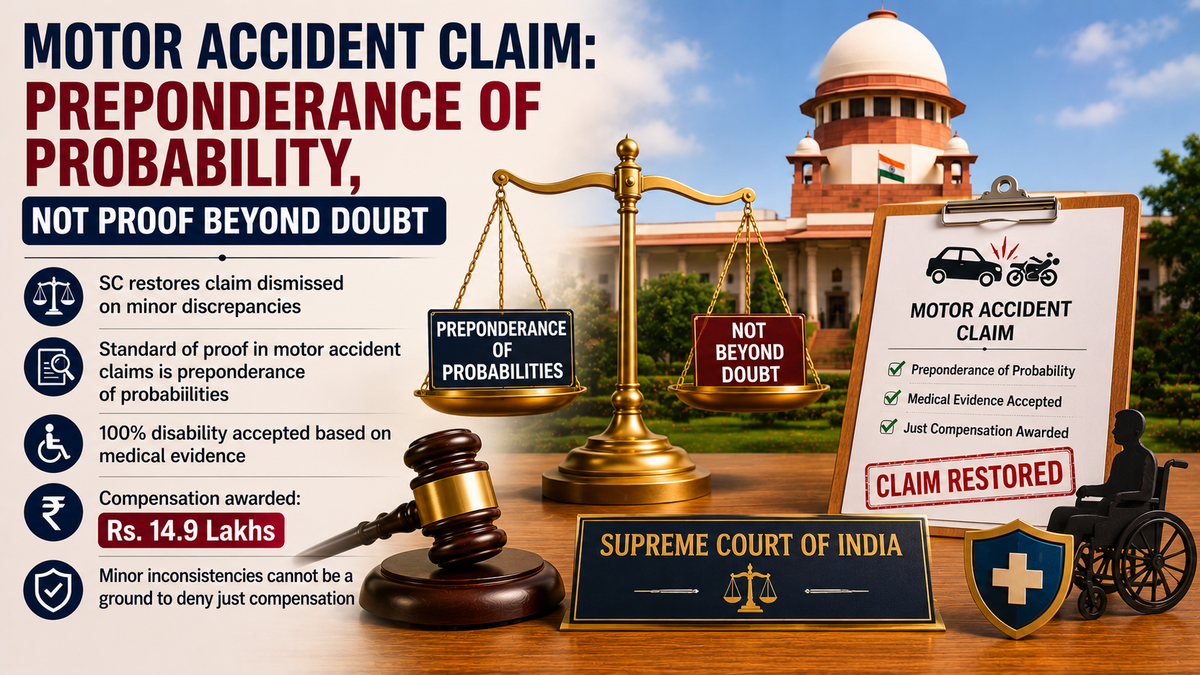
In claim proceedings under the Motor Vehicles Act, 1988, the standard of proof is preponderance of probabilities, not proof beyond reasonable doubt. Under Section 163A, negligence need not be proved; it is sufficient that the injury is reasonably connected with the motor vehicle in question. Discrepancies that do not go to the root of the occurrence cannot defeat a claim. Medical history recorded at the time of emergency treatment is ordinarily based on information supplied by attendants and cannot be treated as a precise reconstruction of the accident. Delay in lodging FIR is natural in cases of grievous injuries where priority is given to medical treatment. Isolated errors in oral testimony, particularly from a witness who suffered serious injuries, cannot outweigh contemporaneous documentary consistency. The adjudicatory process must remain sensitive to the practical realities that accident victims face. The Second Schedule under Section 163A suffers from several defects and can only be used as a guide. In exercise of power under Article 142 of the Constitution, the Court may determine compensation by drawing guidance from principles evolved under Section 166 when strict confinement to Section 163A would not serve the interests of justice.
Holding / Decision
The Supreme Court allowed the appeal, set aside the judgments of the Motor Accident Claims Tribunal and the High Court, and awarded compensation of Rs. 14,90,000 with interest at 6% per annum from the date of filing the claim. The Court held that the courts below applied a higher threshold of proof beyond reasonable doubt rather than preponderance of probabilities. The claimant suffered 100% permanent disability (traumatic paraplegia) and was rendered incapable of pursuing his occupation as a brick-field labourer. The respondent-insurer was directed to deposit the amount within three months before the MACT, which shall be released to the legal representatives of the original claimant (who died during the pendency of proceedings).
Background & Facts
On 21 May 2004 at 5:00 PM, the original claimant Raj Kumar Das alighted from a rickshaw near Mondalpara Bus Stop and was allegedly knocked down by a lorry bearing registration No. WB-41-3999. He lost consciousness, sustained injuries, and was ultimately diagnosed with traumatic paraplegia, resulting in permanent disablement. He filed a claim petition under Section 163A of the Motor Vehicles Act, 1988 on 9 February 2005 seeking compensation of Rs. 3,50,000. The Tribunal dismissed the claim on 11 September 2007 on the ground that the injuries were not proved to be a result of the alleged accident. The High Court affirmed the dismissal on 27 September 2022, citing discrepancies including an MRI Report entry 'fall from lorry', delay in lodging FIR, variation in vehicle registration number in oral testimony, and non-examination of independent witnesses. During the pendency of the proceedings, the original claimant died and is represented by his legal representatives. The Supreme Court granted leave and heard the appeal.
Statutes Involved
- Section 163A, Motor Vehicles Act, 1988 — Provides for no-fault liability compensation on structured formula basis under the Second Schedule; negligence need not be proved
- Section 166, Motor Vehicles Act, 1988 — Provides for application for compensation on fault liability basis
- Second Schedule, Motor Vehicles Act, 1988 — Contains structured formula for compensation under Section 163A; noted by the Court as suffering from several defects
- Article 142, Constitution of India — Empowers the Supreme Court to pass any order necessary for doing complete justice
- Section 168, Motor Vehicles Act, 1988 — Provides for award of just compensation by Claims Tribunal
Full Analysis
Premium Content
Subscribe to access the full analysis, practical implications, and related case mapping.
Subscribe — ₹99/monthAlready a subscriber? Sign inAdvocate's Note — Agarawal Associates
Professional insight for advocates on how to deploy this judgment in practice...
Subscribe to access the Advocate's Note.
Key Conditional Rule / Important Caveat
This judgment applies ONLY where (a) a claim for compensation under the Motor Vehicles Act, 1988 is dismissed on grounds of insufficient proof of the accident, (b) the claimant has adduced some evidence (testimony, FIR, chargesheet, medical records) that collectively establish the accident on a preponderance of probabilities, (c) the discrepancies relied upon by the courts below are minor and do not go to the root of the occurrence (e.g., isolated medical history entry, delay in FIR, variation in oral testimony), and (d) the claimant suffered grievous injuries or permanent disability. The standard of proof is preponderance of probabilities, not proof beyond reasonable doubt. The judgment does NOT apply where (a) there is no evidence whatsoever linking the injuries to a motor vehicle accident, (b) the claimant's testimony is fundamentally inconsistent or contradicted by incontrovertible documentary evidence, (c) the discrepancies are so material that they render the accident improbable, or (d) the claim is manifestly fraudulent. The exercise of Article 142 power to award compensation under Section 166 principles for a Section 163A claim is an exception made in the peculiar facts of this case and shall not be treated as a precedent.
Cases Cited
- Mathew Alexander v. Mohammed Shafi (2023) 13 SCC 510 — Held that strict proof of an accident caused by a particular vehicle in a particular manner need not be established by the claimants; standard of proof is preponderance of probabilities.
- Dulcina Fernandes v. Joaquim Xavier Cruz (2013) 10 SCC 646 — Referred to in Mathew Alexander; reiterates that strict proof is not required in claim petitions.
- Ravi v. Badrinarayan (2011) 4 SCC 693 — Held that delay in filing FIR cannot be a ground to doubt the claimant's case in motor accident claims.
- Sunita v. Rajasthan State Road Transport Corporation (2020) 13 SCC 486 — Held that the approach is not to find fault with non-examination of witnesses but to analyse evidence already on record on the touchstone of preponderance of probability.
- U.P. State Road Transport Corporation v. Trilok Chandra (1996) 4 SCC 362 — Three-judge bench held that the Second Schedule under Section 163A suffers from several defects and can only be used as a guide.
- National Insurance Co. Ltd. v. Pranay Sethi (2017) 16 SCC 680 — Held that compensation must remain fair, realistic and commensurate with the actual loss suffered.
- Sarla Verma v. DTC (2009) 6 SCC 121 — Laid down the multiplier method for computing compensation in motor accident claims.
Courtroom Arguments
For Petitioner
Accident Established on Preponderance of Probability — (2026) INSC 541
The claimant's testimony, FIR, chargesheet, and medical evidence collectively establish the accident on a preponderance of probabilities.
For Respondent
Accident Not Proved; Discrepancies Justify Dismissal — (2026) INSC 541
The claimant failed to prove the occurrence of the accident. The MRI Report records 'fall from lorry', not that he was hit by a lorry. There was a delay of 2.5 months in lodging the FIR.
More Civil Law Judgments
View All →Found this useful? Share it with your colleagues.
One tap sends the case name, citation, key issue and link.
Take This Further in Court
2 courtroom argument frameworks available for this case — full submission structure, bench question simulator, and opposition rebuttals.
Disclaimer: This summary is prepared by Agarawal Associates for informational purposes only. It does not constitute legal advice. For legal matters, consult a qualified advocate. © 2026 Agarawal Associates — apexdigest.in