Parvathi Nairthi v. Laxmi Nairthy
(2026) INSC 521
Key Issue / Question of Law
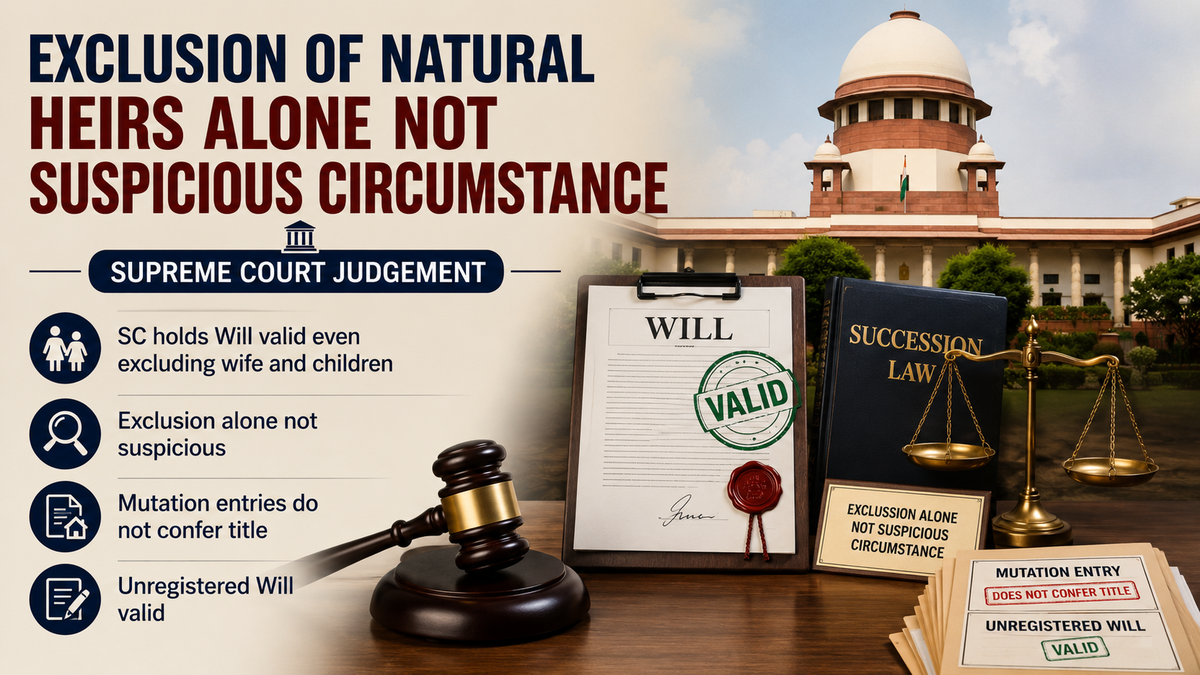
Whether the Will executed by the testator bequeathing all his properties to his only sister, excluding his wife and children, is valid and duly proved under Section 68 of the Indian Evidence Act, 1872 and Section 63 of the Indian Succession Act, 1925, and whether the exclusion of natural heirs alone constitutes a suspicious circumstance sufficient to vitiate the Will.
Ratio Decidendi
A Will is validly proved when at least one attesting witness, who is alive and capable of giving evidence, testifies that the testator signed the Will in his presence and that the witness signed in the presence of the testator. The exclusion of natural heirs from a Will is not by itself a suspicious circumstance sufficient to invalidate it, because the very purpose of a Will is to interfere with the normal line of succession. However, if the exclusion of natural heirs is accompanied by other suspicious circumstances — such as a shaky signature, a feeble mind, an unjust disposition, or the propounder taking a leading part in the making of the Will while receiving substantial benefit — the Court must scrutinise the Will more carefully. Mutation entries in revenue records do not confer title and are only for fiscal purposes. An unregistered Will is valid in law. Non-compliance with Order XLI Rule 31 of the Code of Civil Procedure, 1908 (framing of points for determination) does not vitiate the judgment if there is substantial compliance and the appellate court has considered the entire evidence on record.
Holding / Decision
The Supreme Court dismissed the appeal, affirming the concurrent findings of the Trial Court, First Appellate Court, and the High Court. The Will dated 15.05.1983 was held to be validly executed and proved through the testimony of one attesting witness (PW2). The exclusion of the testator's wife and children did not constitute a suspicious circumstance, as the Will itself stated that the testator had already provided sufficient properties to them. The mutation entries in favour of the wife did not confer title. The affidavits filed by other attesting witnesses denying their signatures were filed before the written statement without Court notice and were not admissible as evidence under Section 3 of the Indian Evidence Act, 1872. The First Appellate Court had substantially complied with Order XLI Rule 31 of the CPC.
Background & Facts
B. Sheena Nairi, a Chartered Accountant residing in Bombay, owned substantial immovable properties in Karnataka. He executed a Will on 15.05.1983 bequeathing all his properties to his only sister, Laxmi Nairthy (Plaintiff/Respondent No. 1), excluding his wife Parvathi Nairthi (Appellant No. 1) and their five children. The testator stated in the Will that he had already given sufficient properties to his wife and children residing in Bombay. The testator died on 30.11.1983. After his death, his wife applied for mutation of the properties in her name before the Tehsildar, Udupi, which was granted on 06.04.1984. On 22.11.1990, Laxmi Nairthy filed a civil suit seeking declaration of ownership under the Will, recovery of possession, mesne profits, and injunction. The wife and children denied the Will, claiming it was forged. The Trial Court decreed the suit on 16.12.2008. The First Appellate Court dismissed the appeal on 06.08.2012. The High Court dismissed the second appeal on 15.11.2012, holding that no substantial question of law arose. The wife and children appealed to the Supreme Court.
Statutes Involved
- Section 68, Indian Evidence Act, 1872 — Requires that a document required by law to be attested shall not be used as evidence until at least one attesting witness has been called to prove its execution
- Section 63, Indian Succession Act, 1925 — Prescribes the formalities for execution of a Will, including signature by the testator and attestation by two or more witnesses
- Section 3, Indian Evidence Act, 1872 — Defines 'evidence' and provides that affidavits are not evidence unless ordered by the court under Order XIX of the CPC
- Order XLI Rule 31, Code of Civil Procedure, 1908 — Requires the appellate court's judgment to state points for determination, decision thereon, and reasons for the decision
- Order XX Rule 12, Code of Civil Procedure, 1908 — Provides for decree for possession and mesne profits
- Karnataka Land Revenue Act, 1964 — Governs mutation of land records and revenue entries
Full Analysis
Premium Content
Subscribe to access the full analysis, practical implications, and related case mapping.
Subscribe — ₹99/monthAlready a subscriber? Sign inAdvocate's Note — Agarawal Associates
Professional insight for advocates on how to deploy this judgment in practice...
Subscribe to access the Advocate's Note.
Key Conditional Rule / Important Caveat
This judgment applies ONLY where (a) the propounder of the Will has produced at least one attesting witness who testifies that the testator signed the Will in his presence and that he signed in the presence of the testator, (b) the attesting witness is alive, subject to the process of the Court, and capable of giving evidence, and (c) there is no evidence of fraud, undue influence, or suspicious circumstances that remain unexplained. The exclusion of natural heirs alone does NOT constitute a suspicious circumstance sufficient to invalidate the Will, especially if the Will itself provides a reason. However, if the exclusion of natural heirs is accompanied by other suspicious circumstances (e.g., shaky signature, feeble mind of the testator, propounder taking a leading part in making the Will while receiving substantial benefit), the Court will scrutinise the Will more carefully, and the propounder's onus becomes heavier. This judgment does NOT apply where no attesting witness is produced, where the sole attesting witness fails to prove due execution, or where the Will is surrounded by credible evidence of fraud or undue influence.
Cases Cited
- H. Venkatachala Iyengar v. B.N. Thimmajamma 1958 SCC OnLine SC 31 — Laid down foundational principles for proof of Will, including the test of satisfaction of a prudent mind and the removal of suspicious circumstances by the propounder.
- Shivakumar v. Sharanabasappa (2021) 11 SCC 277 — Held that suspicious circumstances must be 'real, germane and valid' and not merely 'the fantasy of the doubting mind'.
- Meena Pradhan v. Kamla Pradhan 2023 SCC OnLine SC 1198 — Reiterated that a Will carries an element of sanctity and stringent requisites for proof are statutorily enjoined to rule out manipulation.
- Rabindra Nath Mukherjee v. Panchanan Banerjee (1995) 4 SCC 459 — Held that mere deprivation of natural heirs is not by itself a suspicious circumstance because the whole idea of a Will is to interfere with normal succession.
- Ram Piari v. Bhagwant (1990) 3 SCC 364 — Held that prudence requires a reason for denying inheritance to natural heirs; absence of reason, though not invalidating the Will in all cases, shrouds the disposition with suspicion.
- Balwant Singh v. Daulat Singh (1997) 7 SCC 137 — Held that mutation entries are only for fiscal purposes and do not confer title.
- Ishwardeo Narain Singh v. Kamta Devi (1953) 1 SCC 295 — Held that there is nothing in law requiring registration of a Will; unregistered Wills are valid.
- G. Amalorpavam v. R. C. Diocese of Madurai (2006) 3 SCC 224 — Held that non-compliance with Order XLI Rule 31 CPC does not vitiate judgment if there is substantial compliance and the appellate court has considered the entire evidence.
- Ayaaubkhan Noorkhan Pathan v. State of Maharashtra (2013) 4 SCC 465 — Held that an affidavit is not 'evidence' within Section 3 of the Indian Evidence Act, 1872, and can be used as evidence only if ordered by the court under Order XIX CPC.
Courtroom Arguments
For Petitioner
Will Invalid Due to Suspicious Exclusion of Natural Heirs — (2026) INSC 521
The testator excluded his wife and five children from the Will without any valid reason. This exclusion of natural heirs constitutes a suspicious circumstance that vitiates the Will.
For Respondent
Will Validly Proved, Exclusion Not Suspicious — (2026) INSC 521
The Will was duly executed and proved through the testimony of an attesting witness.
More Civil Law Judgments
View All →Found this useful? Share it with your colleagues.
One tap sends the case name, citation, key issue and link.
Take This Further in Court
2 courtroom argument frameworks available for this case — full submission structure, bench question simulator, and opposition rebuttals.
Disclaimer: This summary is prepared by Agarawal Associates for informational purposes only. It does not constitute legal advice. For legal matters, consult a qualified advocate. © 2026 Agarawal Associates — apexdigest.in