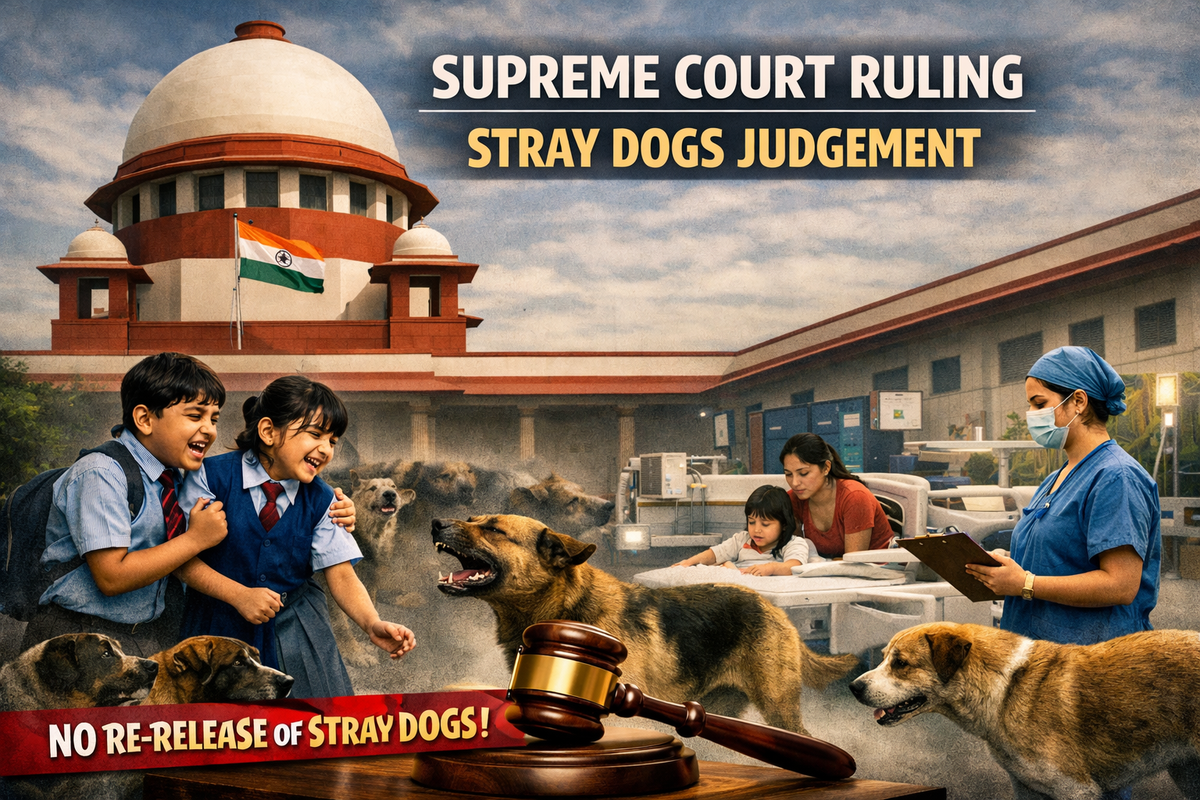
In Re: City Hounded by Strays, Kids Pay Price
(2026) 1 SCC 774
Key Issue / Question of Law
Whether stray dogs found within institutional premises such as educational institutions, hospitals, sports complexes, bus stands, and railway stations fall within the classification of 'street dogs' or 'community owned dogs' under Rule 7(2) of the Animal Birth Control Rules, 2023, and whether Rule 11(19) mandating re-release of sterilised and vaccinated dogs to the same locality applies to such institutional areas, or whether this Court can, under Article 142 of the Constitution of India, direct their removal and prohibit re-release to safeguard public safety under Article 21.
Ratio Decidendi
Rule 7(2) of the ABC Rules, 2023 is merely a classificatory provision and does not create any vested or enforceable right for stray dogs to occupy any space indefinitely. When read in conjunction with Section 2(i) of the Prevention of Cruelty to Animals Act, 1960, which defines 'street' as public spaces such as roads, lanes, passages, and other areas to which the public has access, the expression 'same place or locality' in Rule 11(19) cannot be construed to include institutional or restricted-access premises such as schools, hospitals, sports complexes, bus stands, and railway stations. Stray dogs found within such sensitive institutional spaces do not fall within the scope of Rule 7(2) read with Rule 11(19). The statutory scheme does not mandate the continued presence or reintroduction of stray dogs within such areas. The directions issued under Article 142 of the Constitution of India, excluding such premises from the operation of re-release, are in consonance with a purposive and harmonious interpretation of the statutory framework and are valid. The Court's power under Article 142 to do complete justice permits such modulation, as the exercise does not supplant substantive law but tailors its application to constitutional imperatives.
Holding / Decision
The Supreme Court dismissed all interlocutory applications seeking modification, clarification, vacation, recall, or stay of the directions issued on 7 November 2025, and also dismissed all applications challenging the Standard Operating Procedures issued by the Animal Welfare Board of India. The Court affirmed its earlier directions that stray dogs found within institutional areas (educational institutions, hospitals, sports complexes, bus stands/depots, railway stations) shall be removed and shall not be re-released to the same locations. The Court held that Rule 11(19) of the ABC Rules, 2023 does not apply to such sensitive premises. The Court directed all High Courts to register suo moto writ petitions as continuing mandamus to monitor compliance. The NHAI was directed to formulate a mechanism for removal of stray animals from highways. The States and Union Territories were directed to establish at least one fully functional ABC Centre per district. The Court permitted euthanasia of rabid, incurably ill, or demonstrably dangerous/aggressive dogs strictly in accordance with statutory protocols. The Court listed the matter for further hearing on 17 November 2026.
Background & Facts
The Supreme Court took suo motu cognizance of news reports highlighting escalating incidents of stray animal intrusions and dog-bite cases across the country, particularly within institutional premises such as schools, hospitals, sports complexes, bus stands, and railway stations. On 11 August 2025 and 22 August 2025, the Court issued interim directions. On 7 November 2025, the Court issued detailed directions mandating removal of stray dogs from institutional areas and prohibiting their re-release to the same locations. Animal welfare organisations filed multiple interlocutory applications seeking modification, clarification, stay, or recall of these directions, contending that they conflicted with Rule 11(19) of the ABC Rules, 2023 requiring re-release to the same locality. Other applications supported the directions and sought their expansion. The Court heard all applications together. The Animal Welfare Board of India issued Standard Operating Procedures on 27 November 2025 in compliance with Direction (J) of the 7 November 2025 order, which were also challenged.
Statutes Involved
- Article 21, Constitution of India — Guarantees the fundamental right to life and personal liberty, which includes the right to live in a safe environment free from preventable hazards such as stray dog attacks
- Article 142, Constitution of India — Empowers the Supreme Court to pass any decree or order necessary for doing complete justice in any cause or matter pending before it, including modulating the application of statutory provisions
- Section 2(i), Prevention of Cruelty to Animals Act, 1960 — Defines 'street' as any way, road, lane, square, court, alley, passage or open space, whether a thoroughfare or not, to which the public has access
- Rule 7(2), Animal Birth Control Rules, 2023 — Classifies 'street dogs' or 'community owned dogs' as those which are homeless and are found living on the street or within a gated campus
- Rule 11(19), Animal Birth Control Rules, 2023 — Provides that sterilised and vaccinated dogs shall be released at the same place or locality from where they were captured
- Prevention of Cruelty to Animals Act, 1960 — Parent enactment providing for the prevention of cruelty to animals
- National Highways Act, 1956 — Governs the development, maintenance and management of National Highways
Full Analysis
Premium Content
Subscribe to access the full analysis, practical implications, and related case mapping.
Subscribe — ₹99/monthAlready a subscriber? Sign inAdvocate's Note — Agarawal Associates
Professional insight for advocates on how to deploy this judgment in practice...
Subscribe to access the Advocate's Note.
Key Conditional Rule / Important Caveat
This judgment applies ONLY to stray dogs found within institutional premises such as educational institutions, hospitals, sports complexes, bus stands/depots, railway stations, and other analogous public spaces characterised by high footfall and congregation of vulnerable populations. For such premises, Rule 11(19) of the ABC Rules, 2023 does NOT mandate re-release of sterilised and vaccinated dogs to the same location. For stray dogs found on public streets (as defined in Section 2(i) of the PCA Act, 1960), Rule 11(19) continues to apply, and such dogs must be re-released after sterilisation and vaccination. The judgment does NOT apply where the institutional premises are not sensitive or restricted-access (e.g., large open university campuses with controlled dog management programmes that have not resulted in attacks). The Court also created a limited exception for NALSAR University of Law, Hyderabad, permitting experimental implementation of the CSVR model within the campus subject to tortious liability undertaking — this is a case-specific exception, not a general rule.
Cases Cited
- Union Carbide Corporation v. Union of India (1991) 4 SCC 584 — Constitution Bench held that powers under Article 142 of the Constitution of India are plenary and that prohibitions in ordinary laws cannot ipso facto act as limitations on constitutional powers.
- Supreme Court Bar Association v. Union of India (1998) 4 SCC 409 — Constitution Bench held that Article 142 powers cannot supplant substantive law but can be exercised to modulate its application consistent with constitutional values.
- Shilpa Sailesh v. Varun Sreenivasan (2023) 14 SCC 231 — Constitution Bench clarified that Article 142 powers are prohibited only when the order is plainly and expressly barred by statutory provisions based on fundamental principles of public policy.
Courtroom Arguments
For Petitioner
Animal Welfare Organisations Seeking Modification of Directions — (2026) 1 SCC 774
Rule 11(19) of the ABC Rules, 2023 mandates re-release of sterilised and vaccinated stray dogs to the same locality.
For Respondent
States and Municipal Authorities Supporting Directions — (2026) 1 SCC 774
The directions issued by this Court are necessary to protect public safety under Article 21.
More Constitutional Law Judgments
View All →Found this useful? Share it with your colleagues.
One tap sends the case name, citation, key issue and link.
Take This Further in Court
2 courtroom argument frameworks available for this case — full submission structure, bench question simulator, and opposition rebuttals.
Disclaimer: This summary is prepared by Agarawal Associates for informational purposes only. It does not constitute legal advice. For legal matters, consult a qualified advocate. © 2026 Agarawal Associates — apexdigest.in