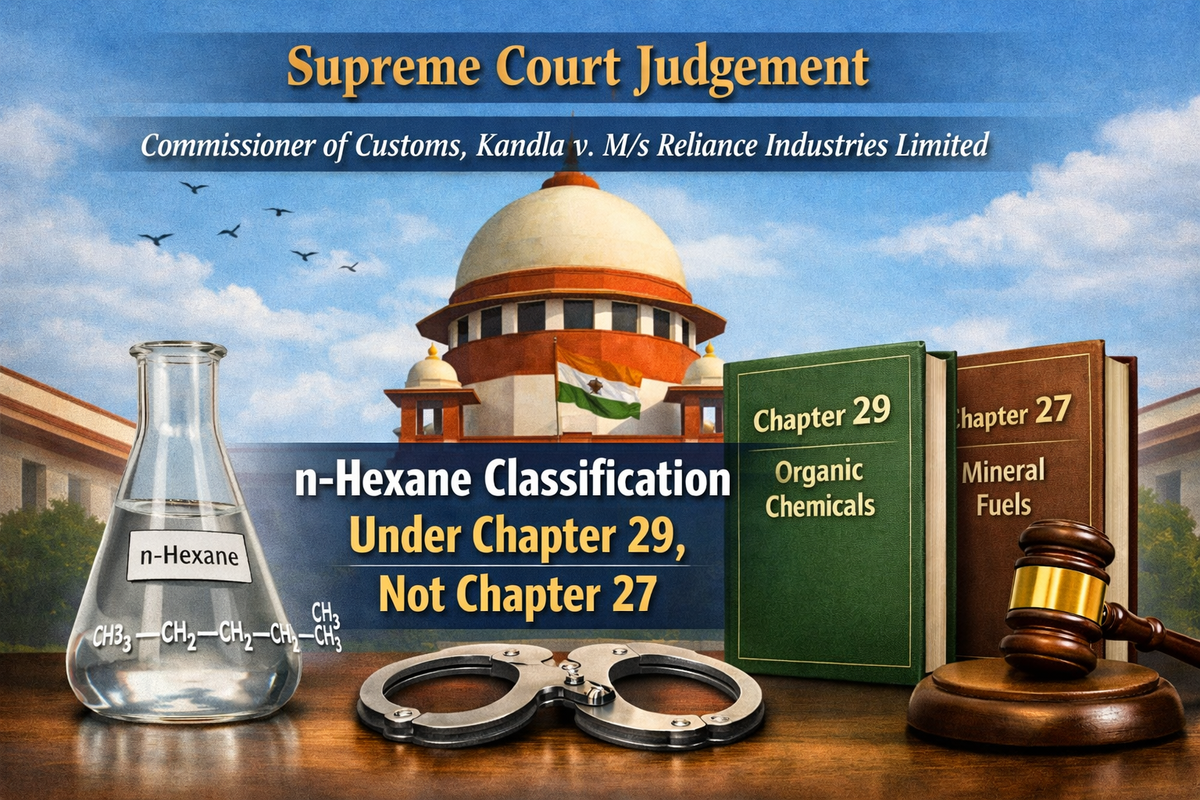
Commissioner of Customs, Kandla v. M/s Reliance Industries Limited
(2026) INSC 536
Key Issue / Question of Law
Whether the imported product 'n-Hexane' (also known as Exxsol Hexane) should be classified under Chapter 27 of the Customs Tariff Act, 1962 (Heading 2710.00) as a petroleum oil/motor spirit, or under Chapter 29 (Heading 2901.10) as a separate chemically defined organic compound (saturated acyclic hydrocarbon), considering its chemical composition, distillation range (63-70°C), flash point (below 25°C), and the presence of impurities.
Ratio Decidendi
For a product to be classified as 'Motor Spirit' under Chapter 27 (Heading 2710.00), the Revenue must establish three conditions: (a) the product is a hydrocarbon oil excluding crude mineral oil; (b) its flash point is below 25°C; and (c) it is suitable for use as fuel in spark ignition engines either by itself or in admixture. The burden of proof for classification rests on the Revenue. n-Hexane is a saturated acyclic hydrocarbon with the chemical formula C6H14, having a definitive linear structural diagram, and is specifically enumerated under Chapter 29 (Heading 2901.10) of the HSN Explanatory Notes. The presence of impurities (unconverted starting materials, by-products) that are not deliberately added does not disqualify it from being a 'separately chemically defined compound' under Chapter 29. Rule 3(a) of the General Rules of Interpretation (specific description preferred over general description) applies, as Chapter 29 provides a more specific description for hexane than Chapter 27. The DGFT Policy Circular No. 40 (RE-2003)/2002-2007 dated 14.07.2004 clarified that import of Hexane falls under Chapter 29, which is binding.
Holding / Decision
The Supreme Court dismissed the appeal filed by the Revenue and affirmed the order of CESTAT, Ahmedabad dated 15.07.2011. The Court held that n-Hexane is correctly classifiable under Customs Tariff Heading 2901.10 and Central Excise Tariff Heading 2901.90 (Chapter 29) as a saturated acyclic hydrocarbon existing as a separate chemically defined compound. The Revenue failed to discharge its burden to prove that the product satisfies all three conditions for classification as 'Motor Spirit' under Chapter 27. The DGFT Policy Circular dated 14.07.2004 clearly stating that Hexane falls under Chapter 29 was also relied upon.
Background & Facts
The respondent-assessee (Reliance Industries Ltd.) filed a Bill of Entry classifying imported 'n-Hexane' (Exxsol Hexane) under Customs Tariff Heading 2901.10 and Central Excise Tariff Heading 2901.90 (Chapter 29). The Revenue issued a Show Cause Notice seeking classification under Chapter 27 (Heading 2710.00 for Customs and Heading 2710.12 for Central Excise) based on an SGS Chemical Test Report showing distillation range of 67.2°C and flash point below 25°C, claiming it was an admixture of hydrocarbons and motor spirit. The Adjudicating Authority (Assistant Commissioner) classified the product under Chapter 27. The Commissioner (Appeals) reversed this order, classifying it under Chapter 29. The Revenue appealed to CESTAT, which dismissed the appeal. The Revenue then appealed to the Supreme Court.
Statutes Involved
- Section 2, Customs Tariff Act, 1975 — Provides for duties of customs and classification of goods under the First Schedule
- Chapter 27, Customs Tariff Act, 1975 — Covers mineral fuels, mineral oils and products of their distillation; Heading 2710.00 covers petroleum oils and oils obtained from bituminous minerals
- Chapter 29, Customs Tariff Act, 1975 — Covers organic chemicals; Heading 2901.10 covers saturated acyclic hydrocarbons
- Chapter 27, Central Excise Tariff Act, 1985 — Corresponding provisions for excise classification; Heading 2710.12 covers special boiling point spirits with nominal boiling range 63-70°C
- Chapter 29, Central Excise Tariff Act, 1985 — Heading 2901.90 covers other acyclic hydrocarbons
- Harmonized System of Nomenclature (HSN) Explanatory Notes — Internationally accepted guide for tariff classification; specifically enumerates hexane under Heading 29.01
- Rule 3(a), General Rules for the Interpretation of the Import Tariff — Provides that the heading which provides the most specific description shall be preferred to headings providing a more general description
- Paragraph 2.3, Foreign Trade Policy (2002-2007) — Provides that any doubt regarding classification under ITC (HS) shall be referred to DGFT, whose decision shall be final and binding
- Policy Circular No. 40 (RE-2003)/2002-2007 dated 14.07.2004 — Issued by DGFT clarifying that import of Hexane is covered under Chapter 29 of ITC (HS) Classifications
Full Analysis
Premium Content
Subscribe to access the full analysis, practical implications, and related case mapping.
Subscribe — ₹99/monthAlready a subscriber? Sign inAdvocate's Note — Agarawal Associates
Professional insight for advocates on how to deploy this judgment in practice...
Subscribe to access the Advocate's Note.
Key Conditional Rule / Important Caveat
This judgment applies ONLY where (a) the imported product is a saturated acyclic hydrocarbon with a definitive structural diagram (e.g., n-Hexane), (b) the product is specifically enumerated in the HSN Explanatory Notes under Chapter 29, (c) the Revenue seeks classification under Chapter 27 based solely on physical parameters (flash point, boiling point) without proving end-use as motor spirit for spark ignition engines, and (d) the product contains impurities that are unconverted starting materials from the manufacturing process and not deliberately added. The judgment does NOT apply where (a) the product is actually used as a fuel in spark ignition engines and the Revenue proves such use, (b) the product is a crude oil or a simple mixture of hydrocarbons without a definitive chemical structure, (c) the impurities are deliberately added to make the product suitable for a specific use, or (d) the product is not specifically enumerated under Chapter 29. The DGFT Policy Circular is binding on classification disputes only where the matter is referred to the DGFT under the Foreign Trade Policy; it does not automatically bind classification disputes under the Customs Tariff Act if the DGFT has not been consulted.
Cases Cited
- CCE v. Wood Craft Products Ltd. (1995) 3 SCC 454 — Held that HSN Explanatory Notes are a safe guide for resolving tariff classification disputes; the basis of central excise tariff is the HSN.
- Collector of Customs, Bombay v. Business Forms Ltd. (2005) 7 SCC 143 — Reaffirmed that in case of any doubt, HSN is a safe guide for ascertaining the true meaning of any expression used in the Tariff Act.
- Union of India v. Garware Nylons Ltd. (1996) 10 SCC 413 — Held that the burden of proof in classification matters rests on the taxing authorities; mere assertion is insufficient.
- Gastrade International v. Commissioner of Customs (2025) 8 SCC 342 — Held that the standard of proof in classification proceedings is preponderance of probability, not proof beyond reasonable doubt.
- CCE v. GAIL (India) 2022 SCC OnLine SC 2130 — Held that for a product to be classified as 'Motor Spirit' under Chapter 27, all three conditions must be satisfied; the use of the term 'other' in the supplementary note excludes reference to a class of oils.
- Atul Commodities Private Limited v. Commissioner of Customs (2009) 5 SCC 46 — Held that under Paragraph 2.3 of the Foreign Trade Policy, any doubt regarding classification under ITC (HS) shall be referred to DGFT whose decision shall be final and binding.
- CCE v. Madhan Agro Industries (India) P. Ltd. 2024 SCC OnLine SC 3775 — Relied upon for the proposition that HSN Notes can be safely referred to for resolution of classification disputes.
- CCE v. Bakelite Hylam Ltd. (1997) 10 SCC 350 — Relied upon to support the use of HSN Notes for tariff classification.
- CC v. Phil Corporation Ltd. (2008) 17 SCC 569 — Relied upon to support the use of HSN Notes for tariff classification.
Courtroom Arguments
For Petitioner
n-Hexane Is Motor Spirit Classifiable Under Chapter 27 — (2026) INSC 536
The SGS Chemical Test Report establishes that n-Hexane has a flash point below 25°C and a distillation range between 63-70°C, satisfying the physical parameters of 'Motor Spirit' under Chapter 27.
For Respondent
n-Hexane Is Separate Chemically Defined Compound Under Chapter 29 — (2026) INSC 536
n-Hexane is a saturated acyclic hydrocarbon with a definitive linear structural diagram, specifically enumerated under Chapter 29 of the HSN Explanatory Notes.
More Tax Law Judgments
View All →Found this useful? Share it with your colleagues.
One tap sends the case name, citation, key issue and link.
Take This Further in Court
2 courtroom argument frameworks available for this case — full submission structure, bench question simulator, and opposition rebuttals.
Disclaimer: This summary is prepared by Agarawal Associates for informational purposes only. It does not constitute legal advice. For legal matters, consult a qualified advocate. © 2026 Agarawal Associates — apexdigest.in